
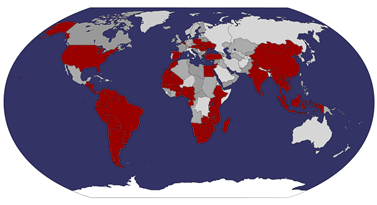
We are woefully behind on posting since we came back to the United States. Despite having almost constant access to computers and the Internet, we have focused our time on seeing family and friends. Even for me, it is hard to say, "Mom, I know you haven't seen me for two years, but I just have to get those Obsessions posts done..."
So, without anymore excuses, here come Asia's obsessions:
India- Spitting. An easy one. The average Indian might spit 1200 times per day. And we aren't talking about small little bits of spittle. We're talking about pieces of lung the size of a fist. Sure, lots of Indians also have a paan habit (think chewing tobacco, but different ingredients that also happen to make one's spit Kool-Aid red), but even those that don't chew still spit. And before the spitting comes a noise that sounds like the regurgitation of a cow. Wait, most Indians don't eat cow, so a goat. Like hawking up a goat.
Sri Lanka- Water tanks. What is a water tank you ask? Well, I'm going to tell you even if you didn't ask. A water tank is a man made lake. Sri Lanka has a lot of areas that are at altitude and are very wet for part of the year, but very dry for the rest of the year. So, starting a thousand years ago or more, digging giant water pits became the prerequisite for growing any large city that wasn't on the sea. And they did it with gusto. Some of the cities have dozens of lakes that are far larger than many dammed lakes in the US, and they were all dug out by hand. Or maybe with hands and a rock and maybe a chisel, but you get the point. Good job, ancient Sri Lankans!
Malaysia- Tourism posters. If all the Asian countries were elementary school students, Malaysia would get the "Tries Hardest" certificate at the end of the year. Not only are tourism posters in nearly every window of Malaysia, they are in nearly every hotel and vaguely related travel business everywhere in Asia. They must have printed millions of them. And that makes it even sadder that more people don't visit Malaysia, which really is a spectacular country.
Singapore- Rules. Singapore has rules for everything. And fines for not following most of them. The list of fines in the subway cars was as long as my arm. (We especially appreciated that one of the highest fines was for bringing the smelly durian fruit on the train.) If you like to conform, consider moving to Singapore. If you have ever voted Libertarian or are a card carrying member of the Tea Party, consider vacationing somewhere other than Singapore.
Indonesia- Cats without tails. Didn't see that one coming, did you? We saw hundreds of cats in Indonesia and every one of them had some or all of its tail missing. We can only assume that people think they should not have tails and take it upon themselves to cut off the tails with whatever sharp instrument is laying around when they see a cat with tail intact. We thought that we might see this in other countries, but it was really just Indonesia.
Thailand- 7-Eleven. Think of all the 7-Elevens you have ever seen. Multiply that number by 100. That is how many 7-Elevens are on the average block in Thailand. It used to be a joke in New York that Starbucks would often have locations right across the street from one another. 7-Eleven in Thailand might regularly have three stores on a block. I don't understand how they stay in business, especially since they are more expensive than most Thai businesses, but they all seem the thrive. Since I love Slurpees, I thank the Thai people for making cheap Slurpees available everywhere.
Burma (Myanmar)- Gold leaf. I had never heard of someone's job being to hammer gold until it was gold leaf. In Burma, that ranks as one of the most popular jobs. Where does all that gold leaf go? Buddhists in Burma buy the gold leaf and then rub it onto the Buddha statues (or anything else that they believe should be gold) at the Buddhist temples. This keeps everything bright and shiny. Oh, I should point out that only men are allowed to do this. Women aren't allowed to touch the Buddha statues, but can buy some gold leaf and have a manly man rub it onto the Buddha.
Cambodia- Angkor Wat. It seems sort of lame to be obsessed with your biggest tourist attraction, but Cambodia unquestionably is. It adorns the flag, half the stores in the country are named for it, and it inspired enough awe that even Pol Pot didn't destroy it. And Pol Pot destroyed just about everything in Cambodia.
Vietnam- Motor scooters. The average person in Vietnam has 3.2 motor scooters. Approximately. Through a quantum trick, they ride all of them simultaneously. So, while Vietnam has only 80 million people, 250 million people ply the roads on motor scooters at any given time. And most of those 250 million are going down the road that you want to cross. The streets of the large cities look like a moped convention.
Laos- Fruit shakes. I try to find something deeper than a food for country obsessions, but fruit shakes made with fruit, condensed milk, sugar, and ice are what hold the country of Laos together and makes the whole country so friendly. That's pure speculation, but locals and tourists alike can be found drinking delicious and cheap shakes all over the country, and we were certainly fans. For those who are not feeling happy enough after a regular shake, many places seem to offer "happy" shakes, which come with whatever drugs they happen to have in stock (pot in most places).
China- Crotchless pants. No, China isn't turning into 1980s New York. Any child under the age of three in China wears pants with a giant slit down the crotch and no underwear underneath. This allows them to go to the bathroom anytime and anywhere they like. And I do mean anytime and anywhere. Let's say the kid is waiting in a busy ticket line inside the train station with the parent and needs to go to the bathroom--that's what those pants are for. Number one or number two? Doesn't matter. Does the parent clean it up? No. It stays there for others to step in. While China seems likely to take over the world one day, we hope they get rid of crotchless pants prior to that.
Mongolia- Chengis Khan. Yeah, I thought it was Genghis Khan, too, but not in Mongolia. This founder of the Mongol Empire is known for uniting the nomads of Mongolia, declaring war on anything that moved, killing about a bajillion people, and creating the beginning of the largest empire the world has ever known. That, of course, makes him the hero of Mongolia. Based on our experience, I don't see the second coming of the Mongol Empire anytime soon.
There you have it: the obsessions of Asia. Disagree with us? Too bad. Write your own blog. Or leave us nasty comments about how we disparaged your country. That's why our home address isn't on the blog. Well, that and we don't have a home yet...
Countries Visited
Showing posts with label Mongolia. Show all posts
Showing posts with label Mongolia. Show all posts
Friday, July 15, 2011


Monday, June 27, 2011
From Rupees to Rupiah: Financing Asia
All through our travels, people told us how cheap Asia would be...and, looking forward to bringing down our average daily budget, we hoped that they were right. Luckily, they were!
Here are the numbers by country. In case you forgot how we do this, these numbers are for two people, including visa costs and all costs on the ground (and in the air if we took internal flights). Sometimes we also include the cost of a flight into the country if that was the only way to get there.
India: $53 per day. Visas cost $74 each at the embassy in Istanbul. India is one of the cheapest countries we've been to, so staying there for five weeks did wonders for our financial (if not gastrointestinal) health. Hotel rooms ranged from $10-$25 depending on level of comfort (except in Mumbai, where it's hard to find a double for less than $50); restaurant meals could usually be had for a buck or two, and street food for pennies; and train transport in sleeper class cost less than a hotel. Not getting ripped off on cabs and tourist excursions required some negotiating.
Sri Lanka: $80 per day (including flight from Chennai, India, which costs about $120 per ticket; $53 per day without flight). No visa fees. Sri Lanka's hotels and food were a little more expensive than India's, but it made up for it with what is possibly the world's cheapest public transport on a $-per-hour basis. If you plan to visit more than two historic sites in the "Cultural Triangle" area, getting a pass can save you $25 or more.
Malaysia: $47 per day. No visas. Some travelers complain about Malaysia being pricey, but as it turns out, the only traveler item that is really expensive in (Muslim-majority) Malaysia is beer! As long as you don't drink much, the country is terrific value, especially considering how developed it is. Air-con double rooms with shared (but very clean, hot-water) bathrooms cost $10-$15, and delicious, cheap street food abounds. Transport is a little pricier than some Asian countries, but you usually get comfortable, AC buses on smooth roads. We stuck to the peninsula this time and didn't do any fancy tourist excursions, but our memories of our previous trip to Borneo are that prices were very reasonable there, too.
Singapore: $111 per day. No visas. We only spent two days in Singapore, so this is kind of skewed, but it's certainly one of the most developed and expensive countries in Southeast Asia. Most of the cheaper hotels are in the red light district, where we found a decent private room for $35 a night. Public transport, museums, and restaurants are comparable to Western prices, but taxis (which are metered, hallelujah!) and street or food court foods are relatively cheap.
Indonesia: $102 per day. One-month visas on arrival at the airport cost $25 each. Indonesia was surprisingly expensive, though that's largely because we did a lot of pricey activities like SCUBA diving, chartering a boat to Krakatau volcano, and a few other organized tours. No-frills internal flights between the islands were a pretty good deal, usually less than $50 one-way and could be booked just a day or two before. Buses and trains on the ground varied a lot in price and quality. Hotel rooms for $10-$15 could be found, but were usually pretty disgusting; if we wanted cleanliness and AC, we usually had to pay at least $25. Cheap street food could be found in most places, though not so much in touristy Bali, where we usually had to shell out for real restaurants.
Thailand: $83 per day. No visa fees. Considering how many touristy activities we did in Thailand (diving, elephant training camp, etc.), this is a great average. Hotel and transport standards are pretty high, but competition for the tourist buck keeps prices low. Markets selling cheap local food are pretty easy to find, and even fancy restaurants are probably cheaper than the Thai restaurants you find at home. Just try not to get robbed, which could certainly send your costs soaring!
Myanmar: $77 per day. Visas cost $27 each in Bangkok. This average includes flights into and out of Yangon from Bangkok ($130 each roundtrip), which accounted for one-third of our expenditures there. Once you're on the ground, Myanmar (Burma) is super cheap in all categories, though its rough roads, ancient vehicles, and power cuts often made it feel more like traveling in sub-Saharan Africa than Southeast Asia.
Cambodia: $53 per day. Visas cost $20 each at the border. Cambodia is excellent value. $11 a night got us rooms with bathroom, AC, and sat TV in both Siem Riep and Phnom Penn, the two most touristed cities in the country. Markets and restaurants offer cheap food; bus transport and tourist site admissions are pretty reasonable. If we had stayed longer, or ventured out to less touristy places, it probably would have been even cheaper, but even so, Cambodia was one of the cheapest destinations on our trip.
Vietnam: $66 per day. Visas cost $45 each in Phnom Penn, Cambodia. Vietnam's one of those countries that feels more expensive than it is, probably because people are trying to rip you off almost continuously. But we did manage to stay in some pretty nice hotel rooms and eat decent food for not a lot of money. Trains cost more than buses but are much nicer (which isn't the same as saying that they're actually nice!), especially for overnight travel. Halong Bay overnight cruises can be an especially good deal for a decently swanky experience...provided your boat doesn't sink in the night, of course.
Laos: $57 per day. Visas cost $40 each at the border. Laos is pretty poor, so the roads and buses aren't always the nicest, but hotels were quite comfortable, food was inexpensive, activities like kayaking were very reasonable, and prices overall about as cheap as could be.
China: $92 per day. Visas cost $160 each in Vientiane, Laos--the most expensive of our entire trip. (They are about $100 less expensive for non-Americans, though.) Yunnan province, in southwestern China, was incredibly inexpensive; with $10 hotel rooms and cheap bus rides, it cost no more than Laos, where we had just come from. As we moved east and to the bigger cities, things got more expensive, though you could always find cheap and tasty food, even in Beijing. In general, China didn't feel overpriced considering the good quality of rooms, trains, and food that we got, and some tourist attractions, like the Forbidden City, were surprisingly reasonable.
Mongolia: $121 per day. No visas needed for Americans, though most nationalities need one. This number is high because we spent 6 of our 8 days in the country on a private jeep tour of the Gobi. If we'd managed to find a couple of other travelers to share the tour with, costs would have been halved. Otherwise, the country's pretty budget-friendly: In Ulaan Bataar, the capital, a hostel room with breakfast, Internet, and shared bath cost $15; there were expensive restaurants and cheap local-food canteens to choose from; and the 15-hour train from the China border cost around $9 for seats, or $25 for sleeper berths.
So, Asia had a few expensive countries, but was mostly pretty cheap for us. Hope that this post was slightly helpful to you if you're planning to backpack through Asia. If you have any questions, leave a comment and we'll do our best to get back to you!
Thursday, May 26, 2011
Nuttin' but Mutton: Mongolian Food
Mongolia may be huge geographically, but it has the food variation of...well, something without a lot of variation. Food all over the country consists of mutton, mutton, mutton, and camel. And a bit of wheat thrown in for good measure. That will make this a short post, which makes my job easy. That should make us both happy.
At the surprisingly well-stocked store in the town where we got stuck for a day, they had very good Russian-style ice cream that is just in a cone with a piece of paper over it. The best ice cream we had had in many months. And by reading this picture, you can practice your Mongolian--written in Cyrillic and sometimes borrowing a word, it generally doesn't sound a bit like Russian.
 This picture includes most of what they eat in Mongolia. The dumplings are called buuz, and are generally filled with a rather strong-tasting mutton. And with a lot more meat than any dumpling that I've ever had. The fried things taste like they look and are filled with mutton. (We also had one filled with vegetables, but our tour guide acted like that was crazy when we told her.) The drink is "tea." Tea or milk tea in Mongolia consists of watered down milk (often from a camel and sometimes a goat if you are in the Gobi), with salt and a tiny hint of tea. We actually didn't think it had any tea at all until we saw people making it and they would throw about a teaspoon of tea leaves into a gallon of the tea.
 We did find cheap strawberry nectar and yogurt (made from actual cow's milk). Both were good, but not great. Neither is typical Mongolian food, but Ulaan Bataar has a lot of good supermarkets. We aren't sure who eats all the stuff since we only saw actual Mongolians eating about four things.
 And here is the best of the four things that Mongolians eat. These are fresh noodles with mutton, but the mutton brings down the excellent noodles. They taste like Amish-style egg noodles, though I don't think they have egg. Tara liked them so much that she has sworn to start making fresh noodles all the time. I approve.
 Our tour guide in the Gobi bought us this grape juice that has chunks of aloe gel in it, sort of like drinking a bubble tea. It was strange at first, but we grew to like have chunks of jelly in our grape juice.
 Here we are forced to repeat foods. In this photo, Tara is trying the fried, meat-filled pancakes from a different place. That's all this restaurant served. It is often the case with "restaurants" in the Gobi that they only serve one dish. And they never prepare anything (sometimes including buying the supplies) until you have ordered.
 When you're visiting families in a yurt, they will often pass around a bone with some mutton meat. The first time this happen, Tara and I stared quizzically at one another until we saw people cutting off bits to put in their "tea." And sometimes they just pop a bit into their mouths.
 This is my mutton in tea. I can't say that I suggest adding mutton to your tea, but it was a novelty.
 Also served along with tea are these donut things. They are fried bread items that last longer than actual bread in the harsh desert. They aren't sweet, but they are often served mixed with sugar cubes like this. It makes a better tea time snack than mutton on a bone.
 We asked our guide if it was possible to try camel meat. Luckily, we were staying the very next day with a family that makes its living raising camels. They had some dry camel meat that we tried by itself and then added to our soup for the evening. It has a very strong gamey taste. I thought it was edible, but Tara thought it was bad. One-humped camel wins the camel-tasting contest, though.
 And in our last picture, Tara poses proudly with her horse meat. She was very disappointed that we couldn't find horse at any restaurants, but then we found some packaged horse at the grocery store. It is pretty good. Not like any meat we've had before, but we would eat it again. Yeehaw!
 Eight days in Mongolia, and that's all we ate. Well, we ate more, but it was just the stuff pictured repeatedly. And we had Indian food one night, but that didn't qualify as Mongolian. The food was better than we expected based upon warnings that we had received, but it was just as limited as we had heard.
One last thing. Mongolia now has a couple of Mongolian barbecue buffets, but they American-owned. Sadly, while the concept may be based on how they cooked food in Mongolia hundreds of years ago, the idea now only exists in practice in very expensive American-owned restaurants.
At the surprisingly well-stocked store in the town where we got stuck for a day, they had very good Russian-style ice cream that is just in a cone with a piece of paper over it. The best ice cream we had had in many months. And by reading this picture, you can practice your Mongolian--written in Cyrillic and sometimes borrowing a word, it generally doesn't sound a bit like Russian.
This picture includes most of what they eat in Mongolia. The dumplings are called buuz, and are generally filled with a rather strong-tasting mutton. And with a lot more meat than any dumpling that I've ever had. The fried things taste like they look and are filled with mutton. (We also had one filled with vegetables, but our tour guide acted like that was crazy when we told her.) The drink is "tea." Tea or milk tea in Mongolia consists of watered down milk (often from a camel and sometimes a goat if you are in the Gobi), with salt and a tiny hint of tea. We actually didn't think it had any tea at all until we saw people making it and they would throw about a teaspoon of tea leaves into a gallon of the tea.We did find cheap strawberry nectar and yogurt (made from actual cow's milk). Both were good, but not great. Neither is typical Mongolian food, but Ulaan Bataar has a lot of good supermarkets. We aren't sure who eats all the stuff since we only saw actual Mongolians eating about four things.And here is the best of the four things that Mongolians eat. These are fresh noodles with mutton, but the mutton brings down the excellent noodles. They taste like Amish-style egg noodles, though I don't think they have egg. Tara liked them so much that she has sworn to start making fresh noodles all the time. I approve.Our tour guide in the Gobi bought us this grape juice that has chunks of aloe gel in it, sort of like drinking a bubble tea. It was strange at first, but we grew to like have chunks of jelly in our grape juice.Here we are forced to repeat foods. In this photo, Tara is trying the fried, meat-filled pancakes from a different place. That's all this restaurant served. It is often the case with "restaurants" in the Gobi that they only serve one dish. And they never prepare anything (sometimes including buying the supplies) until you have ordered.When you're visiting families in a yurt, they will often pass around a bone with some mutton meat. The first time this happen, Tara and I stared quizzically at one another until we saw people cutting off bits to put in their "tea." And sometimes they just pop a bit into their mouths.This is my mutton in tea. I can't say that I suggest adding mutton to your tea, but it was a novelty.Also served along with tea are these donut things. They are fried bread items that last longer than actual bread in the harsh desert. They aren't sweet, but they are often served mixed with sugar cubes like this. It makes a better tea time snack than mutton on a bone.We asked our guide if it was possible to try camel meat. Luckily, we were staying the very next day with a family that makes its living raising camels. They had some dry camel meat that we tried by itself and then added to our soup for the evening. It has a very strong gamey taste. I thought it was edible, but Tara thought it was bad. One-humped camel wins the camel-tasting contest, though.And in our last picture, Tara poses proudly with her horse meat. She was very disappointed that we couldn't find horse at any restaurants, but then we found some packaged horse at the grocery store. It is pretty good. Not like any meat we've had before, but we would eat it again. Yeehaw!Eight days in Mongolia, and that's all we ate. Well, we ate more, but it was just the stuff pictured repeatedly. And we had Indian food one night, but that didn't qualify as Mongolian. The food was better than we expected based upon warnings that we had received, but it was just as limited as we had heard.One last thing. Mongolia now has a couple of Mongolian barbecue buffets, but they American-owned. Sadly, while the concept may be based on how they cooked food in Mongolia hundreds of years ago, the idea now only exists in practice in very expensive American-owned restaurants.
Wednesday, May 25, 2011
Go Be in the Gobi: Mongolia
The first challenge we faced regarding Mongolia was getting there from China. If you look at a map--but not our blog map, which you may have noticed, is kind of broken--you will see that China and Mongolia are both huge and share a very long border, but it turns out that there are not so many official land border-crossing points. (This baffled me at first, but now that I have been there, I understand--it's because Mongolia has no roads.)
Anyway, direct flights from Beijing to Mongolia's capital, Ulaan Baatar, are super expensive, and direct trains only go on Tuesday and Wednesday--not so convenient if you really want to go on a Friday or Saturday. There is an "overnight" bus from Beijing to the border, but it gets in at 3AM (ugh). There is a (real) overnight train to another city in Inner Mongolia (China's part of the Mongolian plateau), from which you can then take a six-hour bus ride to the border during the day. We were planning to do that, but when we turned up at the station in Beijing five days in advance to buy tickets, we learned that those trains were already sold out. Gah!
So we took the one daily flight that goes from Beijing to Erlian, the border town on the Chinese side. Since it was a domestic flight, it was much more affordable than a flight into Mongolia. Problems solved, eh?
Not quite. We left Beijing in lovely spring weather, but when we landed in Erlian, it was 2 degrees Celsius and snowing out. In the terminal, I made a 10-minute detour into the bathroom to change into warmer clothes...and caused us to miss the only shuttle bus into town. (Turns out that Erlian airport is not quite the busiest in China--it only gets two flights a day.)
So, Andy and I found ourselves stuck at the airport, 25 kilometers from town, surrounded by non-English-speaking airport staff whose response to our every question about buses and taxis was to giggle. Finally, someone managed to communicate to us that we should sit down and wait for 10 minutes. Two hours later, someone finally gave us a lift into town--a surreal ride through flat, flat grassland dotted with huge dinosaur statues, a tribute to the many dinosaur remains that have been found in the area.
The driver kindly dropped us at the bus station and refused to take any money from us, and we were still in plenty of time to catch the cross-border bus at 1PM, so things seemed to be looking up. We spent our last few yuan on a tasty lunch and met a great pair of Dutch travelers, Niels and Bonnie, who were heading to Mongolia on the same bus. We made so much noise talking to each other that the Chinese customs people at the border came and shushed us all twice. But they stamped us out, and Mongolia stamped us in, and hooray, we were in the little border town of Zamin Uud, Mongolia!
But the fun with transport just never ends. We all headed straight for the train station, which was a total mass of confusion, not helped at all by frequent-break-taking reservation agents and blatantly queue-jumping Mongolians. It took us an hour of shoving and fighting to get to the front of the line, only to learn that the overnight train that night to Ulaan Baatar was sold out. We were stranded again.
Thanks to Niels's persistence, we managed to score tickets for the following day, then began the round of local hotels, most of which were full or very expensive. We ended up in one of the dumpier places we've stayed on our whole trip, but at least it was cheap and the family running it was friendly. Then it was off to see the, um, sights of Zamin Uud. Which are:
A camel statue (two humps!)...
 ...and people playing pool on outdoor tables in the main square.
 That's it! You have now seen every sight of consequence in Zamin Uud, Mongolia. So cancel that trip, you don't have to go yourself. Lucky you!
We killed 24 hours, mostly playing cards with our Dutch friends in a vaguely Soviet-feeling restaurant on the square, complete with surly waitresses in miniskirts and high-laced boots. Every few hours we ordered food like gulash and schnitzel from the Cyrillic-only menu (Andy's Russian-reading skills finally come in handy!) and marveled at how very quickly things had changed since China, just a few miles behind us.
Here we are with Bonnie and Niels that evening, finally ready to get on the train. (Note the beautiful blue sky--the weather had drastically improved.)
 Mongolians really like to party, and an overnight train, we quickly learned, is as good a place as any to have a good time. Our car-mates were up until the wee hours, playing cards and talking and laughing. But they were also really nice to us. When the train rolled past this man out with his horse and his camel, they made sure to beckon me and Andy (the only tourists in that section) over to the window to see it. Our first Bactrian camel of Mongolia!
 Ulaan Baatar felt SO cosmopolitan compared to Zamin Uud (and compared to anywhere else we'd go in the country over the next week). I'm pretty sure it's the only place in the country with pavement. One-quarter of all Mongolians live there (about one million people), and it's growing quickly. Super-modern new buildings are going up all over the place, like this one that manages to look like a vagina and a phallus at the same time.
 Chinggis Khan (formerly known as Genghis, at least to me), was responsible for Mongolia taking over half the world a few centuries ago, and his bronze statue on the main square is appropriately girthy.
 For a taste of some more traditional architecture, here is one of Mongolia's most important Buddhist sites, the Gandan monastery, looming high over the edge of downtown.

Mongolia is huge (19th biggest country in the world, but lowest population density after Greenland and the Falklands) and we only had time to visit a small chunk of it, so we chose to explore one of earth's harshest climates: the Gobi desert. (Which, our guide quickly informed us, is actually redundant, as "Gobi" means "desert" in Mongolian.)
We signed up for six-day tour, which we were quickly made to understand would involve countless hours of off-roading in an old Russian jeep, three mutton-based meals a day, and absolutely no prospect of a shower for the entire trip. Bring it on!
We had hoped to find other travelers to share the cost with us, but as it turns out, most people actually want to go even longer without a shower, and we couldn't find anyone else who wanted to do less than nine days in the Gobi. So, it would just be me, Andy, a guide, and a driver--really, enough unshowered people for one car, wouldn't you say?
We hit the road, and the road quickly ended outside of Ulaan Baatar, so we hit the dirt. Luckily, we didn't hit these big, beautiful birds--cranes, methinks? (Sabrina?) We saw them in pairs somewhat regularly in the desert.

Here is our jeep on day one, when it was still behaving pretty well. Our super-cheerful driver (the man never stopped smiling!) ended up taking the whole engine apart a few days later while we were hiking. He kept the car running quite impressively the whole time.
 The Gobi really surprised us with its many varied landscapes. Some impressive rock formations on day one.
 Those dark skies in the distance may mean storms are coming, but we get a rainbow, too!
 Our first night in the desert was spent in the village of Erdene Dalai--"the biggest town in the province," according to our guide. This translates to a handful of houses and yurts (round, felt tents--called gers in Mongolian), a school, a few shops, and one pretty monastery in the rocky sand.
 No running water anywhere in the Gobi, so toilets are all squat-style outhouses.
 This is what a gas station looks like in the Gobi.
 Andy really wanted to experience a sandstorm, and secretly hoped that we might get caught in one at some point. He got his wish on day two--luckily, we were near our destination and it was over by the next morning. Still, the howling wind was crazy, and sand seemed to get through every crevice in the jeep. I found the whole experience slightly less romantic than the sandstorm in The English Patient--luckily, we were not trapped in the jeep overnight like Ralph and Kristen were!
 On night two, and every subsequent night of the trip, we got to sleep in a ger. Hooray! The outsides are very plain, but Mongolians like to decorate the insides with lots of bright colors. The centerpiece of every ger is the stove, which either burns wood or animal poop, depending on which fuel source is more locally available.
 Sleeping in a ger was fun for novelty, but not exactly the most restful experience ever. The stoves tend to make the tent roastingly hot for a while, but then they peter out while you're sleeping so you wake up freezing. And the beds in Gobi ger camps may just be the hardest in the entire world. Five nights was definitely enough for me.
Anyway, we thought our goggles had seen the last of their action when we left the ocean behind, but we didn't realize how handy they'd be when you have to go to the outhouse during a sandstorm!
 Sandstorm all calmed by sunrise the next morning. Even in low-wind conditions, though, the Gobi was still freezing.
 We were still all bundled up later that morning for our visit to Bayanzag, a beautiful area of canyons where many important dinosaur remains have been discovered, including the best ones in the New York Natural History Museum!
 That day, the landscape changed again as we drove south past the Gobi's largest mountain range. Suddenly, we were in rolling green hills. Well, green-ish. But it looked like Ireland after where we'd come from!
 The Yol Valley was probably the prettiest destination on our Gobi tour. We hiked to a crazy frozen waterfall (while our driver was taking the car apart back at the ger camp).
 Purple flowers! Moss! Life in the desert!
 The area is plant-rich enough to support many herded animals (sheep, goats, cows, camels)...and horses of many colors.
 I may have taken a walk over some of these hills. And I may have spun around and sang "The hills are alive...with the sound of muuuusic!" once or twice. I mean, who knows what may have happened?
 The crazy nine-day tour group was at the same camp as us that night, and our guides got us together for a traditional Mongolian game night. When our guide told us we'd be playing a game called "animal ankle," we imagined some kind of crazy charades- or perhaps tag-like experience involving grabbing people's ankles. Nope. Mongolians are herders, so we probably should have known that the game would involves actual animal ankles--or at least ankle bones.
It turns out that a sheep or goat ankle bone has four distinct sides, so you can toss like a die, leading to hours of fun as you "roll" ankle bones to learn whether your playing piece (also an ankle bone) will advance along the long wall (made of, you guessed it, more ankle bones) and win the horse-race. A very popular game among Mongolians of all ages to pass time during the long winter months.
 This baby girl at the ger camp was obsessed with cars. The only sound any of us ever heard come out of her mouth was a car noise, and she constantly held up her hands and begged anyone who was getting into a jeep to lift her in, too. Someone let her "drive" at the steering wheel and she was the happiest camper ever, and she screamed bloody murder when she had to get out. I see an exciting profession of cross-Gobi jeep driving in her future!
 Speaking of babies, omigod, omigod, 100 baby goats!!
 Yeah, we finally hit baby season somewhere. Baby camels are also cute, as are baby sheep, but they're skittish and not as willing to be snuggled by strangers as friendly baby goats!
A bit less exciting than baby goats, unless you are Andy, is this lizard.
 All these animals were spotted near the sand dunes we visited after Yol Valley. We didn't make it out to Khongor, the biggest sand dunes in the Gobi, but these were good enough to climb around on for an hour while our guide rustled up some more mutton for our lunch.
 After the dunes, it was finally time to ride some camels!
 The verdict is in: Two-humped (Bactrian) camels are more comfortable than their one-humped (Dromedary) cousins. We actually showed the camel-owners at this ger camp our photos from riding Dromedaries in Mauritania, and they thought it was hilarious that anyone would try to balance a saddle on the top of a camel's hump like that.
 Spring is shaving time for the camels, so that their owners can sell their fur to make all those lovely, expensive camel-hair coats we like in the west. I asked a shaved camel to pose next to an unshaved one for contrast, and he kindly obliged. I didn't tell him that I think he looks ridiculous, kind of like a vulture with his baldy head and neck poking out from that still-fluffy back...
 How do you shave a camel, you ask? First you get it to kneel down, then you knock it over on its side and quickly hog-tie its feet. Then, usually while someone else is sitting on its head, you go to work on its nether regions with a scissor. Easy-peasy! Unfortunately, this photo is not sound-enabled, so you cannot hear this camel's screams of, um, pleasure as this process is carried out.
 We were back near Bayanzag to ride the camels, and took advantage of the nonsandstormy weather that day to walk out to the dinosaur-rich rocks again. Unfortunately, we did not succeed in our mission to discover an andyandtarasaurus.
 Day five. Ruined monastery in the middle of nowhere. During Soviet-friendly, communist times, Mongolia destroyed a lot of religious buildings and put a lot of monks to death. These days, its a much freer place politically and religiously.
 Most of the herd animals you see grazing in the Gobi belong to someone, but there are wild black-tailed gazelles (kind of like deer), which we would spot from time to time. They run away from the jeep FAST.
 Back in rather flat, pretty dry territory--broken up here by some more ruins and a bit of water, which has attracted a horseman.
 Our last major stop was Baga Gazarin Chuluu, also known as "the rocks." Basically, some fun rock formations that reminded us a little bit of the pancake rocks in New Zealand.
 I thought this one looked like a face and had to go honk its nose.
 Nifty, water-conserving desert plant. Nice shot, Andy!
 On our last day, we passed by a slightly salty lake that attracted a lot of birds. Here are some more of our crane-like friends.
 That appears to be all I've got for pictures from Mongolia. We spent one more night in Ulaan Bataar (and took some much-needed showers!) and then hopped an early flight to Moscow, where we would connect to Kiev, Ukraine. We were a little bit nervous to take such a long flight on an airline (MIAT Mongolian) we'd never heard of before, but luckily they were code-sharing with a bigger, better-known airline--Russia's famously safe Aeroflot! (I jest, I jest. Aeroflot has quite a good safety record these days, and the flights were completely professional.)
While I was excited to be heading to Europe, I was definitely also sad to leave Mongolia behind. The Gobi had stunning scenery, welcoming people, and lots of fun animals to play with and ride--it was totally worth all the bumps and the dirt and the cold, cold nights to see. It was also really different from the rest of Asia in cuisine, language, and culture--in many ways it felt more akin to Russia than to China--and made an interesting bridge as we headed toward a couple of former USSR republics.
I would have loved to have seen some other parts of Mongolia--there are famous lakes, and national parks with the last of the wild horses, and plenty more Gobi that we didn't get to. I think that there will definitely be a next time.
Anyway, direct flights from Beijing to Mongolia's capital, Ulaan Baatar, are super expensive, and direct trains only go on Tuesday and Wednesday--not so convenient if you really want to go on a Friday or Saturday. There is an "overnight" bus from Beijing to the border, but it gets in at 3AM (ugh). There is a (real) overnight train to another city in Inner Mongolia (China's part of the Mongolian plateau), from which you can then take a six-hour bus ride to the border during the day. We were planning to do that, but when we turned up at the station in Beijing five days in advance to buy tickets, we learned that those trains were already sold out. Gah!
So we took the one daily flight that goes from Beijing to Erlian, the border town on the Chinese side. Since it was a domestic flight, it was much more affordable than a flight into Mongolia. Problems solved, eh?
Not quite. We left Beijing in lovely spring weather, but when we landed in Erlian, it was 2 degrees Celsius and snowing out. In the terminal, I made a 10-minute detour into the bathroom to change into warmer clothes...and caused us to miss the only shuttle bus into town. (Turns out that Erlian airport is not quite the busiest in China--it only gets two flights a day.)
So, Andy and I found ourselves stuck at the airport, 25 kilometers from town, surrounded by non-English-speaking airport staff whose response to our every question about buses and taxis was to giggle. Finally, someone managed to communicate to us that we should sit down and wait for 10 minutes. Two hours later, someone finally gave us a lift into town--a surreal ride through flat, flat grassland dotted with huge dinosaur statues, a tribute to the many dinosaur remains that have been found in the area.
The driver kindly dropped us at the bus station and refused to take any money from us, and we were still in plenty of time to catch the cross-border bus at 1PM, so things seemed to be looking up. We spent our last few yuan on a tasty lunch and met a great pair of Dutch travelers, Niels and Bonnie, who were heading to Mongolia on the same bus. We made so much noise talking to each other that the Chinese customs people at the border came and shushed us all twice. But they stamped us out, and Mongolia stamped us in, and hooray, we were in the little border town of Zamin Uud, Mongolia!
But the fun with transport just never ends. We all headed straight for the train station, which was a total mass of confusion, not helped at all by frequent-break-taking reservation agents and blatantly queue-jumping Mongolians. It took us an hour of shoving and fighting to get to the front of the line, only to learn that the overnight train that night to Ulaan Baatar was sold out. We were stranded again.
Thanks to Niels's persistence, we managed to score tickets for the following day, then began the round of local hotels, most of which were full or very expensive. We ended up in one of the dumpier places we've stayed on our whole trip, but at least it was cheap and the family running it was friendly. Then it was off to see the, um, sights of Zamin Uud. Which are:
A camel statue (two humps!)...
...and people playing pool on outdoor tables in the main square.That's it! You have now seen every sight of consequence in Zamin Uud, Mongolia. So cancel that trip, you don't have to go yourself. Lucky you!We killed 24 hours, mostly playing cards with our Dutch friends in a vaguely Soviet-feeling restaurant on the square, complete with surly waitresses in miniskirts and high-laced boots. Every few hours we ordered food like gulash and schnitzel from the Cyrillic-only menu (Andy's Russian-reading skills finally come in handy!) and marveled at how very quickly things had changed since China, just a few miles behind us.
Here we are with Bonnie and Niels that evening, finally ready to get on the train. (Note the beautiful blue sky--the weather had drastically improved.)
Mongolians really like to party, and an overnight train, we quickly learned, is as good a place as any to have a good time. Our car-mates were up until the wee hours, playing cards and talking and laughing. But they were also really nice to us. When the train rolled past this man out with his horse and his camel, they made sure to beckon me and Andy (the only tourists in that section) over to the window to see it. Our first Bactrian camel of Mongolia!Ulaan Baatar felt SO cosmopolitan compared to Zamin Uud (and compared to anywhere else we'd go in the country over the next week). I'm pretty sure it's the only place in the country with pavement. One-quarter of all Mongolians live there (about one million people), and it's growing quickly. Super-modern new buildings are going up all over the place, like this one that manages to look like a vagina and a phallus at the same time.Chinggis Khan (formerly known as Genghis, at least to me), was responsible for Mongolia taking over half the world a few centuries ago, and his bronze statue on the main square is appropriately girthy.For a taste of some more traditional architecture, here is one of Mongolia's most important Buddhist sites, the Gandan monastery, looming high over the edge of downtown.Mongolia is huge (19th biggest country in the world, but lowest population density after Greenland and the Falklands) and we only had time to visit a small chunk of it, so we chose to explore one of earth's harshest climates: the Gobi desert. (Which, our guide quickly informed us, is actually redundant, as "Gobi" means "desert" in Mongolian.)
We signed up for six-day tour, which we were quickly made to understand would involve countless hours of off-roading in an old Russian jeep, three mutton-based meals a day, and absolutely no prospect of a shower for the entire trip. Bring it on!
We had hoped to find other travelers to share the cost with us, but as it turns out, most people actually want to go even longer without a shower, and we couldn't find anyone else who wanted to do less than nine days in the Gobi. So, it would just be me, Andy, a guide, and a driver--really, enough unshowered people for one car, wouldn't you say?
We hit the road, and the road quickly ended outside of Ulaan Baatar, so we hit the dirt. Luckily, we didn't hit these big, beautiful birds--cranes, methinks? (Sabrina?) We saw them in pairs somewhat regularly in the desert.
Here is our jeep on day one, when it was still behaving pretty well. Our super-cheerful driver (the man never stopped smiling!) ended up taking the whole engine apart a few days later while we were hiking. He kept the car running quite impressively the whole time.
The Gobi really surprised us with its many varied landscapes. Some impressive rock formations on day one.Those dark skies in the distance may mean storms are coming, but we get a rainbow, too!Our first night in the desert was spent in the village of Erdene Dalai--"the biggest town in the province," according to our guide. This translates to a handful of houses and yurts (round, felt tents--called gers in Mongolian), a school, a few shops, and one pretty monastery in the rocky sand.No running water anywhere in the Gobi, so toilets are all squat-style outhouses.This is what a gas station looks like in the Gobi.Andy really wanted to experience a sandstorm, and secretly hoped that we might get caught in one at some point. He got his wish on day two--luckily, we were near our destination and it was over by the next morning. Still, the howling wind was crazy, and sand seemed to get through every crevice in the jeep. I found the whole experience slightly less romantic than the sandstorm in The English Patient--luckily, we were not trapped in the jeep overnight like Ralph and Kristen were!On night two, and every subsequent night of the trip, we got to sleep in a ger. Hooray! The outsides are very plain, but Mongolians like to decorate the insides with lots of bright colors. The centerpiece of every ger is the stove, which either burns wood or animal poop, depending on which fuel source is more locally available.Sleeping in a ger was fun for novelty, but not exactly the most restful experience ever. The stoves tend to make the tent roastingly hot for a while, but then they peter out while you're sleeping so you wake up freezing. And the beds in Gobi ger camps may just be the hardest in the entire world. Five nights was definitely enough for me.Anyway, we thought our goggles had seen the last of their action when we left the ocean behind, but we didn't realize how handy they'd be when you have to go to the outhouse during a sandstorm!
Sandstorm all calmed by sunrise the next morning. Even in low-wind conditions, though, the Gobi was still freezing.We were still all bundled up later that morning for our visit to Bayanzag, a beautiful area of canyons where many important dinosaur remains have been discovered, including the best ones in the New York Natural History Museum!That day, the landscape changed again as we drove south past the Gobi's largest mountain range. Suddenly, we were in rolling green hills. Well, green-ish. But it looked like Ireland after where we'd come from!The Yol Valley was probably the prettiest destination on our Gobi tour. We hiked to a crazy frozen waterfall (while our driver was taking the car apart back at the ger camp).Purple flowers! Moss! Life in the desert!The area is plant-rich enough to support many herded animals (sheep, goats, cows, camels)...and horses of many colors.I may have taken a walk over some of these hills. And I may have spun around and sang "The hills are alive...with the sound of muuuusic!" once or twice. I mean, who knows what may have happened?The crazy nine-day tour group was at the same camp as us that night, and our guides got us together for a traditional Mongolian game night. When our guide told us we'd be playing a game called "animal ankle," we imagined some kind of crazy charades- or perhaps tag-like experience involving grabbing people's ankles. Nope. Mongolians are herders, so we probably should have known that the game would involves actual animal ankles--or at least ankle bones.It turns out that a sheep or goat ankle bone has four distinct sides, so you can toss like a die, leading to hours of fun as you "roll" ankle bones to learn whether your playing piece (also an ankle bone) will advance along the long wall (made of, you guessed it, more ankle bones) and win the horse-race. A very popular game among Mongolians of all ages to pass time during the long winter months.
This baby girl at the ger camp was obsessed with cars. The only sound any of us ever heard come out of her mouth was a car noise, and she constantly held up her hands and begged anyone who was getting into a jeep to lift her in, too. Someone let her "drive" at the steering wheel and she was the happiest camper ever, and she screamed bloody murder when she had to get out. I see an exciting profession of cross-Gobi jeep driving in her future!Speaking of babies, omigod, omigod, 100 baby goats!!Yeah, we finally hit baby season somewhere. Baby camels are also cute, as are baby sheep, but they're skittish and not as willing to be snuggled by strangers as friendly baby goats!A bit less exciting than baby goats, unless you are Andy, is this lizard.
All these animals were spotted near the sand dunes we visited after Yol Valley. We didn't make it out to Khongor, the biggest sand dunes in the Gobi, but these were good enough to climb around on for an hour while our guide rustled up some more mutton for our lunch.After the dunes, it was finally time to ride some camels!The verdict is in: Two-humped (Bactrian) camels are more comfortable than their one-humped (Dromedary) cousins. We actually showed the camel-owners at this ger camp our photos from riding Dromedaries in Mauritania, and they thought it was hilarious that anyone would try to balance a saddle on the top of a camel's hump like that.Spring is shaving time for the camels, so that their owners can sell their fur to make all those lovely, expensive camel-hair coats we like in the west. I asked a shaved camel to pose next to an unshaved one for contrast, and he kindly obliged. I didn't tell him that I think he looks ridiculous, kind of like a vulture with his baldy head and neck poking out from that still-fluffy back...How do you shave a camel, you ask? First you get it to kneel down, then you knock it over on its side and quickly hog-tie its feet. Then, usually while someone else is sitting on its head, you go to work on its nether regions with a scissor. Easy-peasy! Unfortunately, this photo is not sound-enabled, so you cannot hear this camel's screams of, um, pleasure as this process is carried out.We were back near Bayanzag to ride the camels, and took advantage of the nonsandstormy weather that day to walk out to the dinosaur-rich rocks again. Unfortunately, we did not succeed in our mission to discover an andyandtarasaurus.Day five. Ruined monastery in the middle of nowhere. During Soviet-friendly, communist times, Mongolia destroyed a lot of religious buildings and put a lot of monks to death. These days, its a much freer place politically and religiously.Most of the herd animals you see grazing in the Gobi belong to someone, but there are wild black-tailed gazelles (kind of like deer), which we would spot from time to time. They run away from the jeep FAST.Back in rather flat, pretty dry territory--broken up here by some more ruins and a bit of water, which has attracted a horseman.Our last major stop was Baga Gazarin Chuluu, also known as "the rocks." Basically, some fun rock formations that reminded us a little bit of the pancake rocks in New Zealand.I thought this one looked like a face and had to go honk its nose.Nifty, water-conserving desert plant. Nice shot, Andy!On our last day, we passed by a slightly salty lake that attracted a lot of birds. Here are some more of our crane-like friends.That appears to be all I've got for pictures from Mongolia. We spent one more night in Ulaan Bataar (and took some much-needed showers!) and then hopped an early flight to Moscow, where we would connect to Kiev, Ukraine. We were a little bit nervous to take such a long flight on an airline (MIAT Mongolian) we'd never heard of before, but luckily they were code-sharing with a bigger, better-known airline--Russia's famously safe Aeroflot! (I jest, I jest. Aeroflot has quite a good safety record these days, and the flights were completely professional.)While I was excited to be heading to Europe, I was definitely also sad to leave Mongolia behind. The Gobi had stunning scenery, welcoming people, and lots of fun animals to play with and ride--it was totally worth all the bumps and the dirt and the cold, cold nights to see. It was also really different from the rest of Asia in cuisine, language, and culture--in many ways it felt more akin to Russia than to China--and made an interesting bridge as we headed toward a couple of former USSR republics.
I would have loved to have seen some other parts of Mongolia--there are famous lakes, and national parks with the last of the wild horses, and plenty more Gobi that we didn't get to. I think that there will definitely be a next time.
Subscribe to:
Posts (Atom)