
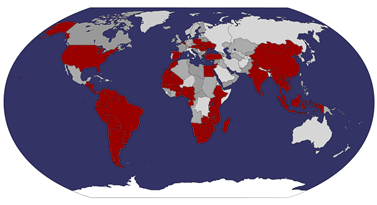
In case you're new, whenever we finish traveling through a certain region of the world, we try to pick one thing that each country seemed to be "obsessed" with. This is totally subjective, of course, and not meant to offend. Well, not too much. If you've been to any of these places, feel free to let us know if you agree or disagree with our choices.
On to the countries we visited in Eastern Africa!
Tanzania: Spare tire covers. I never would have noticed this, but Andy pointed out that nearly every truck in Tanzania had a fancy spare tire cover on the back with some sort of design or corporate logo or something. It did seem to be true. Chalk that one up to boys looking at cars more closely than girls do...
Rwanda: Giving every town two names. And the names are never even close to sounding the same! Musanze = Ruhengheri. Butare = Huye. I'm sure there were more. This made finding a bus to the destination you wanted interesting.
Uganda: Bananas. Growing on the mountain slopes. Loading down bikes being cycled to market. Mashed up in the staple starch, matoke. They're everywhere!
Kenya: Butcher shops. AKA "butcheries." You know, you can see half a skinned goat carcass hanging in the window in many, many places across Africa...but somehow, not quite with the same ubiquity that we saw them in Kenya. No wonder nyama choma is so popular--there's a lotta goat out there to barbecue!
Ethiopia: Walking sticks. As soon as you get out into the countryside, you kinda can't help but notice how pretty much every male over the age of 8 carries a walking stick. Approximately half the aisle space on any bus is taken up with a tangle of sticks, which is kind of a catch-22, because it makes having a stick necessary to negotiate your way out without falling...but to have a stick available for this purpose, you'll have needed to bring it on the bus, and stash it in the aisle...
Egypt: Shisha. You may know this as hookah (the Moroccan term). You probably don't know it by its Jordanian name, and my favorite--hubbly bubbly (I'm not kidding!). But anyway, it's a big apparatus for smoking tobacco, usually fruit-flavored to make it taste sweet, and it's incredibly popular with Egyptians and tourists alike. We don't smoke and didn't try it...it smelled OK when I caught a whiff, but apparently smoking one shisha does as much damage to your lungs as an entire pack of cigarettes, so, um, not so good for you.
Countries Visited
Showing posts with label Uganda. Show all posts
Showing posts with label Uganda. Show all posts
Friday, November 12, 2010


Wednesday, November 10, 2010
Financial Update: Eastern Africa
It's time once again for what may be our most boring blog entry for regular readers, our Financial Update. Boring, but very useful to anyone who is thinking about traveling for a long time. As a reminder, prices are the total for both of us for everything that we need while there. It does not include general trip expenses such as insurance. So, here we go.
Tanzania- $163 per day over 18.5 days. Visas were $100 each at the border (these are much cheaper if you are not American). This is an expensive one. Without my $1100 climb of Kilimanjaro or our $400 safari, the average is only $97 per day. Then again, why go to Tanzania if you aren't going to do anything interesting? Hotels and food are not very expensive if you go to the places that locals go (and locals often stay in rather nice hotels in Tanzania, it seems), but anything even remotely connected to tourism will cost a fortune. National Parks often charge $50 for entrance.
Rwanda- $223 per day over 6 days. No visa required for Americans, but many nationalities need a visa before entry. Entirely because we paid $500 each to see the gorillas. Of course, that is essentially all there is to do in the country other than look at the beautiful countryside or read more about the depressing genocide. Without gorillas, it was only $46 per day. Hotels are a bit more expensive in Rwanda and transport is more expensive than surrounding countries, but not bad.
Uganda- $149 per day over 6 days. Visas were $50 each at the border. Another expensive one. We took an expensive three day organized tour to Murchison Falls that accounts for most of the expense. Outside of Kampala, life is cheap. If you had more time and did everything yourself, it would be much cheaper.
Kenya- $71 per day over 5 days. Visas were $25 each at the border. This is actually made cheaper because we only visited one national park and we stayed with a family in Nairobi. We did the safari part in Tanzania. If you wanted to do a safari in Kenya, the price for Tanzania above is probably more realistic.
Ethiopia- $89 per day over 16.5 days. Visas were $20 each at the airport. Ethiopia is both dirt poor and dirt cheap. We include the entire cost of our flights ($300 each) in this average because Ethiopia refuses to issue overland visas, forcing us to fly. Without that, the average would be closer to $50 per day. Food is especially cheap (and good).
Egypt- $77 per day over 13.5 days. Visas were $15 each at the airport. Everything in Egypt is cheap except entry to all the ruins. Probably a third of our budget was spent on entry fees. Hotels, food, and transport are all cheap and have a high standard.
That's it. Hope you found it helpful. Feel free to contact us with any questions.
Tanzania- $163 per day over 18.5 days. Visas were $100 each at the border (these are much cheaper if you are not American). This is an expensive one. Without my $1100 climb of Kilimanjaro or our $400 safari, the average is only $97 per day. Then again, why go to Tanzania if you aren't going to do anything interesting? Hotels and food are not very expensive if you go to the places that locals go (and locals often stay in rather nice hotels in Tanzania, it seems), but anything even remotely connected to tourism will cost a fortune. National Parks often charge $50 for entrance.
Rwanda- $223 per day over 6 days. No visa required for Americans, but many nationalities need a visa before entry. Entirely because we paid $500 each to see the gorillas. Of course, that is essentially all there is to do in the country other than look at the beautiful countryside or read more about the depressing genocide. Without gorillas, it was only $46 per day. Hotels are a bit more expensive in Rwanda and transport is more expensive than surrounding countries, but not bad.
Uganda- $149 per day over 6 days. Visas were $50 each at the border. Another expensive one. We took an expensive three day organized tour to Murchison Falls that accounts for most of the expense. Outside of Kampala, life is cheap. If you had more time and did everything yourself, it would be much cheaper.
Kenya- $71 per day over 5 days. Visas were $25 each at the border. This is actually made cheaper because we only visited one national park and we stayed with a family in Nairobi. We did the safari part in Tanzania. If you wanted to do a safari in Kenya, the price for Tanzania above is probably more realistic.
Ethiopia- $89 per day over 16.5 days. Visas were $20 each at the airport. Ethiopia is both dirt poor and dirt cheap. We include the entire cost of our flights ($300 each) in this average because Ethiopia refuses to issue overland visas, forcing us to fly. Without that, the average would be closer to $50 per day. Food is especially cheap (and good).
Egypt- $77 per day over 13.5 days. Visas were $15 each at the airport. Everything in Egypt is cheap except entry to all the ruins. Probably a third of our budget was spent on entry fees. Hotels, food, and transport are all cheap and have a high standard.
That's it. Hope you found it helpful. Feel free to contact us with any questions.
Friday, October 22, 2010
Starch Smackdown! Foods of Rwanda, Uganda, and Kenya
When it comes to cuisine, Rwanda, Uganda, and Kenya have one passion in common: Starch! Be it a giant lump of cooked cornmeal (ugali--Kenya), a mass of mashed green plantain (matoke--Uganda), or a melange of every type of starch you've ever heard of (Rwanda), one thing's for certain...travels through these parts of eastern Africa will be the death of your low-carb diet.
Let's kick the pictures off with some foods of Rwanda!
Throughout east Africa, Tetra-Paks of juice or nectar are popular, and each country has its own brands. This one is Rwanda's--it's not the best, but it was the cheapest. (FYI, the best is probably Splash, Uganda's brand.)

Sticking with beverages, Rwanda offered two new flavors of Fanta we had not seen elsewhere! The pale green one is Fanta Citron, slightly limey and not bad. The purple one is Fanta Fiesta, which tasted like the Red Fanta you find in Latin America...in other words, chicle (bubblegum) flavored and pretty disgusting.

OK, lunch or dinner in Rwanda pretty much always looks like this. You sometimes get a melange plate, which for a fixed price of about $1.75 comes with several starches (for example, here we got chips, pasta, rice, beans, and stewed plantain), a green vegetable (cabbage here--sometimes salad or cooked dark greens), and a little bowl with a chewy piece of meat in a tasty sauce. Or sometimes you pay about $2 for an all-the-starch-and-veggies-you-can-fit-on-one-plate buffet, in which the choices are pretty much all the same things you'd normally see in the melange plate, and you then might pay extra for meat. It's not the world's most exciting food, but it's a great deal if you're really hungry.

In Butare, Rwanda, there is an ice cream and coffee shop called Inzozi Nziza, which means sweet dreams, and it is the NGO project of Blue Marble Ice Cream in Brooklyn, NY. Blue Marble ice cream is delicious but crazy expensive (like, $10 for a pint), so we were hoping to find a better deal at their Rwanda branch. Turns out they only have soft serve, but we were able to get large bowls of it for substantially less than the NY rates.

The shop from the outside. It's only been open a few months, but seemed popular with locals and foreigners.

Here is Andy modeling the fun tiny bottle of hot sauce that is found on every restaurant table in Rwanda.

And here is me modeling a giant cheese roll, which I found in a store in Butare. Not quite up to Colombian standards, but still, hooray for cheese bread!

While waiting out a rainstorm in Musanze, Andy allowed some local women to convince him to buy a bag of the strange-looking fruits they were selling. Here is what one of the fruits looks like from the outside...

And here it is out of its papery shell. Unfortunately, I can't remember the name or what they tasted like, but I do remember that Andy liked these a lot better than I did.

On to Uganda!
Uganda must be the banana-producing capital of Africa, if not the world. All through the west of the country, we saw people riding bicycles loaded with bananas, taking them to market.

Here's a shot of my first dinner in Kampala--masala chips and sausages. It would have been better if it was hot.

Bus snacks! The guys outside the window claimed these were both beef, but we think one of them may have been some sort of organ. Please focus on the meat on a stick in this picture and not my hair.

Always a fan of sachets of drinkable yogurt, I was excited to find the novel flavor of butterscotch in Uganda. Sadly, it wasn't as great as I'd hoped.

This might be my favorite billboard in Uganda. Those are some clever marketers who have convinced people they need a special cooking oil just for frying chapatti! (Chapatti are tasty Indian-style flat breads, which you can find all over east Africa--yay!)

Here's Uganda's take on the melange plate: rice, pasta, ugali (cornmeal mush), cassava, cabbage, and matoke, which is Uganda's national starch. It's the yellow stuff on the right of the plate and made of mashed, unripe plantains. Like ugali, it doesn't have a ton of taste.
 On our last night in Kampala, we stumbled upon a store that was selling Bounty bars for an outrageously low price, like 30 cents each. Guess who pounced?
And finally, Kenya.
Kenya probably had the most interesting food of the three countries I'm covering here, though that doesn't necessarily say a lot. Still, we never look down our noses at countries that supply cheap fried dough things for breakfast. These are called maandazi.

Remember in the other post, when I was complaining about not being able to find a restaurant in Naivasha that served both chips and beer? Well, this is what we ended up eating that night instead. I don't remember the name, but it was a kind of mashed-potato thing that also had greens in it, and I was later told it is a Kikuyu specialty. Can anyone identify?

Andy couldn't resist buying this bag of puffy sugary snack things in Naivasha. They tasted kind of stale and we later realized that they were expired...maybe that's why they only cost 5 cents.

My favorite drink in Kenya, and all of east Africa, has to be Picana. It is basically fruit nectar that comes in a glass bottle. There are different flavors--I tried passionfruit and cocktail, and they were both great! In this picture you may also notice large plastic bottles of salt--staples on the table of any restaurant that serves chips.

In Nairobi, our couchsurfing host Jusca and her sons prepared this incredible feast for our first night in town--a meat stew made with tomatoes, onions, and delicious spices, wonderful sauteed greens, and the best ugali we've had anywhere! Even more impressively, they made this all on a single-burner charcoal stove they had set up in the hallway.

Jusca even tried to teach me and Andy how to make ugali. Andy was more skilled at it than I was. You need a lot of arm strength to stir that cornmeal when it thickens up!

Our biggest culinary splurge of our entire trip so far was our trip to Carnivore restaurant in Langata, a suburb of Nairobi. It's pretty much a total rip-off of the Brazilian barbecue (rodizio) concept, but with the African twist of a few game meats thrown in. I had hoped that warthog would be on the menu, but the day we visited, it was just ostrich and crocodile in the "exotic" section.
Anyway, here's the main roasting pit, with many types of meat on swords.

As in any rodizio, the waiters keep coming to your table with different kinds of meat until you lay down your little flag and "surrender." Here's a shot of my plate early on--clockwise starting from the baked potato we have chicken, ostrich (very tasty when not overcooked--dry when overcooked), ox testicle (yup, you read that right--it was very tender), pork sausage (yum), and lamb sausage (meat was good, but trying to eat th casing was a mistake).

Here is Andy later in the meal, contemplating a bite of crocodile meat. It turns out that the meat itself is fairly good, but the fat is really fishy-tasting and disgusting.

The last thing I'll say about Carnivore is that we kept our flag flying for so long that finally a maitre d' came over to us and asked if there was anything particular we wanted more of, since we'd already eaten everything they had. Apparently, most tourists concede meat-defeat much earlier than we did. Ha, we conquered Carnivore!
Sticking with the meat theme, on our last day in Nairobi we went out with Jusca for some nyama choma, which is Kenya's national grilled-meat dish. Usually it is goat, but can also be beef, and that's what we had. The waiter brought a board full of meat to our table and chopped it up before us, then gave us toothpicks to eat with and little piles of salt to dip the meat in. Very flavorful!

In addition to nyama choma and ugali, chips seem to be a national food obsession in Kenya. A big plate or bag of deliciously greasy chips costs about 60 cents in Nairobi. They are served with hot sauce instead of ketchup. Yum!

I think this is the only yogurt I tried in Kenya. It was tasty, and I enjoyed the slightly-more-creative-than-usual naming used by this company.

Finally, as I was preparing to spend our very last few Kenyan shillings at a supermarket before heading to the airport, what caught my eye at the checkout but my old friends from Argentina, Peanut Rocklets?? We've sometimes seen other Arcor products randomly around Africa, but I had not encountered my favorite Peanut M&M knockoffs since Chile. I did a happy dance and added them to my basket. (Sadly, they were kind of old and crumbly when I finally opened the bag, but heck, they had journeyed a long way.)

Our bellies' next destination was Ethiopia, which was a whole new bag of (deliciously spiced, delicately pureed and served atop piles of injera) beans. Stay tuned!
Sunday, October 17, 2010
Anda #2: Ug
Sorry for the shortage of posts lately. Ethiopian Internet connections leave much to be desired. When we last left our fearless hero and her husband, they had just taken a small gorilla out of Rwanda in their luggage and headed for Uganda. And that is where this post finds them.
We thought that Rwanda had gorgeous hills, but it turns out that southern Uganda is even more beautiful, especially at sunset as the fog starts to burn off in the valleys. They terrace almost every available inch of hill to plant crops.
 We quickly proceeded to Kampala, that incredibly chaotic capital. After making plans for an organized tour for a couple of days later, we were off to Entebe, the quieter, gentler city close to Kampala. There we visited the Wildlife Center, which promises that it is not like any zoo and that the animals are all confiscated or rehabilitated. As it turns out, it is like most zoos that we have visited. But this very male vervet monkey did greet us. He seems a little blue about his relations with the females...
 One of the primary reasons we went to the center is to see the shoebill stork, which we hoped to see in the wild, but it is rather endangered and we never saw it. They are really great looking birds. I tried to get into the cage and hold my shoe next to its bill for comparison, but couldn't get over the fence.
 Many of the azaleas have massive spiders of this species on them. I took about a dozen pictures while Tara was running around screaming like a little boy.
 Back in the crowded, dirty, no-traffic-rules city of Kampala, we discovered that the Ugandan National Contemporary Ballet was having a show to celebrate its third season. As it turns out, there were about 20 white people and 2 locals in this rather small national theater. The ballet company was started by this crazy French woman who dances ballet about as well as I do, and she choreographs even worse than I would. Since she choreographed everything, it was rather bad, but many of the local dancers were really spectacular. If they sacked her and got a real leader, they could be an amazing group.
 The parliament building has this sign that looks to me as though they took an ad for Parliament cigarettes and added some words.
 We took a three day tour to Murchison Falls National Park. On the way, we stopped at a rhino park and I got to pet their pet orbi. I think his name was Henry or something like that. Fairly certain that I could only pet him because he was preoccupied with food. I know that is the only time when I let strangers pet me.
 The rhino park is meant to breed white rhinos to release back into the wild of Uganda. The last one was killed decades ago in Ugandan Civil War XXV. Okay, they don't really number their wars like Super Bowls, but it would make the history easier. Here is the biggest male taking a nap. He is Kenyan, and his first baby was Obama, whose mother was American. Cute, eh? Like the real Obama, the whole family have 24 hour armed guards.
 At Murchison Falls, we had to wait a few minutes on the ferry, but they had this nifty globe with which we could play and plan new routes. I discovered that we could go through Iraq, Iran, Afghanistan, and North Korea in a nice route eastward!
 Murchison Falls Park was really, really green. Rainy season is just ending, and it makes for some breathtaking scenery that is much different than the drier parks that we visited. The park has tons of Rothchild giraffes, which are one of the rarer subspecies. Here are some out for a stroll.
 Tara took some great sunrise pictures while waiting for the ferry. This one was especially nice with the clouds and the river. This is the Nile, actually.
 The park has many Jackson's hartebeests, which are also rare, but they are skittish, so I only got them running from us. Like other hartebeests, they have crazy shaped faces.
 This is the Ugandan kob. I remember a guide in Southern Africa going on about how there are five types of kobs, but one of them only exists in Uganda and that he really wanted to see it. I thought that his knowledge was impressive, but that he was incredibly boring. Well, thanks, boring guide--it made it much more fun to actually see this antelope.
 Speaking of kobs, this is a Dafassa waterbuck and waterbucks are also a type of kob. See the resemblence to its cousin above? Right, they both have horns. And fur.
 We came upon this group of lions and about five other cars watching them. Our driver, despite having a park ranger in the car, proceeds to drive our minibus over massive bushes and rolls up about ten feet away from these lions, completely blocking the view of all the cars behind us. We didn't know whether to laugh or tell him to be more polite, but we all took some nice pictures before telling him to move.
 Some cute lion cubs. Three lion cubs were there. I named them Simb-A, Simb-B, and Simb-C.
 An African Hawk, I think. It let us get closer than most hawks, so it is being rewarded by having its picture posted to our blog. If you are reading this, Mr. Hawk, feel free to let us know your name.
 A massive monitor lizard running away from us. We have shots of this same species from Southern Africa, but this was a nice picture. I like his crazy stomach pattern, which you can't normally see when they are sitting still.
 Some of the olive baboons are not at all scared of people, but they are much better behaved than other baboons--they know not to attack people for food, but will happily take what is offered or pick through the trash.
 Here we are with Murchison Falls in the background. Billed as the most powerful falls in the world, all the force of the Nile (granted, the Nile not far from its source) is pushed through this little canyon.
 As if to emphasize the power of the Falls, some crocs lay nearby waiting for a tourist to accidentally step into their mouths. Actually, they open their mouths to release heat, much like a dog pants.
 Looking downstream from the top of the Falls, the Nile starts to look like a real river.
 Can you see the baby buffalo in the mud? The whole little buffalo family was wallowing in the mud to keep the awful, awful biting flies away, but this little guy could barely reach the bottom.
 The next day, we went chimp tracking. All the "tracking" activities prior to this were more "trekking" with someone knowing exactly where the animals were. Not so with the chimps. After about two hours of wandering around and only hearing chimps in the distance once, I started to bore and take pictures of fungi.
 Maybe as good as the fungi are these terrific berries. Looked like they would be a great treat for a chimp, but the chimps apparently disagreed.
 Finally, we spotted one! This picture is only slightly worse than what we actually saw. The people at the back of the line of six people didn't even see this much. You can see the chimp butt if you look hard!
 Back to animals willing to pose. Look at this nice butterfly. I didn't even have to kill him to get this picture.
 As I mentioned earlier, we have debated a lot about whether you can call it "tracking" and animal when the guide just radios someone and asks where to go. The chimp place further confuses the issue of whether it is tracking or trekking:
 And that wraps up our time in Uganda. The country has tons of other places to visit that are supposed to be nice, but we are starting to run low on time in Africa, so we had to move on. We were not big fans of Kampala, though it appeared that the city does have pockets of calm. The rest of the country was very nice, though.
Subscribe to:
Posts (Atom)