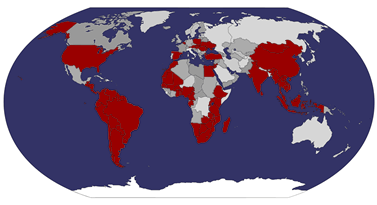
Countries Visited

Svalbard Spain United States of America Antarctica South Georgia Falkland Islands Bolivia Peru Ecuador Colombia Venezuela Guyana Suriname French Guiana Brazil Paraguay Uruguay Argentina Chile Greenland Canada United States of America United States of America Israel Jordan Cyprus Qatar United Arab Emirates Oman Yemen Saudia Arabia Iraq Afghanistan Turkmenistan Iran Syria Singapore China Mongolia Papua New Guinea Brunei Indonesia Malaysia Malaysia Tiawan Philippines Vietnam Cambodia Laos Thailand Myanmar Bangladesh Sri Lanka India Bhutan Nepal Pakistan Afghanistan Turkmenistan Tajikistan Kyrgyzstan Uzbekistan Japan North Korea South Korea Russia Kazakhstan Russia Montenegro Portugal Azerbaijan Armenia Georgia Ukraine Moldova Belarus Romania Bulgaria Macedonia Serbia Bosonia & Herzegovina Turkey Greece Albania Croatia Hungary Slovakia Slovenia Malta Spain Portugal Spain France Italy Italy Austria Switzerland Belgium France Ireland United Kingdom Norway Sweden Finland Estonia Latvia Lithuania Russia Poland Czech Republic Germany Denmark The Netherlands Iceland El Salvador Guatemala Panama Costa Rica Nicaragua Honduras Belize Mexico Trinidad & Tobago Puerto Rico Dominican Republic Haiti Jamaica The Bahamas Cuba Vanuatu Australia Solomon Islands Fiji New Caledonia New Zealand Eritrea Ethiopia Djibouti Somalia Kenya Uganda Tanzania Rwanda Burundi Madagascar Namibia Botswana South Africa Lesotho Swaziland Zimbabwe Mozambique Malawi Zambia Angola Democratic Repbulic of Congo Republic of Congo Gabon Equatorial Guinea Central African Republic Cameroon Nigeria Togo Ghana Burkina Fasso Cote d'Ivoire Liberia Sierra Leone Guinea Guinea Bissau The Gambia Senegal Mali Mauritania Niger Western Sahara Sudan Chad Egypt Libya Tunisia Morocco Algeria
Map Legend: 28%, 75 of 263 Territories

Sunday, September 6, 2009

Butterflies, More Butterflies, and Some Waterfalls

This post is all about Iguacu Falls, which is technically spelled with one of those silly curly things on the bottom of the c or in English with a z. They are big. Really big. Not massively tall (though taller than Niagara), but never-ending. The falls and the mist also create a tropical rainforest on steroids for plant and animal life. This is especially true for butterflies. If you have ever been to one of those butterfly gardens where they have butterflies everywhere, imagine that you increase that butterfly density by about 10x and the number of butterfly types by about 100x and you have the top of Iguacu Falls. I have dramatically cut down the pictures here, but Tara was ready to kill me for trying to take pictures of every single type of butterfly.

Now, to the pictures:

You can visit the falls from both Brazil and Argentina (they are right on the border). We did both, but if you ever visit, I don't really see a reason to spend the money on the Brazil side. The Argentina side is much better. Here is a shot from Brazil, though, which does have a couple nice panaromic viewpoints.

A shot of a completely different section of the falls from Brazil. Everytime you think you have seen them all, you walk around a curve in the path and see more.

Regular readers know that I really like lizards. This lizard gets a gold star for sitting perfectly still while I took his picture. He was close to three feet long.

The lighting isn't great in this shot, but I thought Tara would like it if I included a shot of the two of us. This is in front of part of what is known as "the Devil's Throat". I forgot my barrel, or I would have definitely gone over in one.


I took this picture as a joke, but then we realized that squirrels are rare in most of South America and many of the visitors were genuinely amazed at this crazy creature. We were hiking a trail and these South Americans stopped us to point out the squirrel. They seemed surprised when we laughed and kept walking.


And the butterflies begin. They were everywhere. At times it was like a butterfly storm. If Alfred Hitchcock were still alive, he could write a movie called "Butterflies" about them. I won't pretend to know what kind any of them are. Here's the first. I'm naming it Autumn Gold.


This one is going to be called Orangy Spots on Blue-Violet Wings.


What do butterflies attract? Birds. What are harder to photograph than butterflies? Birds. But I got a few shots. These are common at the falls. I suggest that New York try to replace their pigeons with them. People would be much happier.


I really like pictures of fungus. It is colorful, doesn't move, and doesn't get enough respect. Here is the best from the Falls.


Let's call this guy Electric Blue Death Machine. Sounds more ferocious than Electric Blue Butterfly.


This one was tiny. Thus, I have dubbed him Blue Runt. I think the other butterflies were laughing at him.


A lot of butterflies landed on both me and my backpack. Maybe because they are everywhere and explore everything, or maybe because my diet consists mostly of sugar and they like the taste of me. This one sat on my finger for a good 5 minutes. Let's call him Tigger. He can't bounce, but the colors are right.


Calling this one Saran Wrap since you can actually see through its wings. These were also huge. The biggest butterflies we saw in the park.

We shared a taxi to the Argentine side of the park with a British couple on vacation. They were upset that they had not seen a toucan, and we hadn't seen any close. Then, Tara spotted this one in a tree right above us. Unfortunately, the Brits weren't around, but he was a huge toucan. I asked, but he refused to share his Froot Loops.

If you eat enough of those blue butterflies, you turn blue. That is what happened to this bird.

This one looks like it might actually be a moth. Not sure. It liked me as well. I'll call him Big Blue.

A picture of the some of the falls from the Argentina side.Tough to see, but on the left half there is a small, circular drop off before it falls again. This is the heart of the "Devil's Throat" and presumably the most painful part if you accidentally fell into the river.

We hiked to a small falls where we could swim. On the hike back, we spotted this yellow headed woodpecker. He moved fast, and this is probably the best picture I have. Neither of us had ever seen one, so I thought I should share.

This vulture was just sitting on the road waiting for something to die. They are about the size of a hawk and I don't know what this one was doing since I didn't see any dead animals.

Instead of raccoons, they have an animal called the coatimundi. Like raccoons, they can be aggressive for food. They dig through the trash and come to places where people eat. They are good at grabbing chips from people's hands. These were marching towards us as though they would eat us. They just needed to cross, though.


One last comment. I almost called this post "Water, water everywhere, and not a drop to drink". It is amazing that among this much water, they have no waterfountains. Restrooms every 10 feet, but you have to buy water if you want (not drinkable straight from the tap). We don't take our water filter on day trips like this. So, if you visit the falls, take plenty of water or be prepared to overpay for it.

Friday, September 4, 2009

More questions from readers like you

We have gotten some good questions lately. Here is a sampling:

Q: What is the weather like? (submitted by multiple readers)
A: The weather for the first month and a half of our trip was similar because we were close to the equator. It was generally a high of 90 to 95 degrees and fell to between 70 and 75 degrees at night. In the last few days, it has become more variable. Starting in Rio, it was about 10 degrees cooler. Then, in Sao Paolo, we arrived at 5am and it was about 50 degrees. Tara just about froze. It will now get colder as we go South, though it is now going into Spring since seasons in the Southern Hempisphere are the opposite of the Northern Hemisphere. In a few weeks, we'll be in snow and it will be cold...

Q: Are you now in really good shape after all your travels? (submitted by BD)
A: Are you implying that we weren't in really good shape before? I would say we are in about the same shape. We do walk/hike a lot and we often travel with 30 pound packs on our backs, but we also eat a ton and spend a lot of time just sitting on buses. We weighed ourselves on the free scale at a supermarket the other day, and we are about the same weights as when we left.

Q: Can Andy stop shaving and getting hair cuts? (submitted most recently by AJ)
A: This is a surprisingly common request. No, I fully plan to continue shaving and getting hair cuts. As much as I like the hippie look, I will leave it to my parents' generation.

Q: What is the best place you have been? (also submitted by multiple people)
A: That is like asking which child is a parent's favorite. Even if they have one, they won't tell you. We really liked the Gran Sabana in Venezuela, the forests of Suriname, the sand dunes in Brazil, and Iguacu Falls so far. I'm sure that there will be many more.

Thursday, September 3, 2009

Foods of Brazil, Part Dois

After our first successful Foods of Brazil post, we are back for more.

Coconuts are loved in Brazil, especially northern Brazil. This is an decent size supermarket, but not massive. Here is the selection of coconut milks. In the US, we're lucky to be able to find any coconut milk when we need it.
While we were on the boat to Belem, Tara got very excited because most of the Acai gets shipped through Belem, making it probably the cheapest Acai in the world. She bought this huge bag of it (liquids in bags are common in this part of the world) for about $1.50.
I wish I had a picture of her face when she first tasted it. She thought it was so gross that she asked how long until the boat left. The guy said 30 minutes and off she ran to find sugar. Here she is, looking somewhat dejected, but with enough sugar to take care of the problem.
It is impossible to underestimate the importance of cookies in the Brazilian diet. They are everywhere, in every imaginable flavor. We go through about a roll of them per day. So, when we reached the big city of Rio and discovered that some stores are solely devoted to selling cheap cookies (biscuits, as they call them), we were very excited.
The first few days we were in Brazil, we ended up eating rather expensive meals on the main streets. We got sick of that quickly, and discovered that much better meals exist for much less money. This is a very typical meal and generally costs about $3 if you look around.
We haven't eaten real food at McDonald's, but we do sometimes have ice cream there. Cones are sometimes 50 cents in Brazil. We try not to buy unless that are 50 cents or less.
Brazil has these food carts that sell "salgados", which are lots and lots of random snacks. This one was some kind of grain fried with ground beef inside. The deal on salgados is one of them and a glass of juice for $0.50. We try not to pay more.
I bought these solely because the bag said they were bacon flavor. I would compare them to the things that come with Chinese restaurant soup, except that they were a decent artificial bacon flavor.
This one isn't food we ate, but is interesting. This comes from the favela (shanty town) of Rio, where apparently the undeveloped eggs inside female chickens are considered somewhat of a delicacy, so they leave them attached.
If you want to get Tara to buy a yogurt, call it limited edition or experimental. This was limited edition cashew nut, which Tara was really happy to find. Unfortunately, it apparently didn't taste like cashews at all.
All over Brazil, they sell these massive blocks of guava jelly. Next to them, there is always the similar looking yellow/brown stuff. We finally bought one and it turned out to be sweet potato flavor. Not really that good.
We are told that Sao Paolo has the highest concentration of Japanese people outside of Japan. As a result, most of the street food is Japanese. We had a big bowl of yakisoba noodles for lunch. Tara is mostly smiling because there were vegetables in the noodles.
We'll have at least one more post on foods in Brazil (or maybe combined with foods of other countries).

Wednesday, September 2, 2009

A Tale of Two Cities (Rio and Sao Paulo)

I. Boy and Girl in Ipanema

Did you know that Ipanema (of the song, with the girl) is actually a beachy neighborhood of Rio de Janeiro? Neither did we, but we quickly learned our way around it, and many other neighborhoods, during our two days in Rio.

(Note: It seems that almost all of the pictures we took in Rio were of food, so they will show up in our next "Foods of Brazil" post, but we do have a few to share here.)

I really liked Rio, but it was a sometimes-maddening mix of easy and difficult, glamorous and poverty-stricken, great deals and rip-offs. For instance, in Rio we paid the most we have ever for the smallest room ever on this trip, literally a closet with two bunk beds:


But, we were right in the heart of Ipanema, which had a lovely public beach and felt safe to walk around at night. And on our first night in town, we ate at a fairly swanky yet reasonably-priced churrascaria, (about US $17 pp for terrific salad bar and all-you-can-eat meat on swords, including beef ribs--YUM).

We also found doce de leite filled churros, vanilla soft serve cones, and suco + salgado (cup of juice and a savory pastry) for 1 real (50 cents US) apiece, which is as cheap as we´ve seen anywhere in Brazil, in certain neighborhoods of Rio, even rather touristy ones. So we didn´t starve.

And there were lots of cool things to see for free. We poked our heads into countless churches and cathedrals around the old city...


...and even got to tour the beautiful old parliament building (now used for the state legislative meetings, since the capital moved to Brasilia in the 1960s), absolutely free.


And we rode this cable car all around the bohemian neighborhood of Santa Teresa for a whopping 60 centavos (about 30 cents US) each--highly recommended.


Not everything touristic was such a deal, though. For instance, the famous Christ the Redeemer statue that stands over the city would have cost $18 US apiece to visit on the little tourist train. (Do you know how many meat-on-a-sticks that is?) So we opted instead to utilize the super-zoom on Andy´s new camera...


One outing that was definitely worth the money, though, was the three-hour favela tour we took. A favela is a slum, usually built on a hillside in or near a big city (as was explained to us, ironically in Brazil the rich people live at the bottom of the hill and the poor people have the great views). No joke--we took this picture from a rooftop in Rochima, Rio´s largest favela:


Because the favelas are built up on public land with no urban planning or infrastructure, when electricity, internet, etc. come in, the wires tend to look like this:


This is a great picture not because I am in it, but because you can see 1) how narrow the streets usually are in favelas--no room for cars, and often not even wide enough for an umbrella. Sometimes it is so narrow and the homes are built so high you feel more like you are in a hallway in someone´s house than outside. and 2) you can see a beautiful mosaic someone made on their house, probably out of remnants from another construction site.


There´s so much to write about the favelas--how their security is controlled by drug-trading gangs so there´s very little street crime because they don´t want the police nosing around their neighborhood; how the emerging middle class is staying in the favelas and improving their homes there rather than moving out because of ties to the community. I could go on, but I´ll just highly recommend that you take Marcello´s favela tour if you ever come to Rio.

Our last stop in Rio was the botanic gardens, which had a cool house of carnivorous plants. Also, this bush tried to swallow Andy, but I rescued him.


II. Saaaaay-o...Paolo
(Sorry, I couldn´t think of a good title for this part!)

A brief 6 hour overnight bus trip from Rio (good lord, you know you´ve been in Brazil too long when a 6-hour bus trip sounds incredibly short to you), and we were in Sao Paulo!

Sao Paulo is the financial capital of Brazil, and is known for its high culture, so we had to hit a few museums.

The first was the Butantan Institute on the University campus, apparently world-famous for its study of snake and insect venom! Visitors can tour the "serpentarium," which is where we saw this fellow.


We then went to MASP, the first-rate art museum in the Jardins area. They wouldn´t let us bring our camera in, but trust us, we saw some nice Van Goghs.

There was some impressive architecture and sculpture to be seen; the imposing cathedral on the Praca da Se...


...and this incredible monument at the large park where we picnicked the next day. Our limited ability to read Portuguese led us to think it is a monument to immigrants, or to the pioneers who founded modern Brazil? (If there are any Paulistanos reading, feel free to set me straight about this.)


(Speaking of works of art, at said picnic, Andy impressed me by slicing a tomato with a spork.)


And because there is only so much high culture a person can take, we present you with the following two pictures we also took in Sao Paulo.


One last note: Our guidebook said that Paulistanos are incredibly nice, and we found this to be absolutely true!

Our conductor on one city bus made it his personal mission to make sure we got to the venomous snake museum, even though it wasn´t really on the bus route and it was clear we could hardly understand a word he said; he found another passenger to speak English to us, and when we reached our stop he actually got off the bus and walked halfway down the block with us to tell us where to turn.

Other people came up to us on the street and chatted with us, pointed out places of interest, and offered to help if we looked the slightest bit lost. So, a special shout-out to the people of SP.

16 hours on a bus later, and we arrived in our final destination in Brazil, Foz do Iguacu (Iguacu Falls). Seriously amazing, but we haven´t uploaded the pictures yet and tonight are leavin´...leavin´ on the midnight bus to Paraguay...so you´ll have to wait for that story.

Salvador: We Like It

We took a lot of pictures in Salvador, Brazil, so it gets its own post. Overall, we thought it was a great city, though a bit touristy at times. Great beaches in the city, beautiful old historic buildings, and good street food. Tons of people warned that it could be dangerous at night, but we never felt that way. Now, to the pictures:

I didn't read any statistics, but if I were leading a tour of Salvador, I would say it has approximately 3 churches per person. It is also the center of a Nigerian religion, which apparently has even more small places to worship. This is one of the churches on the main square. The tout who helped us find a hotel room told us that there used to be a law that churches didn't pay taxes until they were completed. So, a lot of churches avoided taxes for years by never completing the second tower. No idea if it's true, but a good story.

The oldest church has a nice back area (seems to be translated in Brazil as sacrisy, but I have no idea if that is the proper term). This guy was my personal favorite. He seemed so lifelike. Well, if a gnome were to become a catholic...

Salvador is famous for its restored colonial architecture. This area is probably the best example. Also (again according to the hotel tout), Michael Jackson once performed here.

Coconuts are so ubiquitous is that even the phones are in the shape of them.

These things were so freaky that I made Tara pose with one. We're almost certain that they had real human hair.

One of the most famous sculptures in Salvador is this one, by a slave who made the blood of christ out of banana resin, ox blood, and rubies. I thought it would be sparklier and cooler, but here it is so that you don't have to pay the $2 if you are ever in Salvador.

Some of the churches have beautiful wooden painted ceilings. They are hard to photograph in the dark cathedrals, but they seem a great use of the tithe money.

The coast by Salvador is really nice. The best urban beaches we saw. Rocky in places, but very clear water.

Salvador is built on hills, so they have ways to get up and down. Apparently, someone in power was really lazy because they built the first elevator up the biggest hill in 1891. It has been redone a couple times since, and now cost the massive sum of 3 cents.

In the mall, they put kids in these giant balls and throw them in pools. Most of the kids cry. Seems awesome. They looked at me as though there was no way I could get in one, so I didn't try.

Some people have asked how we do laundry. Here you are. Seriously, laundry is no fun. We now hoard soap on the rare occasion that a hotel gives us any. It takes forever, and doesn't always dry quickly if in a humid area. We often end up tying it to our backpacks.

Also going up the hill is the funicular, a combination of "fun" and "vehicular homocide" or something like that. Two train cars go up and down on cables. Must be the world's shortest funicular. It also costs 3 cents.

Some guys doing capoiera on the beach, which we learned was invented by slaves who weren't allowed to fight, so they slowed down their fighting and called it a dance. I'd say those were some dumb slave owners if they didn't recognize two guys kicking each other in the head in slow motion as potential fight training.
On the way out of Salvador, you see that not everyone lives on the beach. This is a favela, similar to what we later toured in Rio.

We literally ran into a parade of one of the Carnaval drum teams practicing with about 1000 tourist trailing behind. We hear that teams in Rio actually charge to hear them practice, so this is as close to Carnaval as we got.

Between Salvador and Rio, the landscape changes a lot and much of it is a bit like the US southwest, complete with strange mountains and cacti.

Here are a bunch of yucca like plants taken from the bus window. The stalks on them are probably 30 feet tall.
That concludes our stay in Salvador. Tara and I both agree that its the nicest big city in Brazil. Worth visiting if you are in the area. Also one of the cheaper big cities.