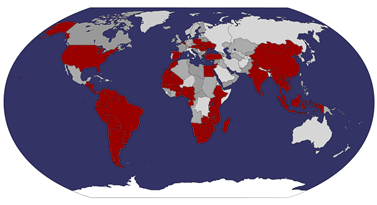
Countries Visited

Svalbard Spain United States of America Antarctica South Georgia Falkland Islands Bolivia Peru Ecuador Colombia Venezuela Guyana Suriname French Guiana Brazil Paraguay Uruguay Argentina Chile Greenland Canada United States of America United States of America Israel Jordan Cyprus Qatar United Arab Emirates Oman Yemen Saudia Arabia Iraq Afghanistan Turkmenistan Iran Syria Singapore China Mongolia Papua New Guinea Brunei Indonesia Malaysia Malaysia Tiawan Philippines Vietnam Cambodia Laos Thailand Myanmar Bangladesh Sri Lanka India Bhutan Nepal Pakistan Afghanistan Turkmenistan Tajikistan Kyrgyzstan Uzbekistan Japan North Korea South Korea Russia Kazakhstan Russia Montenegro Portugal Azerbaijan Armenia Georgia Ukraine Moldova Belarus Romania Bulgaria Macedonia Serbia Bosonia & Herzegovina Turkey Greece Albania Croatia Hungary Slovakia Slovenia Malta Spain Portugal Spain France Italy Italy Austria Switzerland Belgium France Ireland United Kingdom Norway Sweden Finland Estonia Latvia Lithuania Russia Poland Czech Republic Germany Denmark The Netherlands Iceland El Salvador Guatemala Panama Costa Rica Nicaragua Honduras Belize Mexico Trinidad & Tobago Puerto Rico Dominican Republic Haiti Jamaica The Bahamas Cuba Vanuatu Australia Solomon Islands Fiji New Caledonia New Zealand Eritrea Ethiopia Djibouti Somalia Kenya Uganda Tanzania Rwanda Burundi Madagascar Namibia Botswana South Africa Lesotho Swaziland Zimbabwe Mozambique Malawi Zambia Angola Democratic Repbulic of Congo Republic of Congo Gabon Equatorial Guinea Central African Republic Cameroon Nigeria Togo Ghana Burkina Fasso Cote d'Ivoire Liberia Sierra Leone Guinea Guinea Bissau The Gambia Senegal Mali Mauritania Niger Western Sahara Sudan Chad Egypt Libya Tunisia Morocco Algeria
Map Legend: 28%, 75 of 263 Territories

Saturday, December 12, 2009

Our Trip: Ruined

Okay, a deceptive title, but this post will focus on some Mayan ruins. We visited Copan in western Honduras and Tikal in northern Guatemala. In addition, you can read about our visit to Joya de Ceren in El Salvador in that post. Because Copan is in Honduras, and everyone is afraid of Honduras, we saw about 10 people there. Tikal was rather crowded, but still bearable. Tikal also had good birds and animals in the area.

The Mayans had one of the earliest systems of writing in the world. It was fairly complex, and much of it is still being deciphered. Here is a good example of some writing that commemorated a ceremony of some type. Apparently, they just figured out about a decade ago by comparing these types of markers from different cities that some of the symbols were the name of the city. The name of Copan (from where this one comes) is symbolized by a stylized bat because they have a lot of caves around with bats.
This statues represents the first recorded ruler of Copan, whose name was something like Blue Quetzal Macaw. Not a lot is known about early leaders because it was custom for a long time to destroy everything that had been written about the previous ruler when a new one came to power. Then, some guy needed to claim this ruler as an ancestor to give himself some legitimacy and all the sudden the first ruler was everywhere...
Copan is famous for these giant statues called stellae (singular: stella, no idea why they use a Latin word for a Mayan statue in a Spanish country). They all have leaders in the pose of gods and generally commemorated important events. They almost inevitably have a big round table in front of them where common people are expected to leave presents for the ruling class. Often, the ruling class would sit on high structures and watch who was leaving stuff for them.
Here is another stella. These come from about 600 AD. This area developed what is known as the cult of the stellae. Sounds like a geeky scientist cult, but it was really around the quasi-worship of the quasi-gods depicted in these statues. While stellae exist in other parts of the Mayan world, they aren't very fancy and were often just painted.
Tara took this beautiful picture looking out through one of the temples in Copan. Copan is set among the hills and small mountains. All the temples in Copan are built on top of old ones. Every couple hundred years, a new ruler would order bigger, better pyramids and temples built. Apparently, they shared this with the Incas.
If you look closely, you'll see that's me in the middle of what is known as a false arch. The Mayans weren't quite as good as Greek real arches, but they have held up well over time.
On to Tikal, an even bigger Mayan city. Almost 3 million Mayans lived in the area at the peak of the Mayan empire in about 1200AD. The site is huge, but they have only excavated parts, and even keeping those from being reclaimed by the jungle is challenging. There are 7 major temples in the shape of the Big Dipper. This is one of them. You can see how much moss is growing on the sides, slowing breaking down the pyramid.
A gray-throated woodrail along the edge of a lake at Tikal. Why is it called a woodrail? No idea. But I understand the gray throated part.
Our guide was terrible, but he did grab a tarantula and carry it around for a few minuted. We were cheering for it to bite him. Afterall, he told us all about how it was painful but not lethal. And then we probably would have had a better tour guide replace him.
This is another of the temples. Layers of pyramids with a building on the top. The priests and rulers would go up to the top and look down menacingly at the people. I don't think they sacrificed people in this one, but they definitely did in some of them.
A view looking out from the top of one of the temples. You can see a couple other temples. It also gives a sense of how hard the jungle tries to take over the ruins. In the day of the Mayas, there were no trees anywhere. Not only because it was a city, but because there was massive deforestation for firewood.
Tara in front of one of the temples. I know, they all start to look alike, but this one also has Tara! The stairs going up them are very steep. We climbed a couple of them and were certainly tired by the end of the day.
Last one. This one has both of us with some ruins in the background. A tour guide was demonstrating from the ruins in the background that the acoustics were so good that he could speak in a normal voice and anyone on the square could hear him. They should build more public squares like that today.

Last, but certainly not least, is a picture of the wild turkey that is everywhere in Tikal. It not only has colorful feathers, but a blue neck and head with orange spots. From now on, I only plan to eat this type of turkey for Thanksgiving. I think it will make me prettier.

That's the story of the Mayan ruins. Overall, the Mayans were very skilled. They did a lot of weird stuff, like binding the heads of the ruling class to make them all pointy, and sacrificing a lot of people, but they also invented zero, understood a ton of astronomy, and apparently predicted that the world will end on Tara's birthday, 2012 (actually, their calendar just runs out then--they never predicted the end of the world).

Friday, December 11, 2009

Lakes, lava, and a touch of mob violence...Guatemala! (Part 1)

(More about the mob violence in a minute.)

Our bellies still full of pupusas and Mister Donuts from El Salvador, we arrived in Guatemala on December 5 via international bus. We had to change in Guatemala City to get to Panajachel, our ultimate destination on the shores of Lake Atitlan in Western Guatemala.

Guatemala City is divided into numbered "zones," and even though we were just one zone number away from the bus to Pana (as it is called), it was impossible to figure out how far away it was or how to get there, so we had to pay a taxi a slightly usurious price to take us there. We then squashed onto a school bus for the three-hour ride west.

But finally, we arrived. The highlands were refreshingly chilly after weeks of Caribbean heat, and the clothes that the local people (descendents of the Maya) wore were very fun. The women (almost all of whom still dress traditionally) have these beautiful embroidered shirts and patterned wrap skirts, and the men who dress traditionally (fewer than the women) wear colorful shirts, big hats, and three-quarter-length pants.


On our first night in town, we did little other than wander around and eat some dinner. But the next day (which happened to be our 6-month wedding anniversary), we took a boat out on Lake Aitlan to the village across the lake, San Pedro. The boat charges tourists 3 times the price it charges locals, and this is just accepted by everyone--it annoyed us some, but the views of the two nearby volcanoes were pretty excellent.

Here's a shot I took from the shore, including my favorite flowers, azaleas: And here you can see both volcanoes in one shot.
Looks pretty peaceful, right?Well, when we arrived back in town that afternoon and were wandering around the souvenir stalls, we saw some locals suddenly running down the street toward the lake, and then suddenly it seemed like every vendor was racing to pack up his wares and close up shop. Our first thought was "Oh, CRAP, a volcano must be errupting." But we asked people what was going on and finally were made to understand that there was a problem with some thieves in the marketplace, which was in the other direction from the lake, back near our hotel.

"Why is everyone down here freaking out about a couple of theives on the other side of town?" we wondered. Well, soon enough, we had the full story. The problem wasn't exactly the thieves--it was the fact that an angry mob from the marketplace, incensed that the police would do nothing to stop the thieves, was rioting, overturning police cars, and attempting to set the thieves on fire in the square.

"Oh," we said, as black smoke began to rise from the direction of our hotel.

So we did what other tourists seemed to be doing, and slunk down toward the relative safety of the lake to wait out the situation. About an hour later, with me still rather rattled, we were able to get back to our hotel, where we holed up for a while (Andy offered to play cards with me to calm me down and I beat the pants off him at euchre). We heard some helicopters overhead, but otherwise things seemed to have calmed down. At night things were very calm, some restaurants were open, and we were able to get dinner. We left town on an early bus the next day (yes, the buses were running), and on our way out of town, passed several truckloads of national guard troops rolling in in their SUVs.

We read the news that day and learned that a thief had been killed. And that was our introduction to Guatemalan mob justice (happy anniversary!), which apparently has been a growing trend lately--there had been a similar incident in the next town over the week before, with two people killed. Probably none of you read this in the American news, but it did merit an AP article the day after the Panajachel (or "our") incident.

We were never personally in any danger, and that the only signs of the violence we witnessed in person were people running down the street and smoke in the distance. Also I will point out that all of the people we talked to who lived in the area were squarely on the side of the rioters--apparently, the police are completely corrupt and do nothing about crime, forcing people to take the law into their own hands. Most people seemed to be of the "I don't like violence, BUT...this situation is out of control" mindset.

I will also add that it seemed extremely ironic to us that we basically skipped visiting Honduras because we were concerned about possible civic unrest there, and then this happened on our second day in a very touristy town in Guatemala!

Anyway, our next stop was Antigua, a very peaceful colonial city (so don't worry, moms!) and definitely the tourist capital of Guatemala. Apparently Andy didn't upload any pictures of the city, but it had pastel buildings and big churches and overpriced tourist restaurants and all that. (Honestly, after Cartagena, Granada, Leon, and now Antigua, we're getting a little cute-colonial-citied out.)

The coolest thing about Antigua (and we've agreed, Guatemala as a whole) was the trip we took to the nearby Pacaya Volcano, where we were told we would have a chance at seeing flowing lava.

Well, even if we hadn't, the views we had of other volcanoes, poking out high abover the clouds, while climbing Pacaya around sunset were spectacular.

The lower reaches of the volcano had a lot of crumbly black volcanic rocks that got in our socks and were generally unpleasant to hike on, but as we got closer to the top, we started to see more freshly formed rock. You can see some of the patterns here that you get when lava dries.

Then, suddenly, fire in the hole! All around us, we could see 2000-degree molten lava glowing just feet away through cracks in the not-so-old dried lava rock. We also noticed that it was getting kind of hot around us...

...and then we went over a rise, and there it was! Rivers of flowing lava! (Is that pure excitement or sheer terror on my face?)

Yeah, I know, it's still in the picture, but trust me, it was flowing. We have some video. Happy couple with hot lava and fluffy cloud backdrop. Note my hiking stick, btw--our guide borrowed it, lit the end with some lava, and used it to light a cigarrette to general applause. Also, some people brought marshmallows up the volcano and toasted them over the lava, though I have heard that that just makes them taste like sulfur and can make you sick.

We had to hike down in the dark, one of my least favorite activities, but it was totally worth it. If you ever get a chance to go see some flowing lava, do it! Unspeakably cool. I mean, hot.

Andy will pick things up for the rest of our (mob-violence-free) adventures in Guatemala!

Wednesday, December 9, 2009

El Salvador: Not the savior of our waistlines

El Salvador is such a small country, and it has been so heavily influenced by American fast food, that it was hard to believe that it has maintained such a diversity of food. We ate quite well there as we simultaneously had to eat the local food and all the food we missed from the US.

As we were getting on the bus as soon as we got into Ecuador, I grabbed one of these tostada things. I ask my typical question (Does it have cheese?) and the woman said no, so I bought it. It was a tostada (really a fried tortilla) with yucca, cabbage, tomato, and some cream. They really like cream in El Salvador and serve it with several dishes.
Our first night there we got in late and didn't know how safe our neighborhood was (it turned out to be quite safe), so we went to the closest place we could find, which was Wendy's. I love Wendy's, but at least in part for the dollar menu, which didn't seem to exist. After walking through the drive-thru to see if that menu was different than inside, the man behind the counter came and got us and admitted that they have some off-menu items. This is common in South and Central America--they rarely tell you on the menu everything that they have. In any case, we got some bacon burgers (hold the cheese), fries and Frosties, making for a very tasty and not completely Salvadorian dinner.
The most popular food in El Salvador is called the pupusa, which is a thick tortilla with fillings inside. Traditionally, they have beans, cheese, pork, or any combination of the three. You can get them everywhere and they range in price from about 20 cents to a dollar depending on size and quality. Here are some 20 cent ones being baked on a traditional griddle on the street.
A traditional plate of pupusas might look like this, accompanied by a sweet plantain (which we love and bought several of by themselves) and a pickled cabbage salad that is not too bad.
We discovered that El Salvador loves ice cream and has tons of local chains. Several of these chains are 2x1, meaning that everything is two-for-one. Even better, one of the chains called Sarita was having a free scoop deal with the purchase of any waffle cone. So, everyday for three days we went and had waffle cones with two scoops for 85 cents each. The last day we were there, I had two.
Also popular in El Salvador are donuts. Donuts and ice cream. Two of my favorite things. The most popular place is Mister Donut, which has really good donuts. They serve a lot of other food (ala Tim Horton's) which looks bad, but actually seemed more popular than the donuts. Also of note is that the cinnamon rolls and apple fritters were much cheaper than the donuts, despite being better. We took advantage of this by eating some every morning.
Here are two of the donuts. A dulce de leche glazed cream filled on the left and an apple fritter on the right. I love apple fritters and this one lived up to everything that an apple fritter should be.
The local brand of yogurt is called YES. Tara found the novel flavor of grape. I assured her that she would hate it because she hates artificial grape flavoring. Against my advice, she bought it and took it to the movie theater with us. This is clearly taken before she tried it because then her smile changed to disgust.
In the market of San Salvador, she located some horchata, which she had been seeking for some time. Horchata, for those who don't know, is a sweet rice milk drink with cinnamon that is quite good.
In the same market, I opted for the brightest colored drink that I could find. Had it been dark out, it would have glowed. It turned out to be chicle, which is much like bubble gum. Not my favorite, but it was drinkable. And pink.
We met the cousin of an El Salvadorian friend from New York, who took us to a place called Abbi's Pupuseria. It was amazing. Best food in a long time. Here are some of the pupusas with more food in the background and more was brought later. Thanks to Ronald for taking us!
Ice cream vendors on the street are common, but this one had fun bowl shaped cones, so I got a sundae with strawberry and coconut ice cream and strawberry syrup. It won't win any taste awards, but pretty good for 50 cents on a sunny day. We need more people in the US who walk around with coolers of ice cream for sale.
They don't have a ton of empanadas in El Salvador, but in Suchitoto we found these cute vegetable filled empanadas that are then fried. They were very good. Tara also has a fried potato in that bag, which was not bad, but was literally just a whole potato that had been fried.
This is a "plato tipico", consisting of avocado, some local salty cheese that Tara says is like ricotta, and casamiento. Casamiento is a mix of beans, rice, and spices. It doesn't sound that exciting, but it is amazing if done well. Really, really good. I don't know why it doesn't exist in other countries.
The fruit and milk shake is a staple in Central and South America. This one was banana and they were nice enough to add cinnamon. Strangely, El Salvador has a different word than anywhere else for a banana.
These are some local sausages, served with casamiento and the cheese. The sausages tasted like normal sausage, but are made in this fun round shape. They could string them like Christmas ornaments.
Here is Tara with a flavor of YES yogurt that she really liked: aloe vera. I have to assume that it tasted like mosturizer, and that it made her esophagus smooth and supple.
That's it for El Salvador and its foods. A good mix of traditional and American. We really enjoyed eating the food and probably gained a few pounds. Thanks, El Salvador!

Tuesday, December 8, 2009

A little bit of everything: El Salvador

El Salvador is the smallest country in Central America, but we were surprised at what an excellent variety of experiences it had to offer. It's got beaches, volcanoes, Mayan ruins, cute villages and modern city life, and unique, delicious food...basically, everything else you find in other Central American countries condensed into one small area, and I am surprised that tourists have not really caught on to this yet! We were there for three days, but I think that we could easily have stayed a week or longer and not run out of new places to visit...and I can't say that for everywhere. (Also, El Salvador--like Panama and Ecuador--is on the US dollar, making dealing with money incredibly easy.)

Because the country is small, we based ourselves in the capital of San Salvador and took day trips to places of interest. San Salvador has more malls than we have ever seen in one city before, and the one we stayed near was Metrocentro, which is the largest mall in Central America. What's kind of amusing is that after wandering through it for a while you feel like you are seeing the same 10 stores over and over again: Metrocentro must have at least four Mr. Donuts, for example, but that's OK because we love Mister Donut (see Andy's forthcoming food post for more details).

Anyway, our hostel owners also have a beach house, and on our first full day in town, the husband happened to be driving out there to do some maintenance. He took us along and we got to relax on a lovely, nearly deserted beach in the far western part of the country. The Pacific ate my goggles, but otherwise it was a very pleasant outing.

There was even wildlife to spot near the beach. Like these colorful blue-tailed lizards...
...and a whole slew of turkey vultures on fenceposts! Andy got this great close-up of one.

That night, we went to (where else?) the mall! Which had a cinema, and it just so happened to be half-price Wednesday, so we saw that worldwide blockbuster, "New Moon," for $2 apiece. We both agreed that "Twilight" (which we saw on a tour bus in Peru) was better.

On our second day in the country, Andy and I mastered the city and regional bus systems to get ourselves out to our next destination. All ex-American school buses, by the way. Smoking is banned on these buses (yay!)...but apparently so is ice cream (boo).

Our destination was the Mayan ruins of Joya de Ceren, aka the "Pompei of El Salvador." These ruins, preserved by a volcanic eruption in the 600s AD, are the only surviving example of everyday Mayan dwellings (rather than the great temples and public buildings you find elsewhere). Also, they are the southernmost Mayan ruins, marking the far reach of the Mayan empire.

Here you can see an average Mayan's dormitory--the raised platforms on the left were beds. Each family dwelling consisted of three structures: a dormitory, a kitchen, and a "bodega" (which apparently does not mean little shop, but cellar, or storage area).
And here is the back of the shaman's temple. The shaman had a living space and a working space with lots of nooks for his potions and such.

Joya de Ceren is a small site, and it only took us about half an hour to see. So we hopped back on the bus and were back in San Salvador by lunchtime. Easy!

We took this opportunity to visit the old city center, which is a loud, crowded place filled with street stalls and bus fumes. Much of the old architecture has been destroyed by successive earthquakes, but the churches are still nice to look at. I think that this one is the Sacred Heart of Jesus church, probably the fanciest one downtown.
A tree up in the main plaza of San Salvador. The season is definitely getting underway down here...we heard a lot of Christmas songs (in Spanish, of course) playing over the sound system at (where else?) the mall.

That afternoon, after much hunting for the correct city bus, we visited a park high above the city where the "Puerta del Diablo" (Devil's Door) offers great, if slightly smog-hindered, views of a good chunk of the country.
And that night, we visited another neighborhood high above the city to eat amazing pupusas with our Salvadorean hero, Ronald, the cousin of our New York friend Julia, who had never met us before but nevertheless picked us up at our hostel to take us to a traditional dinner and city tour--how awesome is that!

Anyway, at Pupuseria Abbi, the diners next to us were serenaded by a full-on mariachi band. Apparently, many such bands rove the restaurants at night to play to paying customers. It was the first time we had seen this in our travels, reminding us of how we creep ever closer to Mexico.

Our final day in El Salvador was spent mostly in Suchitoto, a village known for its colonial architecture and proximity to a beautiful lake and waterfalls.

The town itself was a little sleepier than we'd expected, but it did have a nice main square and church.
We hiked out to the Los Tercios waterfall, which falls over these crazy geometric rocks. The waterfall was not the biggest waterfall ever, but fun to see nevertheless.

And right near the waterfall was an incredible mirador looking out over the lake. One of the more beautiful and peaceful vistas I have seen on our whole trip.
In closing, if you have a week or 10 days or so and are thinking of taking a Central American vacation, I highly recommend El Salvador. There's plenty to see, it's not too expensive, the people are very friendly, the food is amazing, and you don't have to shlep around a lot on long bus rides. Put it on your itinerary!