

Time to share our last batch of country expenditure averages! Mostly, Central America was very cheap, and the last few countries in South America were pretty easy on the wallet as well. We left off last time with
Countries Visited
Thursday, January 14, 2010
Financial Updates: Central (and some of South) America


Obsessed: Central America (and the rest of South America)!
If you check out the labels, or tags, on this blog, you will see that Andy has written 52 entries so far and I have only done 45. Maybe that’s because he writes all the obsessions and finance posts. Well, no more—it’s my turn to tell you with what things the countries we visited on the last leg of our trip were obsessed!
Saturday, November 21, 2009
More than just cheese bread...Foods of Colombia, Part Dos
We will start off with the highly authentic Colombia food of crepes, from the highly authentic Latin American chain restaurant, Crepes y Waffles.
Not much to say here except that crepes are delicious, and that this one, filled with "arequipe," the Colombian preferred term for what is known in other countries as dulce de leche or manjar, was no exception.

A slightly more authentic sweet treat: churros! The Bogota street version is skinny, unfilled, and round (well, oblong) and has a distinctive kind of syrupy taste. Very yummy. Note the utterly grease-soaked bag.

We could never figure out exactly what this fried thing was. We think it was layers of yucca and meat or something. Andy ate it.

The outdoor market area in the Caribbean beach town of Santa Marta had lots of food stands. The first thing we tried was this sausage, which came with some yucca slices. It was OK.

The market also yielded some fun fresh produce, such as these two taxo fruits. Well, they are called taxo in Ecuador, something else in Colombia that I don't remember. Anyhow, they are shaped like a banana on the outside...
 ...but are passionfruity on the inside!
I also found "personal-sized" papayas at the market, which made me very happy, because I love papaya, but can't eat a whole huge one myself. I enjoyed this Tara-sized papaya for breakfast the morning of our hike through Tayrona National Park.


The "New Welcome" restaurant in Santa Marta provided one of my favorite meals out in a while. I got a huge steaming pot full of spaghetti in a mushroom-and-cream sauce for about $3...

...and for $1 more, a bucket of pineapple juice! Fresh and foamy with a hint of lime. Sadly, I had to share this bucket with Andy.


Fresh fruit salad! Andy still won't eat it because of his food poisoning episode, but I don't let that stop me from getting my vitamins A and C.

Andy prefers his fruit to be cooked, like this flattened, deep-fried banana. (And note the sweat stains on Andy's Icebreaker shirt, which absorbs moisture in a weird way.)

More Andy, more fried stuff. This one in Cartagena was pretty good, a crescent shape made of yucca with meat inside. Tastier than the flat yucca-and-meat thing from further south!

Another candy from the candy ladies. This one is a tamarind ball. What I liked about it was that it was coated with sugar both outside and inside.


On our last day in Colombia, we made a couple of farewell purchases. Andy had to have this arequipe baby from the candy ladies...

...and at the airport, I spent our last few pesos at a branch of Qbano, the Cuban sandwich fast food chain, on this ropa vieja sandwich. I shared with Andy, and we weren't able to eat again for at LEAST half an hour.

Friday, November 20, 2009
What Colombians are Eating, Part Uno
Empanadas occur in many places, but they are very popular in Colombia. And they are always fried, not baked like some of those countries that shall remain nameless in southern South America. Here I am shoving almost the whole thing into my mouth.
 Here is a picture of an empanada for me and the first nasty smelling cheese bread of Colombia for Tara. This particular cheese thing looks to me like cheese curds mixed with flour and fried. Tara loves them. From a distance they look like donuts, making me somewhat leery to try real donuts in Colombia...
 Here is Tara with two more types of cheese bread. Tara tried to learn the names of all the breads, but it proved confusing, so she gave up. In this one there is one that looks like a meringue. It is baked and smells the nastiest of all the cheese bread family. The second is more like a bun or roll. When warm, it also smells bad. It is less offensive when cool, but could then be more easily confused with a normal roll.
 Hooray for good ole meat-on-a-stick! This meat-on-a-stick has some kind of green sauce, which wasn't bad. It should be noted that food is sort of expensive in Colombia. Not US expensive, but more than most countries in South America. This is probably the most expensive meat-on-a-stick we've had at over $1 per stick.
 One of the great street foods of Colombia is the giant fried stuffed potato. They take some meat (normally chicken) and spices and cover it in mashed potato in a giant ball and then fry the whole thing in batter. Almost as big as my head for $1. Kept me full for a day, and stopped me from eating anything else for at least 5 minutes.
Colombia was lacking in the corner bakery department, but we finally found a good one in Cali that was close to our hostel and cheap. Here is a guava filled sweet roll. It was way better than anything with cheese that Tara got from the same bakery.
 For breakfast in Cali, we bought a whole pineapple for 60 cents and cut it up to go with our bread. Not the best pineapple ever, but it was 60 cents.
Tara eating cheese bread number four from the Cali bakery. This one seems like a straight-forward bread with lots of cheese on top. Tara seemed happy with it and it didn't smell too bad, so I didn't really have anything against it. Also, this bakery was nice enough to bag the cheese breads separately from my tasty sweet treats.
 In Cali, a small population (mostly descended from slaves) keeps alive African traditions and cuisines. This drink is an example. The sign said what it was, but we had no idea. We asked the woman, but had no idea what she said. It was a mix of two drinks, we believe derived from fruits of some type, with one being creamsicle color and the other light brown. The orange was fairly good while the other was terrible. On top, they put some kind of honey that we had never had.
 On to cheese bread number five. This one is the famed pan de yuca, which turns out to be completely different in Colombia than at the Colombian bakery that Tara loves in New York. It looks like a bagle, but is crunchy and has the texture of crunchy styrofoam from what I could tell. Tara didn't love this one. You hear that, Cheesebread? Tara hates you, so go away and leave us in peace!
We have had a ton of snow cones all over South America, and don't normally photograph them, but this one was made with more love than I had ever seen. It took the guy what seemed like an hour to make and has more layers than phyllo dough. Sadly, it wasn't really as good as it looked.
 Just when I thought we had exhausted the cheesebreads, Tara found another. These were tiny and filled with guava jelly. Looked decent except for the cheese part. She enjoyed them and they doubled as an acceptable dessert.
 Strangely, we never saw fresh potato chips on the street in Bolivia or Peru where they grow so many potatoes. We finally found and bought some in Bogota. Not bad, though they don't salt them unless requested, which seemed strange given the rest of the cuisine.
 As I mentioned, the food in Colombia is generally expensive. However, we found a lunch place where the locals eat where lunch was $2 and included a plate of food like this, a big bowl of soup, and a glass of juice. A great deal.
 Oh, look, here is a picture of the soup. I gnawed on the meat for a few minutes before concluding that it was just meant to flavor the soup and not meant to be eaten. I believe Lassie would have been proud of my attempt, though.
 They have a lot of manjar blanco in Colombia, which is like thick dulce de leche and sort of like a fudge. We thought this was such a thing, but it sadly tasted like plasticy pudding with the raisins being just about the only tasty part. We win some and lose some with the street food.
 We found these desserts in Bogota that are essentially a guava fruit roll-up filled with the dulce de leche fudge stuff described above. They weren't cheap, but were really good. Maybe we will try making our own.
 If you can identify this fruit, let us know. We see lots of fruit that we don't know, but this one seemed especially colorful. The sign calls it a Pithaya, but the fruit doesn't look like the Pitaya on the front of other Pithaya flavored things...
 We decided to cook in Bogota because we stayed at a hotel that gave us our own apartment, complete with kitchen. We used some more of the lentils that we have been carrying since southern Chile. Turns out that a kilo of lentils is enough lentils to last a long, long time.
Tara didn't trust me to do all the food myself, so she will be posting the second half. To summarize the first half of Colombian food: fried, often cheesy, somewhat expensive.
Monday, November 16, 2009
Go North, Young Travelers
Tara took this flower picture on the walk into Tayrona National Park. Not sure what kind of flower (looks like a crazy orchid), but she took a really nice picture.
 We had to hike for a couple hours to get to he beach. It wasn't the hardest hike, but it was about 100 degrees with humidity near 100%. And I had told Tara that it would be a nice walk, so Tara was less than ecstatic. Here she is very happy to finally make it to the ocean, though.
 While hiking, we saw these neat red bugs. Let us know if you know what they are. I thought about picking one up and/or tasting it, but it seemed potentially dangerous.
 A view of the mountain from the beach. We didn't know it at the time, but the next day we had to hike to the top of it.
 I like this picture because a.) the rocks are cool, and b.) I have a terrible grimace on my face because I was staring almost directly into the sun as Tara told me to smile.
Tara and I have this unspoken competition to see who can get closer to animals that don't like being approached for close-up pictures. I admit that Tara did a nice job getting about 2 inches from this grasshopper without it bounding away.

The return of the hammocks! For regular readers of our blog, you may have found yourself thinking, "Didn't they buy hammocks about three months ago? Have they done anything with them?" The answer: Yes, we did buy hammocks, but all we've done is carry them. The funny thing is that in the National Park, it was quite a bit more just to string our own hammocks than it was for a decent room in Santa Marta, the nearby city.
 All over the national park, they have land crabs. I had only seen big ones like this in Mexico, and they are sort of freaky since there are hundreds of them all over staring at you, but they go down their holes as soon as you get close. This is a blue one, but red ones are also common.
After staying overnight in our hammocks, we set out on a different route to take us back to the main road. On the map, it seemed much shorter (and distance wise, it was). However, as we started the first trail by going through a little cave, we realized that it might be a tougher trail. 45 minutes in and we both looked like we had just come out of the shower.
 But the trail had lots of great fungus! I love fungus. Colorful, fun shaped, easy to photograph. Here is my favorite. Looks almost like a coral, but it's a fungus about one inch tall.
 Along the trail, Tara spotted a frog. It is fairly rare that Tara spots anything on the forest floor, so we stopped for her to take a picture. She did manage to get fairly close to it, though I won't pretend it is anywhere near as cool as my frog below. Looks about right for frog juice, though.
Later on the trail, I found this little poison dart frog. I had trouble getting a good picture of him, but this one isn't bad. After finding him, I looked hard for others, but couldn't find any more.

After my lovely frog, Tara tried to compete by finding this almost as interesting caterpillar. We think its head is on the left, but we weren't really sure.

On our long and strenuous hike, we had the chance to use our water filter for the first time ever in nature. Most of the time, we just use a sink and filter it, but this was straight out of the stream! Hasn't killed us yet.

We finally came out of the woods near the end of the hike and had a great view of the valley below. This doesn't capture the panoramic nature of the scene, but gives you an idea. Also, we were happy to be out of the woods after a much longer hike than we expected. At this point in the day, we had sweated more than some Americans sweat in a lifetime.
 Back in the town of Santa Marta before catching a bus to Cartagena, we had to take some pictures of the great Christmas decorations. Colombia really like Christmas, and they don't have Thanksgiving to start the season, so they start with Halloween.
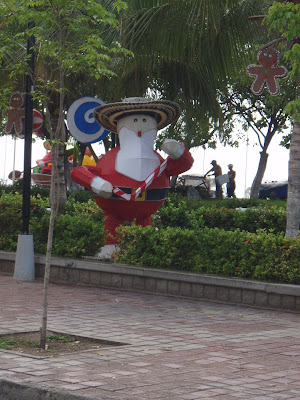 And what would Santa be without trust Rudolph? They had these all over the city. Really great, especially when they would have fake snow as you are walking along the beach in the 100 degree weather.
On to Cartagena! The most colonial city in architecture in South America, and certainly one of the most touristy as well. The city really is lovely, but prices are about twice as high as the rest of Colombia. Here is the main cathedral. Hard to get a good picture.

This is the clock tower of Cartagena. Tara told me it is famous, but we traded our guidebook, so I can't look up what makes it so famous, and I'm too lazy to Google it. So, I'll guess that it's the oldest clocktower in South America. That or it was used by Marty McFly to go back in time.

I pointed out to Tara that this sculpture looks a lot like Harry Potter. We appreciate any city that puts up a sculpture of Harry Potter.

Cartagena was sacked by raiders about 30 times. Okay, less than that, but the whole city is surrounded by walls with canons and towers from which to shoot people. Here is Andy standing on the wall of the city.
 Here is one of the forts to protect the city. We can't say how effective it was at keeping out enemies, but it successfully kept us out by trying to charge $8 to get in. In most of South America, we could have bought the whole fort, or at least rented it for the day, for less than $8.
I have to guess that part of the reason the city was captured so many times is that the moat just wasn't deep enough or wide enough. Really, look at it and ask yourself if it would keep you from storming the walls.

A lovely colonial street of Cartagena. Tara is especially in love with the azaleas that grow everywhere here. You can see them on all the balconies.
 They have a shaded walkway here called "Portal de las Dulces" where vendor after vendor sells homemade candy. All the vendors are basically the same, but the concept is still fun. And they sell these amazing coconut candies that you will see in the food post.
 Well, that's northern Colombia. Santa Marta and Tayrona were very nice and also affordable. Cartagena is also very nice, but much less affordable compared to most of South America. Still, for a couple of days, it has been a nice place to stay. Now, we off to spend our last night in Colombia celebrating the fiesta that is occuring here... For what? Who knows. But it seems to be a really big holiday.
(Note from Tara: It's the independence of Cartagena, silly! Four days of partying.)