

Time to share our last batch of country expenditure averages! Mostly, Central America was very cheap, and the last few countries in South America were pretty easy on the wallet as well. We left off last time with
Countries Visited
Thursday, January 14, 2010
Financial Updates: Central (and some of South) America


Obsessed: Central America (and the rest of South America)!
If you check out the labels, or tags, on this blog, you will see that Andy has written 52 entries so far and I have only done 45. Maybe that’s because he writes all the obsessions and finance posts. Well, no more—it’s my turn to tell you with what things the countries we visited on the last leg of our trip were obsessed!
Friday, November 13, 2009
Ecuadorian food: more than bananas
The first picture wasn't even clear enough to see, but it was Tara holding a glass of white stuff just as we got across the border into Ecuador. It tasted like melted ice cream and was really good. We later discovered that it is a popular drink made of cream, milk, and oats. Really tasty. And it had oats, so it was healthy.
Once we made it to Puerto Lopez on the Ecuadorian coast, the street food abounded. We jokingly call this city the Brigadoon of street food. You would find the most amazing food, walk a block to try something else, come back for seconds, and the vendor was gone. Ecuador was the first place we had been where street vendors apparently roam rather than staying in one spot for the day.
Here is Tara trying a sweet coconut bread in Puerto Lopez. The bakeries were not bad, and very cheap. What I don't have a picture of is her eating the first cheese bread of the trip. More on that later.
 We discovered these people that sold a big pile of fries covered with tasty chicken breast (and doused in ketchup and mayo) for $1. Not surprisingly, they disappeared after our first night in Puerto Lopez.
Sometimes, we go wrong with street food. This most often occurs when I see something that looks tasty, knowing in my heart that it probably isn't as good as it looks, but thinking, "what if it is the best food around and I miss out on it?" That thought resulted in this purchase of some dry rolled up cake stuff with the fairly tasteless sugary icing from a homeless looking guy hawking them to a bus of senior citizen tourists outside our hotel. Nonetheless, I ate all of them.

The underwater macro mode made this photo look much better than it probably would have otherwise been. Tara looks like a devil fish accepting her meat sacrifice. This spiral sausage had some nice french fries stuck on the end for Tara's enjoyment.

Our biggest victory in Puerto Lopez was milkshakes. I had been craving real milkshakes for at least a few weeks. We came upon some teenagers in the street who would mix homemade ice cream with fresh fruit and sell a big milkshake like the one in the lower right of this photo for 75 cents. We each had a strawberry one and a pineapple one. We came back the next night before our bus left town, but, alas, they weren't there.

We took a long walk in the cloud forest outside Puerto Lopez, and it was really beautiful despite not seeing any birds. Our talented guide, Juan, saw a grapefruit still hanging on the tree (it is past the season), chopped off a stick with his trusty machete, and perfectly hit the branch above the grapefruit to make it fall. I generally find grapefruit to be bad, but this one was almost sweet enough to be edible. (Those who know me are aware that sweetness is my primary determinant of good or bad in food, and really in people, I suppose.)
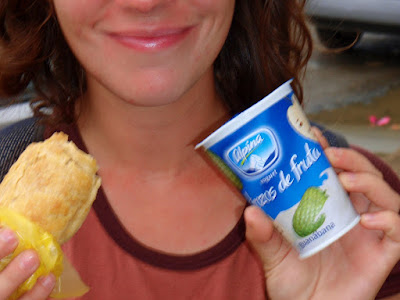
 Tara found some guanabana yogurt and a sausage in a roll for breakfast. She loved the sausage pastry, but we returned less than five minutes after buying it for another and the vendor was gone. We looked around for a few blocks, but he had vanished.
 Tara seems to be in more food pictures than me, but we both eat a lot. I just happen to be holding the camera more. In this one, she is eating freshly fried plantain chips. Made more interesting because they put a salad and mayo on top. It is a lot better than it sounds.
 When we made it to Quito, we arrived at 3:30 in the morning. Because Tara and I knew we would have to pay an extra night if we checked into a hotel then, we decided to wait a couple hours at the nice new (though cold) bus station. While there, we had some excellent hot chocolate and some not so excellent churros.
At the store, I pointed out to Tara that Ecuador was really her kind of country. It was the only place we have been where yogurt comes in gallons.
 In Ecuador and Colombia, tomato del arbol, or tomato of the tree, is a really popular fruit. We tried a shake made of one when the camera was out of order, and it did taste a bit like tomato. Not terrible, but we would never go out of our way to get it. Here is a picture of some.
 After not eating for a few days, here is the first thing I ate: grape jello. Jello is really popular on the streets in Peru and Ecuador and I had been wanting to try some. The timing seemed appropriate and they had grape, which everyone knows to be the best flavor. It tasted just like American jello. Not sure what I expected, but at least it didn't taste like poison.
Tara got a mix of guanabana and raspberry juice at the market in Otavalo. It was fairly good. I don't have a picture of a guanabana for those reading, so look it up on the Internet. It looks sort of like a mutant pineapple.
 I went from my grape jello to a concoction of fried potatoes with fried meat topped with a tomato salad. The meat was bad, but the potatoes were tasty. I later regretted this decision as my stomach informed me that I was an idiot and that it was going on strike for several hours.
 Tara liked my potatoes enough to go and ask a lady if she could just buy the potatoes. Despite being skeptical of the idea, the woman sold them to her and put them in this nice bucket so that Tara had a bucket of potatoes. We had a similar bucket when I was a kid that held Mr. Potato Head.
From Otavalo, we traveled to Ibarra, a town specializing in ice cream. And specifically specializing in fruit flavored ice cream. Fortunately, my stomach had forgiven me for the earlier fried food and was good with ice cream. We started at Rosalia Suarez, the most famous of these ice cream places (and apparently the original). We wanted to try a couple places, so we started with the cones, which were smaller than the cups. I had raspberry and coconut while Tara had taxo (related to passionfruit) and coconut.
 At first, this picture might look like a second shot of the one above. But, then you might notice that the ice cream flavors are different. The first was so good that we got seconds. I stuck to the amazing coconut and tried strawberry. Tara outright stole my first combination. They were really great, but we knew that other ice cream places awaited.

So, after eating ice cream from four different places, we caught a bus to the Colombian border. Ecuador left a positive food impression on us, and I don't think we ate a single banana while there (though there was some in the fruit salad that stayed in my body for only a few hours). Tara could live on cheese bread and yogurt forever (I would starve on the same), and we could both eat street fries and shakes for most of our meals. It also helped to keep our food cost down for Ecuador. In conclusion, hooray for cheap street food and boo for the bacteria contained in cheap street food.
Thursday, November 12, 2009
Less math, more eating: The rest of Ecuador
So I'll do the best I can with what I've got. We left you with a snap of the boobies (heh) we saw on our sea trip from Puerto Lopez. Our next stop was Quito, the capital city of about 2 million people. Like La Paz, it is at elevation and surrounded by beautiful mountains. Unlike La Paz, we did not get robbed in Quito, which may be part of the reason I liked it so much.
Central Quito is divided into an Old City and a New City. We stayed in the New City, which had more amenities (like camera repair shops, and yogurt-and-pan-de-yuca shops, which may be the best shops ever invented), but visited the Old City to check out the churches and lovely colonial architecture.
Here are two shots we took (blind, btw--the screen on our camera was still busted at this point) facing in two different directions from the same street in the Old City. In one direction you can see a huge statue of the virgin, keeping an eye on the town...
 ...and the other way you can see the towers of the basilica. Neat!
 Quito had more old churches in the town center than almost anywhere we've been. Unfortunately, our first day in the city was a national holiday, so they were all closed to visitors. "God is on vacation from Ecuador," Andy said.
Another street in the old city...the closest we got to visiting the real thing. Ah well, next trip to Ecuador!
 One thing that was open on the holiday was the Teleferico, or cable car that takes you hiiiigh above Quito up a nearby mountain. I suggested we walk from the Old City, but our guidebook map gave me a really innacurate estimate of how far it was, and we ended up walking for about two hours, most of it uphill. The book also goofed on the price, which at $8 per ticket was twice as expensive as we'd expected.
But we'd come so far, we had to go up. And in fairness, the Teleferico took us at least twice as high as we'd expected, too. Well up into the clouds, in fact. So, no more pictures of Quito, as early the next day we found a repairman who had the right parts to fix the screen. We kind of got the sinking feeling that said parts may have been supplied by stolen cameras through some chain of suppliers. I hope not, but unfortunately I can't say for sure.
Katie D., this is for you: One thing I wish we had a picture of was the public transit system, which I thought was really great. Quito has a really nice, efficient Trole (trolleybus) system and bus system, with subway-like stations in the streets where you buy little plastic tokens for 25 cents, enter though a turnstile, and wait for the bus or trolley to come. They run on fixed routes to other little stations; we never had to wait long, and the system was really easy to figure out (much easier than the similar Transmilenio system in Bogota, which cost 75 cents a ride and in which we were constantly getting lost!).
That night, as we were going to bed, Andy mentioned that his stomach didn't feel great. A couple of hours later he woke up, ran off to the baño, and thus began the first bout of food poisoning either of us has suffered on this trip. We knew it was bound to happen, but had been happy to be lucky so far.
He thinks it came from a cup of fruit salad we bought (where else?) on the street in Quito. We have had countless similar fruit salads before, but apparently one bite of this one tasted like poison to him, and though he should have spit it out, he didn't. (My prince charming, swallowing the poison to spare me!) So poor Andy was in for 24 hours of misery. I ran a few errands to get him Gatorade knock-offs and find food for me, but mostly hung aroud the hostel as well. Luckily we had sprung for a room with private bath this time around.
Happily, he was much better the next day, and after picking up our fixed (yay!) camera, we headed off to Otavalo, the town 2 hours away that is known for its giant Saturday market. And the next day just happened to be Saturday!
Here is a fun huge statue you pass between the bus station and the center of town in Otavalo. For once, is not Jesus/the Virgin, but local people dancing. The main church in Otavalo is lit up beautifully at night. It's not quite so impressive in the daylight.
 The next day was market day! Most of what we bought was food (which you'll see in our next foods post) or gifts for people (which we're not going to post, of course), but I did finally get a Peruvian-style hat with earflaps of my very own! The vendor wanted $3 but I used all my shrewdness and cunning to bargain him down to $2.50.
 A note on money--did you know that the official currency of Ecuador is the US dollar? Yup, the country made the switch in the 1990s to curb inflation...so all prices are now in dollars, and you pay in US cash. This was wonderful for me and Andy, of course, because it took away the need for us to, as my friend Jan C. would put it, "commit math." No longer did we have to go up to street vendors, hoteliers, etc., ask "¿Cuanto cuesta?", and furiously multiply or divide to figure out how much things "really cost"...we just knew. (Also nice was that hotel rooms generally cost $15-$25 and street food was often as cheap as 25 or 50 cents.)
The only confusing thing about the money was that Ecuadorians use dollar coins and 50-cent pieces regularly (the rest of their change is actually a mix of US$ and Ecuadorian coins that are the same size as their US equivalents but wouldn't be valid tender in the US). I got into a bit of a mess at an ice cream place when I took back my change in bills but told the scooper to keep the coins as a tip, not realizing that she was giving me two dollar coins as part of my change with the rest of the small change, which I'd meant to leave her. She thought I was the most generous tipper ever until Andy caught my mistake and made me go get our $2 back. D'oh.
Speaking of ice cream, the last town we visited in Ecuador was Ibarra, which is famous for its helados de paila, or fruit-flavored ice creams made fresh in huge copper pots. As soon as I read about this place, I knew that we would have to make a pilgrimmage there.
Turns out that there is a whole street in Ibarra lined with heladerias serving this kind of ice cream, and we visited four of them. The oldest (from the late 1800s), most expensive (at 65 cents a cone rather than 50 cents), and best was the first place we visited, La Heladeria de Rosalia Suarez.  Pictures from our five rounds of ice cream to come in the next food post!
In closing, Ecuador was pretty great; nature, shopping, city life, delicious food, pretty cheap, and no currency converting. It seems to be the country where Andy is cursed to get sick (when he was there eight years ago with his sister, he had a bad reaction to malaria medicine and couldn't swallow for a few days), but marred by no such experiences myself, I give it high marks.
Friday, November 6, 2009
Another cool ancient culture and birds
This is the Temple of the Sun of the Moche people in Northern Peru (near Trujillo). It was built around 600AD and was apparently the biggest manmade structure in the Americas for a long time. Basically, these people mastered irrigation and fish farming, so life was easy. As a result, they spent all their free time building cool stuff or making good ceramics and jewellery. The excavation of this Temple and the nearby Temple of the Moon is completely privately funded, so it is officially sponsored by a beer company...
 Every hundred years or so, a new ruler would come along and decide to build a bigger, better pyramid. They would just fill in the old one with bricks and build on top of it. This means that many of the lower levels were really well preserved once they pulled all the bricks out.
In the Moche culture, you were taxed in bricks. Every family had to make and give a certain number of bricks to the government each year. Because they had no written language, each family would mark its bricks in some way. Some were boring and just used an X. Some had elaborate designs. We liked the smiley face.

This detailed fresco tells the story of the Moches and was on the outside of one of the pyramids. One of the more interesting parts is that they would sacrifice humans when El Nino screwed up the climate. However, unlike the Incas who would sacrifice children, the Moches would let prisoners volunteer to fight in teams of two. The winners got to go free and the losers were sacrificed to the gods. Seems much more reasonable.

Also in the above is the Peruvian Hairless dog (which actually has a bit of hair). They are still popular and considered to have some sort of mystical powers that allow them to heal people. Here is one healing whatever might ail Tara:

After this, we were off to Puerto Lopez in Ecuador. This turned out to be a rough trip. We made it into Ecuador and took a bus to Guayquil. Unknown to us, Ecuador had a four day holiday weekend and it was one of the biggest travel weekends of the year. When we got to Guayquil, it was the busiest bus station we had ever seen. Every line had a couple hundred people waiting to buy tickets. The line we wanted had even more. So, after waiting in line for about an hour and not moving an inch, we broke down and paid the exorbitant sum of $50 to a taxi to take us two hours away to a town where we could catch a local bus. The local bus had about 300 people crammed in, and Tara calls it the party bus due to the loud salsa music being played on it.
Once we made it to Puerto Lopez, it was wet and muddy. Here is the main street. The mud did not win Tara's heart, but the city was much nicer the next day after it had dried out.

Now you can really see the broken camera impact, which is too bad because the pictures would otherwise be nice. We visited Isla de la Plata, which is a small island off the coast where you can find blue footed boobies, red footed boobies, banded boobies, and other inappropriately named birds. Blue footed boobies are definitely one of the best birds anywhere, so it is a shame that they are hard to see in this photo.

Red footed boobies mostly stay in the trees. Here is one where you can just about see the red feet. They aren't as fun looking as blue footed, but still neat.
 After that, we were off to Quito. We'll try to put a few of those pictures in our next post.