Countries Visited

Svalbard Spain United States of America Antarctica South Georgia Falkland Islands Bolivia Peru Ecuador Colombia Venezuela Guyana Suriname French Guiana Brazil Paraguay Uruguay Argentina Chile Greenland Canada United States of America United States of America Israel Jordan Cyprus Qatar United Arab Emirates Oman Yemen Saudia Arabia Iraq Afghanistan Turkmenistan Iran Syria Singapore China Mongolia Papua New Guinea Brunei Indonesia Malaysia Malaysia Tiawan Philippines Vietnam Cambodia Laos Thailand Myanmar Bangladesh Sri Lanka India Bhutan Nepal Pakistan Afghanistan Turkmenistan Tajikistan Kyrgyzstan Uzbekistan Japan North Korea South Korea Russia Kazakhstan Russia Montenegro Portugal Azerbaijan Armenia Georgia Ukraine Moldova Belarus Romania Bulgaria Macedonia Serbia Bosonia & Herzegovina Turkey Greece Albania Croatia Hungary Slovakia Slovenia Malta Spain Portugal Spain France Italy Italy Austria Switzerland Belgium France Ireland United Kingdom Norway Sweden Finland Estonia Latvia Lithuania Russia Poland Czech Republic Germany Denmark The Netherlands Iceland El Salvador Guatemala Panama Costa Rica Nicaragua Honduras Belize Mexico Trinidad & Tobago Puerto Rico Dominican Republic Haiti Jamaica The Bahamas Cuba Vanuatu Australia Solomon Islands Fiji New Caledonia New Zealand Eritrea Ethiopia Djibouti Somalia Kenya Uganda Tanzania Rwanda Burundi Madagascar Namibia Botswana South Africa Lesotho Swaziland Zimbabwe Mozambique Malawi Zambia Angola Democratic Repbulic of Congo Republic of Congo Gabon Equatorial Guinea Central African Republic Cameroon Nigeria Togo Ghana Burkina Fasso Cote d'Ivoire Liberia Sierra Leone Guinea Guinea Bissau The Gambia Senegal Mali Mauritania Niger Western Sahara Sudan Chad Egypt Libya Tunisia Morocco Algeria
Map Legend: 28%, 75 of 263 Territories
Showing posts with label ghana. Show all posts

Monday, August 29, 2011

Flashback: First Day in Ghana

The blog lives!

Andy and I have finally wrapped up our domestic travels (check out the "Where Have We Been?" column on the right if you'd like to know, uh, where we have been this summer) and made it back to New York...just in time for Hurricane Irene! Luckily, my parents' house was not flooded, which means that the meager remains of our worldly possessions are still intact.

Anyway, as we take breaks from looking for jobs, we hope to bring you a last few blog entries here, reflecting on our round-the-world experience and offering some final advice to those of you out there who are considering doing this one day.

Here's a brief entry to get things (re)started. I wrote this 250-word essay for a funny-travel-story contest sponsored by Budget Travel magazine...but then decided not to submit it, because apparently they take ownership of your writing and photo submission, even if you don't win, which means I would have to pay them if I wanted to publish them later in a book or something. Bah. But now that means you get to read it for free!


First Day in Ghana

Every time we go over a bump, the goats scream.

My husband and I are bouncing down the road in rural Ghana in a crowded minibus. Our hips dig into our neighbors’, our shoulders jostle for space, and everyone’s sweating—especially me and Andy, who failed in our mission to get window seats and are now cut off from even the tiniest breeze.

Bump. Bahhhhh!

Most of the passengers came to the station that afternoon with a few bags, like us, but one brought a dozen goats. With the driver’s help, he strapped several to the luggage rack up top, then started shoving goats inside, under the seats.

Now every time we hit a bump—about every 10 seconds, or just long enough for your brain to start recovering from the noise—the goats get jostled and bleat bloody murder. A year into our round-the-world honeymoon, Andy and I thought that we were used to sharing public transport with livestock (they don’t call them “chicken buses” in Central America for nothing!), but this is taking it to a whole new level.

Hog-tied and stuffed into a dark space, the inside goats protest loudest, but it’s the roof goats who take the ultimate revenge. A man at the end of our row, trying to get more shoulder room, has his torso hanging halfway out the bus when a stream of yellow liquid runs off the roof and hits him on the arm. Suddenly, we’re glad we didn’t get those window seats.


Friday, June 11, 2010

Financing West Africa

Our journeys in Africa until now have been pleasantly affordable, if not always pleasantly comfortable. We wanted to do the entire region at once, so here is what we can tell you about finances in West Africa. As a reminder, these prices generally include our visas (and visa prices may vary depending on where they are issued) and all expenses for the two of us. They are obviously a rough guide, but should be helpful to other traveling in the area.

Morocco- $47 per day over 15 days. Thanks to Morocco not requiring visas, cheap lodging and transport, and easy do-it-yourself tour options, this is one of the cheapest countries we have visited. We stayed in a few terrible hotels, but also a few rather nice ones, but you could easily stay in nice ones the whole time and not add more than $10/night.

Mauritania- $68 per day over 8 days. This reflects the $45 visa, but is lessened by us staying with a family for a few days. Hotels are a bit pricey in Mauritania for the quality, and most of the food is imported, so it can also be pricey if you want Western-standards. However, transport is cheap, with the iron ore train being almost free.

Senegal- $61 per day over 7 days. Senegal is the other country in this part of the world that does not require visas for Americans (or most Europeans), which reduces the cost. Hotels are reasonable except in Dakar, where you should definitely stay in the very nice Catholic Guesthouse or couchsurf if you are on a budget.

The Gambia- $106 per day over 4 days. This is skewed by the $50 visas and only being there for four days, but in The Gambia, you have to take tours (often costly boat tours) to see much. Guides can be hired very cheaply if you can find them, but boats cannot. We do have some good suggestions for bird and wildlife guides if you decide to go.

Mali- $76 per day over 8.5 days. Visas are $25 each. Mali has more tourists, so everything is a bit more expensive, especially tours of Dogon Country, which are costly, but interesting. If you are really on a budget, you can often get a mattress on someone's roof for very little money, which is actually your only chance to be cool enough to sleep if you are there in hot season unless you pay the outrageous additional amounts (normally $20/night) for air conditioning.

Burkina Faso- $66 per day over 7.5 days. Visas were $20 each at the border, but only good for 7 days. Transport is fairly cheap and often nicer than surrounding countries (even sometimes air conditioned on the main east-west road). Without your own car, you do have to hire a guide and car to see some of the interesting spots in the west of the country, which was not crazy expensive, but raised the average.

Ghana- $46 per day over 14 days. Visas were $30 each. Ghana feels more expensive than it is because at a few touristy places, you feel like you are being overcharged. Food on the street is good (if you can find it without fish sauce) and really cheap. Hotel rooms are very reasonable, though you may want to look at a few in Accra to find the right cleanliness/cost balance.

Togo- $49 per day over 4.5 days. Visas were $30 each. This is completely skewed by us staying entirely with Peace Corps volunteers while in the country. The average would have been about $30 per day more without that. Take the Post Bus, which is nice and reliable (and air conditioned) when traveling.

Benin- $65 per day over 5.5 days. Visas were $20 each. Good value since we had to pay $50 each for the car/tour to Pendjari tour and paid for hotels throughout the country. Take InterCity bus when possible--it was cheaper than most and air conditioned.

Nigeria- $80 per day over 11 days. Visas were $130 each. The visas make it expensive, but our couchsurfing in Lagos offsets that since hotel prices there are very high. Transport costs vary a lot from place to place in the country, sometimes with little reason. Street food availability also varies a lot, and restaurants are expensive. Make sure your hotel has a generator (almost all do) since the country is without power most of the time.

Cameroon- $59 per day over 15 days. Visas were $100 each. Hotels aren't that expensive, though the water and electricity in Cameroon is spotty, so you could find yourself without one or both even at decent hotels (good hotels have generators for power, but the backup for water is to give you a couple of buckets). Travel prices also vary a lot here in different parts, so just bargain hard and hope for the best.

Gabon- $78 per day over 7.5 days. Visas were $100 each. Gabon is expensive. Transport is two or three times more expensive than any other country in the region. Hotels are not cheap, though of a high standard (couchsurfing in Libreville greatly helps our expenses). If you venture to the national parks rather than Lope, they start at $300 per night per person. Yet, we have had a decent time here.

That wraps up expenses. As always, ask if you have any questions.

Thursday, June 10, 2010

Obsessions of West and Central Africa!

This post is a long time coming, but we figured we'd wait til the end of this segment of the trip and do one big post covering all 15 countries we've visited so far! Either that, or we've just been lazy. You decide...


I guess we'll start with the three European nations we hit en route to West Africa.


Belgium - Chocolate. That one's easy. Brussels's streets are line with chocolate shops, each one fancier than the next. Luckily, if you hang around long enough and look serious enough about possibly buying something, most of them will give you a free sample!


Gibraltar - "Apes." They're actually baboons, which are monkeys, but all the tour guides call them apes. They were brought over from Africa by army soldiers in the 1800s (I think) for...um, company? Now they run "wild" over the Rock of Gibraltar, except they seem to know exactly where the tourists with the food congregate. Saying Gibraltar's obsessed with them may be a stretch, but hey, we only spent a few hours there and don't really have any other candidates.


Spain - Ham. Or jamon, in the local parlance. Brussels's chocolate shops are replaced in Spanish cities with shops with huge haunches of pig hanging in the window, selling all manner of pork products! In Madrid there is even one emporium called the Museo del Jamon. (It made for a strange gateway to the Muslim world, where pork products are impossible to find...)


On to West Africa!


Morocco - "Berber artisan cooperatives." A.k.a....carpet shops. A guy starts guiding you through the medina (old town) and you think you're just gonna see the sights. Then he steers you to the amazing "artisan cooperative" where you are in luck the Berbers are in town, selling their amazing crafts, just for one day only! (Except that miraculously, they're still there when you walk by the next day, and the next.) Suddenly you find yourself trapped in a carpet showroom, with carpet after carpet being unfolded for your "viewing pleasure" and a slick salesman countering your every objection to purchasing ("Can't carry a carpet around the world? We ship to America!"). And then you start thinking, to your horror, "Hm, that carpet does look nice, and shipping it wouldn't cost so much..." You barely escape. Luckily, this only has to happen to you in one city (OK, maybe two...) before you catch wise and just refuse to even enter such places!


Mauritania - Tea. We thought Morocco was obsessed with tea until we got to Mauritania! A super-strong blend of green tea, fresh mint, and loads of sugar, decanted over and over until your tiny glass is just basically filled with tea foam, and drunk in three rounds over the course of an hour with your new friends, tea is an unavoidable but excellent Mauritanian experience.


Senegal - Pretending to have Internet access. In no other country have we entered so many buildings that had the word "cyber" or "internet" over the door, only to find that the place didn't even have electricity, much less computers or a connection! Senegal's sign-painters are apparently afflicted with an optimism that they will one day have Internet access, and are painting for the future, not the present...


The Gambia - "Happy couples!" For some reason, Gambians like to shout the phrase "Happy couples!" at pairs like me and Andy (i.e. whities)as we walk down the street. This is then often followed by some sort of fairly innocuous attempt to sell you something. We surmise that there was some sort of tourism-promoting PR campaign at some point that proclaimed The Gambia the place for happy couples.


Most of the time it didn't bother us, but one time we had just lost a bunch of money to a malfunctioning ATM (since recovered) and Andy was really mad. Upon emerging into the street, we heard someone call to us "Happy couples!" and begin their approach. Andy barked, "We're not happy right now, leave us alone!" And you'd better bet he did.


Mali - Mud. A lot of West African countries have houses made out of mud, but Mali takes mud art and architecture to a whole 'nother level. It has the largest mud-brick mosque in the world at Djenne, a town filled with other intricate mud-brick buildings. It also sells beautiful bogolan, or mud-cloth, dyed with different pigments derived from, you guessed it, mud. If you don't like mud, you might not enjoy Mali.


Burkina Faso - Mobylettes. The Burkinabe are crazy about their motorbikes, or mobylettes. The nicest store in Ouagadougou is a fancy mobylette emporium. Mobylettes swarm through the cities, and you see pairs that have crashed sprawled across intersections. But if, like me, you are reluctant to take one (without a helmet, down a bumpy dirt road!), people just don't understand.


Ghana - Fish. All of West Africa likes fish, but Ghana is especially obsessed and puts fish in everything. This was a real bugbear to us as we tried to eat street food, because almost every sauce had at least a hint o'fish in it. Every market has a huge, stinky fish section...and it doesn't matter if a town is many miles from the ocean or river--that's what dried fish is for! There is one toll booth in the middle of nowhere outside of Tamale in the north where women with huge baskets on their heads swarm passing tro-tros to sell people dried fish. How this situation evolved, I will never know, but everyone knows the fish-lady toll booth.


Togo - Pate. This is more learned from our Peace Corps friends than directly experienced, but Togolese people are really obsessed with the starchy staple they call pate. It's made of pounded corn and is fairly tasteless (unless you get the fermented version...bleh) but if they have to have a meal without it, they'll go a little crazy. We had to try it, of course...not bad, but we (like most other yovos we met in-country) don't really get what the fuss is about.


Benin - Celine Dion. You know those immortal lyrics, "Near...far...wherever you are..."? Wherever you are apparently includes Benin! We heard Celine playing at the bus office, at the Internet cafe...well, maybe that's it, but it made an impression. Celine seems to be fairly popular in much of West Africa, singing in French, English, and even Spanish.


Nigeria - Locks. OK, we know that Nigeria has a poor reputation for security, but it seems to have an excessive number of indoor locks. In the apartment we stayed in in Lagos, every room had its own lock and key, and in two different hotel rooms we were given a refrigerator with a lock on it. You know, in case those dastardly thieves tried to steal your yogurt...


Central African obsessions:


Cameroon - Beans and beignets. Or maybe that's just what we were obsessed with when we were there. But in every town you can find at least one lady frying up beignets (balls of fried dough) and selling them for 5 cents US apiece. The same lady also always has a big pot of beans (a bowl costs 20 cents) and another big pot of a warm sweet porridge (a cup costs 10 cents). This magical trifecta was our dinner many, many times.


Gabon - Speeding. Good lord, those Gabonese drivers drive fast. Our guidebook features warnings about reckless drivers for several African countries, but only in Gabon do we feel like we're taking our lives in our hands every time we get in a vehicle. And it doesn't matter if it's a taxi or a bus. In most other countries, if a car is driving fast, it will at least slow down as it goes through a village, but not in Gabon--the driver just leans on his horn to warn all the children/goats/other cars to get out of his way. (Honorable mention Gabon obsession: mayonnaise.)

There you have'em, the obsessions from this first leg of our Africa travels! Take them with a grain of salt, of course, and feel free to let us know if you agree or disagree!

Friday, May 7, 2010

Something fishy in Ghana

Food in Ghana is as cheap as anywhere we have ever been. In addition to standard street food, Ghana has what are called Chop Bars. This is a deceiving name since most don't actually serve alcohol or have a bar of any kind. Chop is slang for food in at least Ghana and Nigeria. These are buildings that are just a step above eating on the street and are often little more than shacks with a couple of lightbulbs hanging from cords and a stove for the women to heat up the food (men don't actually work in most of West Africa and I have never seen one working at a street food place other than at a grill, which is apparently an acceptable masculine cooking role the world over).

Most of these places have some combination of rice balls (rice pressed together into giant balls), fufu (normally yams or potatoes boiled and then pounded forever until they form a dough like a giant gnocci, or rice with a variety of sauces. Most are not known for their hospitality. The first time we visited one, they really didn't want to help us figure out what anything was. So, we got two rice balls with palm nut soup (palm oil mixed with some spices) because we knew what it was. The funny part about this is that we had just got to Ghana and the woman said it would be "6". As it turns out, Ghana cut four zeros off their currency a few years ago, but apparently most people haven't gotten the message. The woman meant 600 of the old currency, which is about 45 cents, but we thought that food was just expensive in Ghana and that it was 6 of the current currency, or about $4.50. So, I gave her a $8 bill and proceeded to get in a huge fight with her because she said that she couldn't change it. It seemed crazy that she couldn't change it for a $4.50 meal. She finally found change after I told her it was the only way we could pay, and Tara and I were rather embarassed to discover that the real cost was only $0.45, which we could have easily paid for with a coin...

In any case, here were those rice balls with palm nut soup. Very tasty.
Similar to fufu is a staple that is called T.Z. in Ghana. (Pronounced T-Zed if you are a Ghanian or British). We don't know what it stands for or what it is exactly, but we think it is basically like fufu that has been slightly fermented so that it is like a sourdough fufu. This one is pictured with some kind of sauce made out of leaves and a bit of fish sauce. Tara says that it had no leaves and was a peanut sauce. I saw leaves. And it definitely had fish.
After our travels are done, we are likely to be awarded honorary Ph.D.s in fried objects. This one was filled mostly with onion and a bit of fish as well.
This brings us to an important point about Ghana: they absolutely love fish. They use fish like most countries use water. In fact, if you took any recipe that called for water (soup, dough, juice) and added some combination of fish juice and fish pieces, Ghanians would love it. This made it really, really hard for us to buy street food because the conversation always went like this:
Me: Does this have fish in it?
Woman selling food: No.
Me: So, you didn't use any fish to cook this?
Her: Of course I did.
Me: Okay, do you have any item here that you didn't cook with fish?
Her: No, but this one only has fish sauce.

Here is one of the few that I found where I couldn't taste the fish, though I suspect it was in there. This one is beef rice jollof. Jollof is a Ghanian specialty that must translate to something like "spicy tomato fried rice".
Most exciting of all in Northern Ghana was this "apple pie" (more like apple bread pudding) ala mode. It wasn't American pie, but it was really good. Feel free to visit Luxury Restaurant in Tamale the next time that you are in the area.
Speaking of fried things, it is in Ghana that we first found sweet fried things that might be called donuts. These pictured were my favorite and are easily identifiable by the extra-crispy KFC look on the outside. A yummy dough inside. Oh, and for some reason, people seemed furious that we were eating in this market. We really didn't understand since we bought it right there. If anyone from the Kumasi area is reading this, feel free to fill us in.
While walking through the market, we found some ladies with huge bowls of peanut butter. We needed to buy some, so I asked one of the women if I could taste it. She said yes, so I stuck my finger in the huge bowl and tried some. Tara was slightly horrified. Then we bought some. 70 cents for this bag, which makes it on par with American peanut butter, though this is more like natural peanut butter and needs some sugar or a lot of jam.
In Ghana, we tried a product that we had first seen in Burkina Faso--Fan Milk. We originally thought that they just had yogurt and chocolate milk. but would later discover that they also sell ice cream! Here is Tara with a cold strawberry yogurt. Like most things in West Africa that come in a bag (which, come to think of it, is most things), you bite off the corner and suck out whatever is in the bag.
I bought this sucker because the only ingredients were butter and sugar. It tasted disappointingly like a normal sucker and not like a pat of butter with sugar on it.
Here is Tara with Fan Ice! Fan Ice is the soft ice cream made by Fan Milk. For 30 cents, this is the best deal going in Africa. Vendors are everywhere in Ghana, Togo, and Benin, and the quality is very good. We often eat several per day. Eating it is sort of like having your own tiny soft-serve machine--you rip off a corner and squeeze it into your mouth.
In Ghana, one of the most touristy neighborhoods also seems to be the place to go to get fun plantain items. It seemed as though every 10 feet someone was selling a new item, almost always fried, that they told us was made of plantain. We had to try them all. This woman had what might be described as a massive muffin tin with slightly larger holes than a standard tin over a wood fire that she would fill with this batter to cook it. Seemed to be a combination of plantain, ginger, palm oil, and spicy. Rather good.
This is a classic British meat pie. A doughy pastry filled with ground beef and onions with some spice. Not bad, but we have had much better meat pies in other former British territories. We'll let you know about the meat pies of Nigeria if possible.
Back to plantain concoctions. These were shredded plantain and who knows what else deep-fried into a ball. It was a little too cooked for me, but Tara enjoyed it.
One of the difficulties of living with no refrigeration for Tara is that she cannot easily keep cheese unless it is shelf-stable cheese. Most people know Laughing Cow as the most famous example, but Tara actually prefers the Austrian knock-off, Happy Cow. She found some on clearance at a supermarket in Accra and here she is that night with her prizes.
We found this juice that is made by Fan Milk, so we had to try it. I liked it, though it wasn't the best we have had. Sort of like a Sunny-D type drink, but with more sugar added...
While staying at the Green Turtle Ecolodge on the beach, Tara felt compeled to order the Muesli because it had been a long time since she had had anything resembling an American breakfast. She was a bit disappointed by it, but still happy to have an Americanish breakfast.
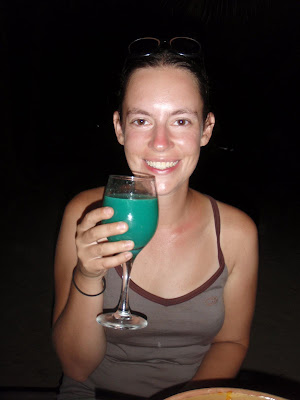
Also at the Green Turtle, Tara decided to try some of the Happy Hour cocktails. This one was called a Black Star, which is also the symbol of Ghana, so I guess they consider this the signature cocktail of Ghana. I don't know what was in it, but Tara liked it, and it must not have been all that strong since she was able to walk the 100 feet to our room after.
Tara had a different cocktail the second night. This one had one part alcohol and four parts well-blended smurf.
After a long absence from our lives since South America, we were happy to make it back to somewhere with street pineapple. We were able to buy a pre-sliced half-pineapple for maybe 25 cents. It was really, really good. It made us happy just before going to learn about how many million Africans died in the slave trade.
Porridge on the street is popular in Ghana and down through Benin. It differs quite a bit from person to person, though. We had some (no picture) in Accra that was made of corn and had lots of sugar and evaporated milk added. It was a fairly standard porridge in the Western sense of the word. This one is millet, but is more of a drink and had no lumps. It actually remided us of the quinoa drinks in South America, but somehow wasn't as good.
This is red snapper with cassava (yam) and palaver sauce. Palaver sauce is some leaves with palm oil and spicy sauce. Quite good, unlike the fish. Tara, however, did an admirable job of eating the fish until I started to crack its skull open so that she could eat the brains...
One of the best places that we went in Accra was to a local chop bar where you could get some rice balls (baseball-sized globs of compressed rice), groundnut stew (peanuts with oil and spices), and a piece of chicken for less than a dollar. We liked it so much the first night that we went back for a second night.In Northern Ghana, we met a Canadian named Tim who was volunteering in Accra, so we had dinner and some drinks with him in Accra. We really appreciated him showing us around and to the chop bar where we got the great food pictured above.
This one is called red-red. Part of the red might be because of the spicy bean concoction, which you might call Ghanian baked beans (though I like them much better). I don't know what the other red is for, since the other half of the dish is plantains and even when fried in palm oil they aren't really red.A staple dish from street vendors in West Africa is rice and pasta with a sauce of some type. In Ghana, most of the vendors actually use a mix of rice and beans rather than just rice. We ate this for breakfast almost every morning in Accra (you can find almost the same for lunch and dinner) and it costs about 30 cents for a big bowl of it. The concept of breakfast food being different than any other meal doesn't really exist in West Africa.
In the main market of Accra, we found a woman selling fried things that we had never before seen. Shocked that anyone might have a fried object that we had not yet tried, we asked her what it was. At this point, another woman comes running over, shoves the first woman aside, and insists that we buy from her. Ignoring this woman, we asked the original woman and she explains that it has cornmeal and ginger and spices. By this time, the intruder has her friends coming up to us telling us that hers are much better than the woman to whom we are speaking. We bought some from the woman with whom we started and they were really excellent. Sweet, gingery, and fried. Sadly, we never saw them again, so they aren't a common food if you are in Ghana.
At one of the Western-style supermarkets in Accra, Tara found this green apple flavored yogurt. Now, as far as I know, green apple is a made up flavor that can only taste like a Jolly Rancher. Apparently, Tara didn't know this and thought it might have some incredible, authentic apple taste despite the neon green color. She was disappointed to discover that it did not taste like a real apple.
We kept walking by baskets of these nut-looking things, so I stopped and asked a lady selling them what they were. She said some name that I didn't understand and offered me one. She then laughed as I asked how to eat it. But, after learning that you just crack it open and eat it, being careful to spit out the seed, I discovered that these little "fruits" taste a lot like the baobab fruit. We bought a bag of them. Still don't know what they are called.
Plantains in Ghana are often sold just grilled. Plantains aren't as sweet as bananas, so I need them fried to bring out some sweetness. Tara, however, likes many things with less sugar than me, so it is not surprising that she really liked grilled plantains. She also likes the recycling since most of them come wrapped in someone's homework assignment or old newspaper.

Wow, that was a lot of food. When I started this post, I had no idea that we ate that much in Ghana. To summarize, food in Ghana is really cheap. If you can find it without fish, it is also really good.

Wednesday, May 5, 2010

Malls, castles, and sand: Southern Ghana

Howdy, readers. I am back with your report from southern Ghana, where we spent our second week in the country. While not exactly as first-world as some folks may have led us to believe, it certainly did have better roads, a more stable electricity supply, and a heck of a lot more chain restaurants than the northern reaches of the country.

We begin in Accra, the country's capital. It's on the Atlantic coast, but definitely not a beach town--we barely saw the water in the four days we were there. Well, unless you count open sewers, which we saw plenty of. Oh, and one day, three men bathing in one. I mean, Accra is darn hot and humid, but I will never be able to fathom what would possess an adult to voluntarily jump down into a river of sewage.

Anyway, as usual, it seems that most of our Accra pictures are of street food, which is copious, cheap, and delicious, but makes for a boring nonfood post. Here are the few nonfood pics I have from our four days in the city (which were mostly spent sweating and procuring visas for onward travel to Benin and Nigeria).

Here's the gateway at Independence/Black Star square. The square itself was built for 30,000 people, but has never had such big crowds. It also houses the "Eternal Light of African Liberation," which has sadly been allowed to go out, we assume due to rising fuel costs. (What does this say about African liberation??)


Down the street from the square is this huge poster that looks like Obama has been photoshopped in as the President of Ghana's running mate. Turns out the partnership is not just BS, though--Obama did visit Ghana last year, the first African country he visited in his presidency, and Ghanaians are damn proud of this fact.
Here's another fun sign, improbably found in the posh Osu district of Accra. Basically, Auntie Aggie will provide any service you need done with sharp objects.
Here is my favorite sign from all of Ghana. This one was right near our hotel. Words fail me.

Aha, the much-vaunted Accra Mall! As the only mall in West Africa*, people who live here (Africans and volunteers alike) are pretty impressed with this place, but...dare I say we were not? You could probably fit the whole thing into one super Walmart in the US. It has the only multiplex in West Africa*, which charges the crazy price of $12 US for a movie. The biggest draw for me and Andy was the AC, the two supermarkets, and the 10 minutes of free Internet the Vodafone shop inside gives you each day (yes, we did go back multiple times, because it was kind of near the embassies that made us wait all day for visas).

Here is Accra's Mormon Temple. So much nicer than most of the surrounding buildings that it got us thinking about converting to Mormonism.
Another of our favorite signs, this one from the town of Cape Coast, about two hours west of Accra. A good example of how Ghanaians will Jesusify anything. Ghanaians are very religious, and Jesusy signs are found everywhere. A corner shop would be called "In Jesus' Name Corner Store" or something.
Cape Coast's main attraction is its castle, actually a fortress in which countless slaves were held for months before they were shipped to the Americas. Here are me and Andy by a cannon, probably looking happier than we should to be at such a sad place.
We took a very informative tour of the dungeons where unbelieveable numbers of slaves were packed in for three months with hardly any light, knee-deep in their own vomit and waste. It was really eye-opening--you learn a lot about the middle passage and slaves' lives in America, but their conditions in Africa before shipment were never really on my radar. Here is one of the cellar rooms.
Our final destination in Ghana was the Green Turtle Lodge another hour west in the tiny village of Akwidaa. Andy and I aren't really beach people, but this place was awesomely relaxing and really cheap considering it's basically paradise. If you ever go there, book ahead, expect to meet loads of Peace Corps Volunteers on break from their villages, and spring for one of the self-contained cabins with bathroom--much nicer than the non-electrified, pee-off-your-porch-in-the-middle-of-the-night-because-the-shared-toilets-are-too-far-away one we got stuck with our second night because, of course, we had no reservations.

Anyway, here's the beach.
And me on it. Note the Mauritanian headscarf nicely converted into beach skirt.

On to Togo next!


*OK, I have since learned that Accra does not have the only mall and multiplex in West Africa--Lagos, Nigeria, has them, too. (We are currently staying walking distance from a mall in Lagos that has cheaper movies and stronger AC than the one in Accra, but no free Internet...)

Wednesday, April 28, 2010

Down the dirt road: Northern Ghana

Pop quiz: What country has towns called Mole and Tamale, and big vats of rice and beans for sale on every corner? No, it's not Mexico...it's Ghana! (Which is nothing like Mexico otherwise, as far as I can tell.)

Ghana was something like a promised land for me and Andy. We tried to resist building it up in our minds too much before we got there, but since our book and everyone we talked to who had been there couldn't shut up about the air-conditioned buses and glittery Accra Mall and English-speaking population, we had sort of high expectations. Too high.

I will admit that we were warned that northern Ghana was like a different country from southern Ghana, and that certainly is true. We entered in the north, and it definitely had just as many malnourished children, awful dirt roads, and uncomfortable packed bush taxis as any other country we've been to in West Africa. But it also had its good bits. Here are some snapshots from our time in the north and central parts of the country.

We entered Ghana from Burkina Faso at Hamile, a remote border crossing in the northwest of the country. We crossed there because it was the nearest point to the even more remote Wechiau Hippo Sanctuary, which we were excited to visit. The hippos turned out to be cool, but after a full day of travel to get there (and then another long day to get away), we only got to spend about 30 minutes observing them in the protected part of the Black Volta river where they live. Also, our "ecotourism guide" was a 17-year old girl from the village who didn't really know anything about hippos. So, overall, we decided it wasn't really worth all the effort of getting there, but here are a few shots of our new hippo friends.

Stealth hippos.
Ferocious hippo roar. Or yawn. You decide.
Our next destination was Mole National Park, which is definitely the wildlife-watching highlight of Ghana. We had an excellent guide on our three-hour walking safari, and saw all sorts of cool creatures. (Too bad it's down an abysmal dirt road and the motel in the park is usuriously priced...still worth the visit, though.)

The park has three types of antelope. We forget the name of this one, but it's the most common.
While we were watching some warthogs from afar, a troupe of mongeese dashed across the path! We named the one in this picture Rikitikitavi (sp?), of course. Special note: I think I took this picture.
Warthog faceoff! Our guide told us that these ones are brothers, and sometimes brother warthogs will live together once the king warthog forces them out (all males except the dominant male get forced out, but most of these then live solitarily).
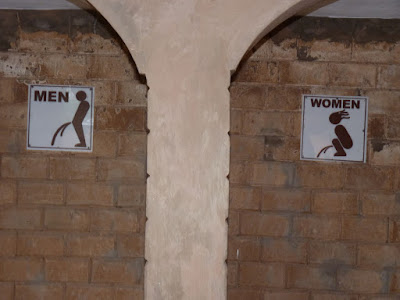
Brief break from the animals to show you the bathroom signs in the park. I would like to learn how to pee like this woman.
This is an African pintail butterfly. If you knew how long Andy has been trying to get a picture of one of these, you'd feel very happy for him right now.
I took this picture, too! It is a termite on a termite mound. The mounds are huge and everywhere in West Africa. They look like castles.
Monkey rides bigger monkey! The red butt identifies these specimens as baboons, which my cousin Merrie reminds me are monkeys, not apes. Pretty big monkeys, though. They are all over Mole and aren't scared of humans at all.
I call this one the baboon madonna and child.

But the highlight of our visit to Mole was undeniably the elephants we were lucky enough to come across. Andy didn't get to ride one, but we got quite close to them in a big open field space at the end of our walk. They had just had a swim, it seems, but didn't manage to wash up their upper third or so.
Here's one we saw at the nearby watering hole shortly after. We learned that an elephant can't just put its mouth in the water and drink, it has to suck it up into its trunk and then squirt into its mouth. Ever since learning that, I have also refused to drink water unless it's been up my nose first.

After Mole, we continued down the worst road in Ghana to Tamale, the largest and most Muslim city in the north, where we spent one night. I don't think we have any pictures from there--there's not too much to see--but we did make a bunch of new friends at our hostel, including Tim the Canadian volunteer and Lily the British med student doing an internship at a local hospital. We also met up with Corey, a Peace Corps volunteer we had met in Mali who invited us to get in touch when we reached Tamale. Ghana is absolutely crawling with volunteers and we probably made more friends traveling there than any other country.

Anyway, we all went out for a great meal and then some drinks at a bar that was also having an amazingly energetic African dance performance. You should have seen the muscles on these shirtless male dancers...oh, and the women were good, too.

From Tamale, we continued south to Kumasi, Ghana's second-largest city. Not the most exciting place in the world, but it's known for having the biggest market in West Africa, which dominates the city center and spills out into all the surrounding streets. It's a crazy place, but we managed to buy some good fresh groundnut paste (a.k.a. peanut butter) there. Here's a view of just some of the covered stalls from above.

Andy loved the shoe vendors, mostly because they appeared to often be selling single shoes, not pairs. I surmised that they must have the second shoe hidden somewhere, like as an anti-theft precaution, but Andy disagrees. Your thoughts? Anyway, here is a typical pavement shoe display.
We took a break from the market to visit the museum in the quiet grounds of the city's cultural center. It had a lot of interesting artefacts of the Ashanti, the major ethnic group in southern Ghana. In the heyday of the "Gold Coast," they used brass weights to measure out gold dust, but each different weight was molded into a beautifully intricate little figurine of an animal or person or other symbol. Each symbol was a different weight.

But the most fun thing about this museum is probably how many receipts they gave us. Here and at Mole National Park, receipts only come in the denomination of 1 cedi (about 75 cents) and they insist on giving you one receipt for every cedi you spent on admission. Here I am displaying our stash of receipts from Mole--20 of them, since admission was 10 cedi each. Funerals are a really big deal in Ghana, and people will advertise them by posting flyers around town. They always have a picture, the name and age of the deceased, and a long list of "principal mourners" and the many services and celebrations that are planned on behalf of the person who died. And everyone is invited.
We have read that funerals often cost more than weddings and put a huge financial burden on poor families. We also heard that if you are wealthy, you may hire a "professional wailer" to wail for the duration of the funeral so that you can be free to go enjoy the food and the music.

Wailing is apparently a very important part of the funeral--we learned this firsthand when we were in the tro-tro (crowded, falling-apart minibus) out to the hippo sanctuary and as we pulled into a village, one of the women on the bus suddenly burst out wailing and scared the heck out of us. The car stopped, and we frantically asked the driver what was wrong, thinking we must have hit someone, probably this woman's child. He told us not to worry, that she was going to a funeral and they'd just reached the village, so she had to start wailing. It was like we had crossed a certain geographical border, so the mourning sounds got switched on.

Kumasi had a lot of good signs, but my favorite was this billboard. If you've ever seen women (often with babies on their backs) pounding yams for hours to make them into gooey fufu paste, then you might understand the appeal a stress-free, instant fufu mix...
So, that's all for the parts of Ghana most vacationers don't go to. We'll check back in soon with pictures from the capital (Accra) and the fantastic beachfront eco-lodge where we (and about a zillion Peace Corps volunteers) chilled out for a few days.