

If you check out the labels, or tags, on this blog, you will see that Andy has written 52 entries so far and I have only done 45. Maybe that’s because he writes all the obsessions and finance posts. Well, no more—it’s my turn to tell you with what things the countries we visited on the last leg of our trip were obsessed!
Countries Visited
Showing posts with label peru. Show all posts
Showing posts with label peru. Show all posts
Thursday, January 14, 2010
Obsessed: Central America (and the rest of South America)!


Sunday, November 8, 2009
Financial Updates
We've been delinquent in posting Financial Updates, but here we go.
Uruguay: $110/day. Tough to call this a good average since we were only there for two days. In general, though, there isn't much to do in Uruguay. Food is more expensive than many South American countries, and you have to look around to find good deals on lodging, but there aren't a lot of tours or other expenses even if you were looking to spend money. A lot of hotels seemed to have raised prices dramatically, but we ended up finding a very nice room for less than $30/night in Montevideo.
Argentina: $115/day. Transport in Argentina is a good deal cheaper than Brazil, which helped to keep costs down. Lodging continued to average $20-30 per day. Food is a bit more expensive, but still cheaper than the US. We took a few different tours in Argentina, which were reasonable, but not super cheap.
Chile: $108/day. This one actually surprised us. It seemed more expensive while we were actually there, especially considering that we took the somewhat pricey boat for three days from southern Chile to slightly less southern Chile. Transport was much cheaper in Chile, though. And we didn't eat out much. Overall, a really good value.
Bolivia: $63/day. This is not including the cost of being robbed, which would have added close to $1000 (about $50/day) to the cost of the country. It does include the $270 for visas, though, so it would have only been about $45/day without the visas. It is by far the cheapest country in South America. Tours and lodging are both very cheap and transport is fairly cheap as well.
Peru: $87/day. Peru ranks high on the value scale. It is cheap, but you can normally find decent quality buses, hotels, and tours. We took some really nice buses for just a few dollars more than the poor local buses. Machu Picchu is expensive (and worth it), but the rest of the country is cheap.
Uruguay: $110/day. Tough to call this a good average since we were only there for two days. In general, though, there isn't much to do in Uruguay. Food is more expensive than many South American countries, and you have to look around to find good deals on lodging, but there aren't a lot of tours or other expenses even if you were looking to spend money. A lot of hotels seemed to have raised prices dramatically, but we ended up finding a very nice room for less than $30/night in Montevideo.
Argentina: $115/day. Transport in Argentina is a good deal cheaper than Brazil, which helped to keep costs down. Lodging continued to average $20-30 per day. Food is a bit more expensive, but still cheaper than the US. We took a few different tours in Argentina, which were reasonable, but not super cheap.
Chile: $108/day. This one actually surprised us. It seemed more expensive while we were actually there, especially considering that we took the somewhat pricey boat for three days from southern Chile to slightly less southern Chile. Transport was much cheaper in Chile, though. And we didn't eat out much. Overall, a really good value.
Bolivia: $63/day. This is not including the cost of being robbed, which would have added close to $1000 (about $50/day) to the cost of the country. It does include the $270 for visas, though, so it would have only been about $45/day without the visas. It is by far the cheapest country in South America. Tours and lodging are both very cheap and transport is fairly cheap as well.
Peru: $87/day. Peru ranks high on the value scale. It is cheap, but you can normally find decent quality buses, hotels, and tours. We took some really nice buses for just a few dollars more than the poor local buses. Machu Picchu is expensive (and worth it), but the rest of the country is cheap.
Saturday, November 7, 2009
Would you like alpaca with that? Foods of Peru.
Yes, we ate alpaca in Peru, though we don't have any pictures of it. It is tastier than llama and not quite as tough. We also ate something else that I know at least one of our readers won't be happy about (Diane, you may want to skip the very last picture in this entry).
But Peru was also a great country for vegetarian eating (as was Bolivia). There were plenty of vegetarian restaurants in the major cities, and plenty of corn, potatoes, quinoa, and churros in most places. Read on for a taste of Peru!
At the bus station on our very first day in Peru, Andy got this pastry. It's a cone filled with dulce de leche and coconut, making it pretty much Andy's ideal food.

The buses in Peru weren't the most luxurious, but one thing I liked is that at every stop, people would come on selling cheap, tasty, homemade treats. I bought a lot on our first day, such as this humita, which is like a sweet mini tamale, or cornmeal cake steamed in a corn husk (biodegradeable packaging!).

Also got these flatbread sandwich things that were stuck together with some sort of sweet goo. Not as good, but when it comes to bus snacks, you win some and you lose some.

In Arequipa, the bread often has a face in it. We thought the face might be some kind of edible candy, but when Andy bit into it, it turned out to be porcelain. I later asked at a marketplace "Por que hay cabezas en el pan?" ("Why are there heads in the bread?") and was told it had to do with a local holiday.

The national dish of Peru is lomo saltado, a stir-fry of beef, onions, tomatoes, and French fries, served with rice. We had many versions of this, including with beef and with alpaca, but my favorite was the vegan one we got at a vegetarian restaurant in Cuzco, featuring fake meat made out of gluten.

Peru's version of meat-on-a-stick comes with an excellent addition--a potato! Sometimes when I was feeling particularly vegetarian, Andy would eat the meat and I would eat the potato.

During our Sacred Valley tour, we stopped at a traditional bakery. Sabrina got a tasty baked empanada...

...and Andy bargained with the lady outside for this corn. Another popular street food in Peru is "choclo con queso," or corn on the cob with cheese. Andy didn't want the cheese, so he felt he should pay less for his corn. Finally, the lady gave in, but made him promise not to tell anyone about the special deal.

That same day, we found these tasty giant bananas with red skins at a convenience store. Stupidly, I thought they would be red inside, too, and was disappointed...but according to Andy and Sabrina, if I knew anything about how plants work, I would never have suspected this. Ah well, they were still tasty.

It was raining later that day, and Andy, Sabs, and I retired to a cafe where Andy ordered the purple corn desert. It turned out to be a dish of warm, sweet, purple liquid...a little strange, but not bad.

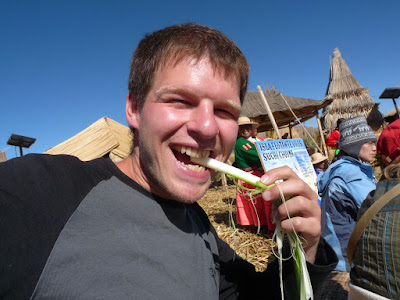
Remember Andy's post about the Uros floating islands in Lake Titicaca, where everything is made out of reeds? Well, they eat them, too. And so did we. Consistency is kind of like celery, but without the nasty celery taste.
One of our favorite drinks in Peru and Bolivia was jugo de quinoa, or quinoa juice. It is basically a thick apple cider-like drink with quinoa floating in it. It was actually even better, and cheaper, in Bolivia than in Peru, but we tried it first in Peru, where it usually cost about 80 centavos to 1 sol, or 25 to 35 cents, a glass.

Plenty of other drinks to be had on the street, too. Here I am at the border, returning from Bolivia, with a papaya drink that a lady blended up right in front of me.

Mmm, papas rellenas--potato balls stuffed with onions and meat and fried, our favorite street food in Arequipa. 80 centavos (25 cents) just outside the main market.

Inside the market, we saw several stalls selling frog juice. Yup, that's right. They throw a couple of live frogs in a blender with some water and sweeten to taste. Apparently it's supposed to make you smarter, but Andy and I prefered to remain stupid in this case.

Also from the Arequipa market, lucuma chip ice cream. You may remember lucuma from our Chile foods post--it's a squash that tastes like butterscotch, and is also popular in Peru. I also had lucuma yogurt in Peru, very nice.

The folks who sold papas rellenas in front of the market also sold these empanada-like stuffed savory pastries, filled with potatoes, meat, onions, and spices. Andy put way too much hot sauce on this one and almost asphyxiated when he ate it.
Churros! There were none in Bolivia, but we found them again in Arequipa and Lima. This is just a little bag of plain ones, not filled, but still sugar-coated and tasty.

We ate dinner in Arequipa in a little local hole in the wall that served us giant plates of stir-fried food from their wok for $1.50 each. I got lomo saltadao and Andy got this plate of tallarines (noodles with veggies and beef) and we shared.

My favorite street breakfast in Peru: a vegetable sandwich and a mug of quinoa juice. Here I have a sandwich with a strip of sweet potato in it; also delicious was the avocado sandwich. About 50 cents US, and vegan!

Decidedly not vegan: chicharones, which basically translates to fried stuff. This bag has a chunk of fried pork in it and some fried giant corn kernels.

Andy enjoyed some sandwiches too, like this beef one he bought on the bus from Nazca to Lima.

Lima turned out to be the churro capital of South America--there was a street right near our hostel (which I dubbed Churro Alley) where you could find three types of churros for sale at the same time from each vendor! You had your choice of a baggie of plain churros, a large dulce de leche-filled churro, or one of these special, giant, apple-filled churros, which are apparently called "churros of the Virgin del Carmen."
Now, I don't know a whole lot about Catholic saints, but if I had to pick a favorite, I would definitely pick the one that has her own churro!

Lima, while not always the most appealing city in other respects, also turned out to have amazing street food. There is an area beside the river in central Lima called Alameda Chabuca Granda where you can find stalls selling food from all parts of the country--it also has a kind of carnival atmosphere and was a great place to walk around at night.
Our very favorite thing that we found there was rice pudding. We always got a mixture of the white and brown pudddings (we think the brown had more spices and/or brown sugar in it) with some raisins, shredded coconut, and condensed milk drizzled on top. It was about $1 for a pint, which we would polish off between us in about 60 seconds.
Less exciting was this cold, gloopy pudding we tried. I made Andy eat most of it.

Picarones are rings of fried dough served in a sugary syrup. They looked too much like donuts for Andy to pass up.
One stall was selling two types of tamales--one kind (tamales verdes, the green one) popular in the north of Peru, and one (tamales criollos) from the south. We may have that backwards. In any case, they were stuffed with different things, and it was fun to taste and compare.

Ergh, we sort of struck out with this one. We thought it was a plate of mixed grilled meats, but actually turned out to be mostly intestines. Andy downed a bit of it, but we just didn't have the stomach to eat...well, stomach.

Much less scary was this cinnamon roll we shared the next day at the fancy mall of Larcomar, which is built into the cliffside in the posh Lima suburb of Miraflores. If you are shocked that Andy would share a cinnamon roll with anyone, please note that it is covered with cream cheese icing--he let me take care of the cheesy surfaces.

On our final night in Lima, Andy and I decided that we had to be brave and try the local dishes that had been consistently recommended to us by Peruvians.
So to that end, we went to a restaurant and I ordered an appetizer of ceviche, which is raw seafood marinated in something acidic that sort of "cooks" it. I don't really like seafood much, so I was hoping for a very small portion. I ended up with this mountain of shellfish:
Oops! I ate as much as I could, but that wasn't very much. I really didn't like it. Luckily, the restaurant had lured us in with the promise of a free pisco sour for each of us, and since Andy doesn't drink, they both went to me! This helped wash the icky seafood taste out of my mouth.

PS, pisco sours in Peru are different from those in Chile. In Peru, they are made with lime juice and egg whites (hence the foaminess) and are, in my experience, way less strong than the lemony Chilean ones.
Anyway, Andy got this fun stuffed pepper appetizer, not too adventurous.

But then, for his main course...
(look away now, Diane!)
Guinea pig! Actually, just 1/4 guinea pig (or "cuy" as it is called in Peru), which isn't much pig at all, but that's what all the restaurants serve. Andy said that what little meat there was to eat was OK, but that the skin was really thick and tough and unappetizing. We later mentioned this to a Peruvian tour guide in Huaraz, and he laughed and told us that we had got "an old one."

Note: For a much, much more fun/horrifying picture of cuy, please check out our friends Ben and Megan's blog post Lake Titicaca (hee hee!) ; it's the fifth picture down!
Well, that's it for foods of Peru. We didn't love those two national specialties, but we did love pretty much everything else we ate and drank on the streets and in restaurants. Eating out in both Peru and Bolivia was cheap, and it continues to be so in Ecuador, so we haven't actually cooked a meal since Chile...probably not so great for our health, but not hurting our wallets too much.
But Peru was also a great country for vegetarian eating (as was Bolivia). There were plenty of vegetarian restaurants in the major cities, and plenty of corn, potatoes, quinoa, and churros in most places. Read on for a taste of Peru!
At the bus station on our very first day in Peru, Andy got this pastry. It's a cone filled with dulce de leche and coconut, making it pretty much Andy's ideal food.
The buses in Peru weren't the most luxurious, but one thing I liked is that at every stop, people would come on selling cheap, tasty, homemade treats. I bought a lot on our first day, such as this humita, which is like a sweet mini tamale, or cornmeal cake steamed in a corn husk (biodegradeable packaging!).
Also got these flatbread sandwich things that were stuck together with some sort of sweet goo. Not as good, but when it comes to bus snacks, you win some and you lose some.
In Arequipa, the bread often has a face in it. We thought the face might be some kind of edible candy, but when Andy bit into it, it turned out to be porcelain. I later asked at a marketplace "Por que hay cabezas en el pan?" ("Why are there heads in the bread?") and was told it had to do with a local holiday.
The national dish of Peru is lomo saltado, a stir-fry of beef, onions, tomatoes, and French fries, served with rice. We had many versions of this, including with beef and with alpaca, but my favorite was the vegan one we got at a vegetarian restaurant in Cuzco, featuring fake meat made out of gluten.
Peru's version of meat-on-a-stick comes with an excellent addition--a potato! Sometimes when I was feeling particularly vegetarian, Andy would eat the meat and I would eat the potato.
During our Sacred Valley tour, we stopped at a traditional bakery. Sabrina got a tasty baked empanada...
...and Andy bargained with the lady outside for this corn. Another popular street food in Peru is "choclo con queso," or corn on the cob with cheese. Andy didn't want the cheese, so he felt he should pay less for his corn. Finally, the lady gave in, but made him promise not to tell anyone about the special deal.
That same day, we found these tasty giant bananas with red skins at a convenience store. Stupidly, I thought they would be red inside, too, and was disappointed...but according to Andy and Sabrina, if I knew anything about how plants work, I would never have suspected this. Ah well, they were still tasty.
It was raining later that day, and Andy, Sabs, and I retired to a cafe where Andy ordered the purple corn desert. It turned out to be a dish of warm, sweet, purple liquid...a little strange, but not bad.
Remember Andy's post about the Uros floating islands in Lake Titicaca, where everything is made out of reeds? Well, they eat them, too. And so did we. Consistency is kind of like celery, but without the nasty celery taste.
One of our favorite drinks in Peru and Bolivia was jugo de quinoa, or quinoa juice. It is basically a thick apple cider-like drink with quinoa floating in it. It was actually even better, and cheaper, in Bolivia than in Peru, but we tried it first in Peru, where it usually cost about 80 centavos to 1 sol, or 25 to 35 cents, a glass.
Plenty of other drinks to be had on the street, too. Here I am at the border, returning from Bolivia, with a papaya drink that a lady blended up right in front of me.
Mmm, papas rellenas--potato balls stuffed with onions and meat and fried, our favorite street food in Arequipa. 80 centavos (25 cents) just outside the main market.
Inside the market, we saw several stalls selling frog juice. Yup, that's right. They throw a couple of live frogs in a blender with some water and sweeten to taste. Apparently it's supposed to make you smarter, but Andy and I prefered to remain stupid in this case.
Also from the Arequipa market, lucuma chip ice cream. You may remember lucuma from our Chile foods post--it's a squash that tastes like butterscotch, and is also popular in Peru. I also had lucuma yogurt in Peru, very nice.
The folks who sold papas rellenas in front of the market also sold these empanada-like stuffed savory pastries, filled with potatoes, meat, onions, and spices. Andy put way too much hot sauce on this one and almost asphyxiated when he ate it.
Churros! There were none in Bolivia, but we found them again in Arequipa and Lima. This is just a little bag of plain ones, not filled, but still sugar-coated and tasty.
We ate dinner in Arequipa in a little local hole in the wall that served us giant plates of stir-fried food from their wok for $1.50 each. I got lomo saltadao and Andy got this plate of tallarines (noodles with veggies and beef) and we shared.
My favorite street breakfast in Peru: a vegetable sandwich and a mug of quinoa juice. Here I have a sandwich with a strip of sweet potato in it; also delicious was the avocado sandwich. About 50 cents US, and vegan!
Decidedly not vegan: chicharones, which basically translates to fried stuff. This bag has a chunk of fried pork in it and some fried giant corn kernels.
Andy enjoyed some sandwiches too, like this beef one he bought on the bus from Nazca to Lima.
Lima turned out to be the churro capital of South America--there was a street right near our hostel (which I dubbed Churro Alley) where you could find three types of churros for sale at the same time from each vendor! You had your choice of a baggie of plain churros, a large dulce de leche-filled churro, or one of these special, giant, apple-filled churros, which are apparently called "churros of the Virgin del Carmen."
Now, I don't know a whole lot about Catholic saints, but if I had to pick a favorite, I would definitely pick the one that has her own churro!
Lima, while not always the most appealing city in other respects, also turned out to have amazing street food. There is an area beside the river in central Lima called Alameda Chabuca Granda where you can find stalls selling food from all parts of the country--it also has a kind of carnival atmosphere and was a great place to walk around at night.
Our very favorite thing that we found there was rice pudding. We always got a mixture of the white and brown pudddings (we think the brown had more spices and/or brown sugar in it) with some raisins, shredded coconut, and condensed milk drizzled on top. It was about $1 for a pint, which we would polish off between us in about 60 seconds.
Less exciting was this cold, gloopy pudding we tried. I made Andy eat most of it.
Picarones are rings of fried dough served in a sugary syrup. They looked too much like donuts for Andy to pass up.
One stall was selling two types of tamales--one kind (tamales verdes, the green one) popular in the north of Peru, and one (tamales criollos) from the south. We may have that backwards. In any case, they were stuffed with different things, and it was fun to taste and compare.
Ergh, we sort of struck out with this one. We thought it was a plate of mixed grilled meats, but actually turned out to be mostly intestines. Andy downed a bit of it, but we just didn't have the stomach to eat...well, stomach.
Much less scary was this cinnamon roll we shared the next day at the fancy mall of Larcomar, which is built into the cliffside in the posh Lima suburb of Miraflores. If you are shocked that Andy would share a cinnamon roll with anyone, please note that it is covered with cream cheese icing--he let me take care of the cheesy surfaces.
On our final night in Lima, Andy and I decided that we had to be brave and try the local dishes that had been consistently recommended to us by Peruvians.
So to that end, we went to a restaurant and I ordered an appetizer of ceviche, which is raw seafood marinated in something acidic that sort of "cooks" it. I don't really like seafood much, so I was hoping for a very small portion. I ended up with this mountain of shellfish:
Oops! I ate as much as I could, but that wasn't very much. I really didn't like it. Luckily, the restaurant had lured us in with the promise of a free pisco sour for each of us, and since Andy doesn't drink, they both went to me! This helped wash the icky seafood taste out of my mouth.
PS, pisco sours in Peru are different from those in Chile. In Peru, they are made with lime juice and egg whites (hence the foaminess) and are, in my experience, way less strong than the lemony Chilean ones.
Anyway, Andy got this fun stuffed pepper appetizer, not too adventurous.
But then, for his main course...
(look away now, Diane!)
Guinea pig! Actually, just 1/4 guinea pig (or "cuy" as it is called in Peru), which isn't much pig at all, but that's what all the restaurants serve. Andy said that what little meat there was to eat was OK, but that the skin was really thick and tough and unappetizing. We later mentioned this to a Peruvian tour guide in Huaraz, and he laughed and told us that we had got "an old one."
Note: For a much, much more fun/horrifying picture of cuy, please check out our friends Ben and Megan's blog post Lake Titicaca (hee hee!) ; it's the fifth picture down!
Well, that's it for foods of Peru. We didn't love those two national specialties, but we did love pretty much everything else we ate and drank on the streets and in restaurants. Eating out in both Peru and Bolivia was cheap, and it continues to be so in Ecuador, so we haven't actually cooked a meal since Chile...probably not so great for our health, but not hurting our wallets too much.
Friday, November 6, 2009
Another cool ancient culture and birds
Our camera, which is supposed to be waterproof and unbreakable, somehow managed to break in my pocket. The screen no longer functions and it seems to have some other problems, which are hopefully all being repaired as I write this. It means we have a shortage of pictures, though, and some of them look like they were taken by a two year old. In any case, here is what we could manage.
This is the Temple of the Sun of the Moche people in Northern Peru (near Trujillo). It was built around 600AD and was apparently the biggest manmade structure in the Americas for a long time. Basically, these people mastered irrigation and fish farming, so life was easy. As a result, they spent all their free time building cool stuff or making good ceramics and jewellery. The excavation of this Temple and the nearby Temple of the Moon is completely privately funded, so it is officially sponsored by a beer company...
 Every hundred years or so, a new ruler would come along and decide to build a bigger, better pyramid. They would just fill in the old one with bricks and build on top of it. This means that many of the lower levels were really well preserved once they pulled all the bricks out.

In the Moche culture, you were taxed in bricks. Every family had to make and give a certain number of bricks to the government each year. Because they had no written language, each family would mark its bricks in some way. Some were boring and just used an X. Some had elaborate designs. We liked the smiley face.

This detailed fresco tells the story of the Moches and was on the outside of one of the pyramids. One of the more interesting parts is that they would sacrifice humans when El Nino screwed up the climate. However, unlike the Incas who would sacrifice children, the Moches would let prisoners volunteer to fight in teams of two. The winners got to go free and the losers were sacrificed to the gods. Seems much more reasonable.

Also in the above is the Peruvian Hairless dog (which actually has a bit of hair). They are still popular and considered to have some sort of mystical powers that allow them to heal people. Here is one healing whatever might ail Tara:

After this, we were off to Puerto Lopez in Ecuador. This turned out to be a rough trip. We made it into Ecuador and took a bus to Guayquil. Unknown to us, Ecuador had a four day holiday weekend and it was one of the biggest travel weekends of the year. When we got to Guayquil, it was the busiest bus station we had ever seen. Every line had a couple hundred people waiting to buy tickets. The line we wanted had even more. So, after waiting in line for about an hour and not moving an inch, we broke down and paid the exorbitant sum of $50 to a taxi to take us two hours away to a town where we could catch a local bus. The local bus had about 300 people crammed in, and Tara calls it the party bus due to the loud salsa music being played on it.
Once we made it to Puerto Lopez, it was wet and muddy. Here is the main street. The mud did not win Tara's heart, but the city was much nicer the next day after it had dried out.

Now you can really see the broken camera impact, which is too bad because the pictures would otherwise be nice. We visited Isla de la Plata, which is a small island off the coast where you can find blue footed boobies, red footed boobies, banded boobies, and other inappropriately named birds. Blue footed boobies are definitely one of the best birds anywhere, so it is a shame that they are hard to see in this photo.

Red footed boobies mostly stay in the trees. Here is one where you can just about see the red feet. They aren't as fun looking as blue footed, but still neat.
 After that, we were off to Quito. We'll try to put a few of those pictures in our next post.
This is the Temple of the Sun of the Moche people in Northern Peru (near Trujillo). It was built around 600AD and was apparently the biggest manmade structure in the Americas for a long time. Basically, these people mastered irrigation and fish farming, so life was easy. As a result, they spent all their free time building cool stuff or making good ceramics and jewellery. The excavation of this Temple and the nearby Temple of the Moon is completely privately funded, so it is officially sponsored by a beer company...
Every hundred years or so, a new ruler would come along and decide to build a bigger, better pyramid. They would just fill in the old one with bricks and build on top of it. This means that many of the lower levels were really well preserved once they pulled all the bricks out.In the Moche culture, you were taxed in bricks. Every family had to make and give a certain number of bricks to the government each year. Because they had no written language, each family would mark its bricks in some way. Some were boring and just used an X. Some had elaborate designs. We liked the smiley face.
This detailed fresco tells the story of the Moches and was on the outside of one of the pyramids. One of the more interesting parts is that they would sacrifice humans when El Nino screwed up the climate. However, unlike the Incas who would sacrifice children, the Moches would let prisoners volunteer to fight in teams of two. The winners got to go free and the losers were sacrificed to the gods. Seems much more reasonable.
Also in the above is the Peruvian Hairless dog (which actually has a bit of hair). They are still popular and considered to have some sort of mystical powers that allow them to heal people. Here is one healing whatever might ail Tara:
After this, we were off to Puerto Lopez in Ecuador. This turned out to be a rough trip. We made it into Ecuador and took a bus to Guayquil. Unknown to us, Ecuador had a four day holiday weekend and it was one of the biggest travel weekends of the year. When we got to Guayquil, it was the busiest bus station we had ever seen. Every line had a couple hundred people waiting to buy tickets. The line we wanted had even more. So, after waiting in line for about an hour and not moving an inch, we broke down and paid the exorbitant sum of $50 to a taxi to take us two hours away to a town where we could catch a local bus. The local bus had about 300 people crammed in, and Tara calls it the party bus due to the loud salsa music being played on it.
Once we made it to Puerto Lopez, it was wet and muddy. Here is the main street. The mud did not win Tara's heart, but the city was much nicer the next day after it had dried out.
Now you can really see the broken camera impact, which is too bad because the pictures would otherwise be nice. We visited Isla de la Plata, which is a small island off the coast where you can find blue footed boobies, red footed boobies, banded boobies, and other inappropriately named birds. Blue footed boobies are definitely one of the best birds anywhere, so it is a shame that they are hard to see in this photo.
Red footed boobies mostly stay in the trees. Here is one where you can just about see the red feet. They aren't as fun looking as blue footed, but still neat.
After that, we were off to Quito. We'll try to put a few of those pictures in our next post.Thursday, November 5, 2009
A tale of two hikes (and an ill-fated horseback ride)
OK, we are out of order a bit here, but before we went to Lima, our first stop after our triumphant return to Peru was Arequipa--Peru's "second city," and the gateway to Colca Canyon, which is deeper than the Grand Canyon and which is where we planned to do a 2-day hiking trip.
I insisted on a day of relaxation in Arequipa before heading to the canyon, and this was a very good decision. Here is a pic of Andy lounging in a city park. Andy is about as good at relaxing as I am at hiking, but he did his best.
So the next day, a bus picked us up at 3:30AM for the six-hour drive to the canyon. Our first stop was Cruz del Condor, where you are supposed to be able to watch enormous Andean condor birds rise up from their nests in the canyon for their morning flight. When we got there it was a little past peak time and we only saw three or four condors, plus the place was overrun with tourists.
This was kind of disappointing for me, because the whole reason I wanted to go to the canyon was to see condors. The hiking trip that was to follow was kind of an afterthought--we'd spent about 30 hours on buses in the previous three days, so I thought a little exercise was called for. Turns out we had signed up for nine hours of strenuous hiking--six hours down and across the floor of the canyon on day one, and a grueling three-hour climb out of the canyon on day two. Oops.
Here's a shot of the canyon. Beautiful surroundings if you have time to appreciate them...which I didn't, really, because I was struggling to keep up with our group.

If you know me, you know that I'm not a very fast hiker on the best of days. But making matters worse, we had been placed in a tour group with six French physical therapists, who apparently like to tear up and down mountains in their spare time, because even at a flat-out run downhill, I couldn´t keep up with them and our guide. They quickly left me and Andy (who surely could have kept up, but was a gentleman and kept me company) in the dust.
I found this frustrating and mildly humiliating, but Andy assured me that it was all in my head, and that no one would care if we were a few minutes behind. Well, no sooner did we catch up with the group at a resting spot, than the guide and one of the French hikers rushed over to me. "Are you OK?? What's the matter?" they asked in very concerned voices. I managed to mumble that I was just fine, but they kept up the solicitations. Thank goodness for Andy, who jumped in. "Nothing is wrong!" he told them, "We just hike a little slower than you do. If you could slow down the pace just a little, we'd appreciate it."
Then the guide knelt down next to me, like I was five years old. "It's hard, isn't it?" she said. "Hey, I like your hiking stick!" It was all I could do not to whack her with it. Luckily, Andy jumped in again and distracted me by challenging me to a twig sword-fight. My twig quickly cut his twig to pieces and I felt much better. How great is Andy?
So the Frenchies took off at breakneck speed again that afternoon, and I did better at keeping up once we switched from straight downhill to more undulating territory. I even managed to pause here and there to enjoy the cool scenery. For instance, these neat striated rock formations...


...cacti in bloom...

...and the light and shadow on the canyon-sides.

Also, at our lodging that night on the canyon floor, there was a swimming pool. Andy suggested we both dunk and take an underwater self-portrait together, which resulted in my new favorite picture from our trip so far. So flattering!

Also of note was that, when the couple who had the cabin next to ours opened their door for the first time, out ran a pig. Apparently he really likes that bedroom, and tried to sneak back in again while they were at dinner. They had to bar the door to keep him out at night!
So, the next day we were up at 5:30 for three hours of climbing to get out of the canyon. Ugh. I'll just say that my energy failed about halfway up and it was ugly. Ignore the smile on my face here at the end of the ascent--I'm delerious.

The last stop on the tour was some thermal baths, and boy did they feel good. We then rode the bus back to Arequipa, and were treated to a showing of the movie "Twilight" (I think I liked it better than the book--yes, I admit I've read the book)...and an incredible sunset.

Three days later, after our trip to Nazca and Lima, we were in Huaraz, a town in the Andes and the "trekking capital" of Peru. Yes, more hiking, I'm a masochist.
But rather than starting off with a hike, we decided we would do a horseback trip instead. You know, take it easy. Unfortunately, the horses had other ideas.
Here is the only shot we got of either one of us on a horse.

About five minutes after we took this picture, some fireworks went off (yes, in the middle of the day--the town where we got the horses was having a festival), our guide's horse bolted, and Andy's and my horses followed. I pulled on the reins for dear life, and I believe I screamed a lot, too.
So we dismounted and walked the horses through the town. 10 minutes after that, we ran into a construction site along the horse trail and had to dismount and do a complicated detour. When the guide told us we could get back on, he came over to help me first. We heard a noise behind us, and turned around to see Andy hanging upside down off the side of his horse! He had apparently tried to mount on his own and overshot, ending up in a handstand on the other side of the animal. I WISH we had a picture of this. Everyone was fine, so the guide helped him mount properly and we continued on.
Then at lunchtime it started to pour, so, no more riding for us. We squeezed into a very crowded collectivo van with our guide and went back to Huaraz. A dissapointing outing all around.
The next day, we did a day hike to Laguna Churup. We were told that it wouldn't be too hard, that we'd only ascend 500 meters, and that our guide would speak English. These turned out to be all lies.
Still, it was a beautiful hike, and this time we had the leisure to enjoy the beautiful views of the surrounding mountains and countryside.

Our guide was really nice, and we practiced a lot of Spanish on him. He was always offering to take photos of us at scenic points, like this one.

So, after four hours of mostly uphill hiking, including an unexpected bonus section of slippery rock-climbing, which saw Andy wipe out and me be hauled up by my arms by our guide, we finally reached the lovely elevated lake with the spectacular snow-capped Churup mountain behind it.

Yes!

The hike down was even more treacherous, because it started to rain, and we had to go down the steep, muddy sections on our butts. We felt appropriately filthy and exhausted by the time we got back to the little town at the base.
Also filthy, but cute: These two little pigs eating garbage in someone´s yard in the town.

That night back in Huaraz, we embraced the piggy spirit by downing a "broaster platter por dos": Six pieces of fried chicken, a monstrous plate of fries, a pitcher of limeade, and two salads (you know, for health). The one thing I like about strenuous hiking is that I can eat absolutely anything I want after and not feel guilty about it!
That wraps up our tales of hikes in Peru. Andy promised me that we would have no more hiking for at least a month after Huaraz, but of course we have already been on a four-hour rainforest hike in Ecuador since he said that. I plan to exact my revenge in Colombia and subject him to many hours of salsa dancing lessons. Stay tuned!
I insisted on a day of relaxation in Arequipa before heading to the canyon, and this was a very good decision. Here is a pic of Andy lounging in a city park. Andy is about as good at relaxing as I am at hiking, but he did his best.
So the next day, a bus picked us up at 3:30AM for the six-hour drive to the canyon. Our first stop was Cruz del Condor, where you are supposed to be able to watch enormous Andean condor birds rise up from their nests in the canyon for their morning flight. When we got there it was a little past peak time and we only saw three or four condors, plus the place was overrun with tourists.
This was kind of disappointing for me, because the whole reason I wanted to go to the canyon was to see condors. The hiking trip that was to follow was kind of an afterthought--we'd spent about 30 hours on buses in the previous three days, so I thought a little exercise was called for. Turns out we had signed up for nine hours of strenuous hiking--six hours down and across the floor of the canyon on day one, and a grueling three-hour climb out of the canyon on day two. Oops.
Here's a shot of the canyon. Beautiful surroundings if you have time to appreciate them...which I didn't, really, because I was struggling to keep up with our group.
If you know me, you know that I'm not a very fast hiker on the best of days. But making matters worse, we had been placed in a tour group with six French physical therapists, who apparently like to tear up and down mountains in their spare time, because even at a flat-out run downhill, I couldn´t keep up with them and our guide. They quickly left me and Andy (who surely could have kept up, but was a gentleman and kept me company) in the dust.
I found this frustrating and mildly humiliating, but Andy assured me that it was all in my head, and that no one would care if we were a few minutes behind. Well, no sooner did we catch up with the group at a resting spot, than the guide and one of the French hikers rushed over to me. "Are you OK?? What's the matter?" they asked in very concerned voices. I managed to mumble that I was just fine, but they kept up the solicitations. Thank goodness for Andy, who jumped in. "Nothing is wrong!" he told them, "We just hike a little slower than you do. If you could slow down the pace just a little, we'd appreciate it."
Then the guide knelt down next to me, like I was five years old. "It's hard, isn't it?" she said. "Hey, I like your hiking stick!" It was all I could do not to whack her with it. Luckily, Andy jumped in again and distracted me by challenging me to a twig sword-fight. My twig quickly cut his twig to pieces and I felt much better. How great is Andy?
So the Frenchies took off at breakneck speed again that afternoon, and I did better at keeping up once we switched from straight downhill to more undulating territory. I even managed to pause here and there to enjoy the cool scenery. For instance, these neat striated rock formations...
...cacti in bloom...
...and the light and shadow on the canyon-sides.
Also, at our lodging that night on the canyon floor, there was a swimming pool. Andy suggested we both dunk and take an underwater self-portrait together, which resulted in my new favorite picture from our trip so far. So flattering!
Also of note was that, when the couple who had the cabin next to ours opened their door for the first time, out ran a pig. Apparently he really likes that bedroom, and tried to sneak back in again while they were at dinner. They had to bar the door to keep him out at night!
So, the next day we were up at 5:30 for three hours of climbing to get out of the canyon. Ugh. I'll just say that my energy failed about halfway up and it was ugly. Ignore the smile on my face here at the end of the ascent--I'm delerious.
The last stop on the tour was some thermal baths, and boy did they feel good. We then rode the bus back to Arequipa, and were treated to a showing of the movie "Twilight" (I think I liked it better than the book--yes, I admit I've read the book)...and an incredible sunset.
Three days later, after our trip to Nazca and Lima, we were in Huaraz, a town in the Andes and the "trekking capital" of Peru. Yes, more hiking, I'm a masochist.
But rather than starting off with a hike, we decided we would do a horseback trip instead. You know, take it easy. Unfortunately, the horses had other ideas.
Here is the only shot we got of either one of us on a horse.
About five minutes after we took this picture, some fireworks went off (yes, in the middle of the day--the town where we got the horses was having a festival), our guide's horse bolted, and Andy's and my horses followed. I pulled on the reins for dear life, and I believe I screamed a lot, too.
So we dismounted and walked the horses through the town. 10 minutes after that, we ran into a construction site along the horse trail and had to dismount and do a complicated detour. When the guide told us we could get back on, he came over to help me first. We heard a noise behind us, and turned around to see Andy hanging upside down off the side of his horse! He had apparently tried to mount on his own and overshot, ending up in a handstand on the other side of the animal. I WISH we had a picture of this. Everyone was fine, so the guide helped him mount properly and we continued on.
Then at lunchtime it started to pour, so, no more riding for us. We squeezed into a very crowded collectivo van with our guide and went back to Huaraz. A dissapointing outing all around.
The next day, we did a day hike to Laguna Churup. We were told that it wouldn't be too hard, that we'd only ascend 500 meters, and that our guide would speak English. These turned out to be all lies.
Still, it was a beautiful hike, and this time we had the leisure to enjoy the beautiful views of the surrounding mountains and countryside.
Our guide was really nice, and we practiced a lot of Spanish on him. He was always offering to take photos of us at scenic points, like this one.
So, after four hours of mostly uphill hiking, including an unexpected bonus section of slippery rock-climbing, which saw Andy wipe out and me be hauled up by my arms by our guide, we finally reached the lovely elevated lake with the spectacular snow-capped Churup mountain behind it.
Yes!
The hike down was even more treacherous, because it started to rain, and we had to go down the steep, muddy sections on our butts. We felt appropriately filthy and exhausted by the time we got back to the little town at the base.
Also filthy, but cute: These two little pigs eating garbage in someone´s yard in the town.
That night back in Huaraz, we embraced the piggy spirit by downing a "broaster platter por dos": Six pieces of fried chicken, a monstrous plate of fries, a pitcher of limeade, and two salads (you know, for health). The one thing I like about strenuous hiking is that I can eat absolutely anything I want after and not feel guilty about it!
That wraps up our tales of hikes in Peru. Andy promised me that we would have no more hiking for at least a month after Huaraz, but of course we have already been on a four-hour rainforest hike in Ecuador since he said that. I plan to exact my revenge in Colombia and subject him to many hours of salsa dancing lessons. Stay tuned!
Subscribe to:
Posts (Atom)