Countries Visited

Svalbard Spain United States of America Antarctica South Georgia Falkland Islands Bolivia Peru Ecuador Colombia Venezuela Guyana Suriname French Guiana Brazil Paraguay Uruguay Argentina Chile Greenland Canada United States of America United States of America Israel Jordan Cyprus Qatar United Arab Emirates Oman Yemen Saudia Arabia Iraq Afghanistan Turkmenistan Iran Syria Singapore China Mongolia Papua New Guinea Brunei Indonesia Malaysia Malaysia Tiawan Philippines Vietnam Cambodia Laos Thailand Myanmar Bangladesh Sri Lanka India Bhutan Nepal Pakistan Afghanistan Turkmenistan Tajikistan Kyrgyzstan Uzbekistan Japan North Korea South Korea Russia Kazakhstan Russia Montenegro Portugal Azerbaijan Armenia Georgia Ukraine Moldova Belarus Romania Bulgaria Macedonia Serbia Bosonia & Herzegovina Turkey Greece Albania Croatia Hungary Slovakia Slovenia Malta Spain Portugal Spain France Italy Italy Austria Switzerland Belgium France Ireland United Kingdom Norway Sweden Finland Estonia Latvia Lithuania Russia Poland Czech Republic Germany Denmark The Netherlands Iceland El Salvador Guatemala Panama Costa Rica Nicaragua Honduras Belize Mexico Trinidad & Tobago Puerto Rico Dominican Republic Haiti Jamaica The Bahamas Cuba Vanuatu Australia Solomon Islands Fiji New Caledonia New Zealand Eritrea Ethiopia Djibouti Somalia Kenya Uganda Tanzania Rwanda Burundi Madagascar Namibia Botswana South Africa Lesotho Swaziland Zimbabwe Mozambique Malawi Zambia Angola Democratic Repbulic of Congo Republic of Congo Gabon Equatorial Guinea Central African Republic Cameroon Nigeria Togo Ghana Burkina Fasso Cote d'Ivoire Liberia Sierra Leone Guinea Guinea Bissau The Gambia Senegal Mali Mauritania Niger Western Sahara Sudan Chad Egypt Libya Tunisia Morocco Algeria
Map Legend: 28%, 75 of 263 Territories
Showing posts with label transportation. Show all posts

Tuesday, August 25, 2009

Back in Brazil, by bus and boat, baby!

OK, we have been back in Brazil for about 10 days, so we should probably start blogging about it, huh?

So far the defining characteristic of our travels here have been how long the journeys are from place to place, and how expensive they are. We have been spending $20-$30 a night on hotel, and most of the time less than $10 a day on food, but the cost of transport has pushed our daily average to well over $100. And I have been on more overnight bus trips than I care to count. But we have had a lot of adventures here, which I will start to recap now!

We returned to Brazil from French Guyana via Oiapoque, a dusty border town where we got stuck for 24 hours because the overnight buses to the nearest real city were sold out the day we got in. We have no pics there, as Andy had the flu and spent most of the time asleep in our sketchy but cheap motel room, with me occasionally venturing out to get him fruit nectar (vitamin C!).

We were almost the only white people in town, and vendors constantly called out to us in French ("bonjour madame!" "tres jolie, madame!"). The only tourists they see there are those coming over from French Guyana.

One overnight bus trip later and we were in Macapa, from whence we needed to get on a riverboat to Belem. Most boats take 24 hours to cross the vast Amazon delta, and some take longer. We had read that there were faster 12- and even 8-hr boats, but upon our arrival these did not seem to be in existence. The only boat we could find leaving that day was a 40-hour boat via Breves, another Amazon city. (There is no central ticket office or anything like that; you take a bus 30 KM outside of the city to the port and walk around and talk to people on different boats in the harbor and haggle for a ticket with them. Since we speak next to no Portuguese, figuring this was really fun!)

Luckily, one of the boat ticket salesmen spoke French, so I was able to get info from him and bargain his price down a little. We then had less than an hour to race around town and procure hammocks to sleep in and provisions for our trip.

Our boat, the Oliveira Nobre:


Check out the lovely his and hers hammocks Andy scored for us: $7.50 US apiece.


As you can see, the Oliveira Nobre wasn´t very crowded and our first night was really pleasant. Sadly, in Breves, we had to switch to a much more crowded boat, the Bom Jesus (though I liked to call it the Evil Jesus). Hammocks on top of hammocks, loud, dirty bathrooms, the whole 9 yards.


Even better, our hammocks started swaying violently in the night, and everyone was crashing into each other. So I climbed down and slept for two hours on the floor.

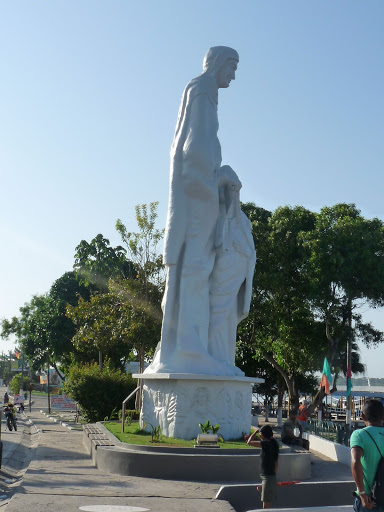
Breves, where we changed boats, had an enormous statue of a saint dominating the harbor. This is very common in South America.

Finally, though, we arrived in Belem. It was one of my favorite cities so far, and I will give you a clue as to why...


More recaps as soon as we can!

Saturday, August 1, 2009

Of parrots and peanut butter, hiking and hitching: Guyana!

Today is our last day in Guyana, the Westernmost of those three small countries in the northwest of the contenent that no one really seems to know about. Guyana is English-speaking and feels decidedly more Caribbean than South American, with a lot of goods available that we haven't seen since Trinidad. Culturally, it is a mix of people African and Indian (East Indian, as in from the country of India) descent with some Amerindian (what we would call Native American in the US) villages in the interior.

Though I am blogging from the capital city of Georgetown, on the Atlantic coast in the north, we started our adventure here far south, in the small town of Lethem, on the border with Brazil. It was a dusty town with no paved roads (here is our guesthouse)...


But, peanut butter!!!


Locally made by a women's collective, to boot.

The next day we took a bumpy bus ride north a couple of hours to the Oasis, a "rest area" along the side of the main road where we got a cabin and were able to hike to see a panorama of the surrounding rainforest and savannah.


(Interestingly, when our book said that the "newly completed" road connecting Lethem and Georgetown was "now all-weather," I took that to mean it was paved. Wrong-o!)

The next day, the real adventure began. We really wanted to go to Surama, an Amerindian village 25KM north that was known for its affordable eco-lodge and beautiful rainforest and savannah surroundings. But when the Oasis told us it would cost us $80 US to hire a car to drive this short distance, we balked...and (moms, don't read this!) hitched a ride with a guy we met at the rest area who was heading that way anyway.

OK, that sounds a lot worse than it was--he was a tour operator with a company jeep and also had two other passengers with him, so it really wasn't that sketchy. But, it gave us a taste for how easy hitchhiking was in this country, which was to come in handy a few days later...

But first, we needed to walk to Surama, which was actually 5.8KM (almost 4 miles) from the junction with the main road where we were dropped off. We knew this in advance and had accepted that it would be a long slog into town carrying our 30-lb bags, but we geared up and did it. We even spotted this pair of scarlet macaws en route, which seemed like a good sign for wildlife to come.


The thing is, no one had told us that once we reached Surama proper, it was ANOTHER 3miles walk to the Eco Lodge, which was well on the outskirts of the small cluster of buildings on the savannah known as "town." So we walked and walked and walked in the direction the woman in town had pointed, and finally we got there.

(When we told the people at the lodge that we had walked in from Surama junction, they looked at us like we were completely insane. They were probably right, but we also thought that paying $80 for a taxi was insane!)

Anyway, we stayed two nights in Surama, and it was one of the highlights of our trip so far for me. We saw lots of birds and a few monkeys in the beautiful, untouched rainforest and out on the savannah that surrounded the eco-lodge.

On our boat trip up the Burro Burro river, we saw loads kingfishers, herons, swallows, macaws, and some capuchin monkeys. Here is a great shot Andy got of a kingfisher.


Turkey vulture:


And here are the bees that decided to attack my bag on the boat. Notice how well they match my bag!


The rainforest was also chock-full of these millipedes, and on our hike up Mount Surama, Andy and the guide convinced me to let one crawl on my arm. Yes, I've officially lost my mind.


Aaand, remember how I said I'd come back to hitchiking? Well, when it was time to leave Surama, we were told it would be $25 US to be driven the 6 miles to the junction, where we could wait for a minibus running the 12-hour route to Georgetown. Now that we knew how long the shlep was and could mentally prepare, we turned down the taxi offer and, once again, strapped on our packs for a long, long slog by foot to the main road.

Two hours and over 500 choruses of "999 bottles of beer/guava-pineapple juice/milkshake etc." later (we switched beverages every 10 choruses and got pretty creative), we arrived at the shop at the junction. It was 12 noon. And we were told that there would not be a minibus arriving until 10PM, and that it wouldn't actually leave the junction until 4AM. Crap.

But then, literally 30 seconds later, this truck pulls up...


I mean, it's like the gods of hitchhiking had sent us this ride. It was clearly meant to be!

So we road 12 hours in the back of an open supply truck over an unpaved road to Georgetown. This was my position for approximately the first 5 hours of it.


My view wasn't bad at all. Note the rainbow!


Of course, when we picked up three more people in Mabura, and it started to get dark, and then it started to rain and we all had to get under this dirty tarp, well, it was a bit less pleasant then. And three days later, Andy's and my butts and lower backs are still a little sore from our adventure.

But, hey, we made it, and saved somewhere between $50 and $100 on bus fare. Solid.

We'll have to do another post recapping all of the fantastic and cheap street food we have enjoyed in Georgetown--we took a lot of pictures. Tomorrow we are off to another country, Suriname and will try to check in from there if we can figure out how to surf the Web in Dutch.

Thursday, May 28, 2009

How will you get around?

Many people ask about transportation. Will you fly everywhere? Are buses safe? Will you rent cars? Have you looked at those tickets where you have to keep going around the world in one direction?

The first point is that people should try not to ask so many yes/no questions. The second, and more important, is that a round-the-world trip involves a lot of transportation types. This posting is devoted to all those.

Planes: While stories exist of people traveling the world without ever getting on a plane, that won't be us. Having said that, I'm generally opposed to planes because they are expensive and force you to skip potentially interesting places and Tara is generally opposed to planes because of their environmental impact. While we will travel from continent to continent and to some remote locations inaccessible by other means (Angel Falls, Madagascar, etc.) using planes, we will mostly travel by other means.

We did explore round-the-world tickets. They come in all types, though very few of them require you to keep going in one direction like they used to. Most have mileage restrictions and may not allow you to pass through certain airports more than a few times or to take more than a certain number of flights. All expire in one year. Because we hope not to fly that much, don't really want to lock in the cities from which we'll be flying (changing dates with RTW tickets isn't hard, but changing cities often incurs a fee), and aren't sure about the one year time limit, we have decided for now that these tickets aren't right for us. For great information, I suggest starting on the WikiTravel site. Probably the most important point is that it is probably cheapest to buy a ticket starting in the UK (and you may physically have to buy it in the UK). The US is one of the most expensive places to start. Many vendors specialize in putting together individual flights to create a round the world ticket, and may be able to do it cheaper than you. I would recommend Boots 'N' All and Round The World Tickets. Airtreks is another popular one. A few more are mentioned on the WikiTravel site above.

I suggest using kayak.com to find international flights, though I always check the other big ones to make sure (orbitz, expedia, travelocity). One important note is that one-way flights are generally half a round trip flight overseas, unlike in the U.S. where you often pay a premium for one-way.

Buses: We expect to spend a lot of time on both local and long distance buses. In South America, long distance buses are common and come in varying classes. We will try all types and find the right balance of cost and comfort. In other parts of the world, buses are less common, though we'll still use them where possible. Some of the bus lines have websites, some don't. From past travels, it has always been easiest just to buy at the bus station, but we'll let you know if we find otherwise.

Trains: Almost non-existent in South America and Africa, but somewhat common in Asia. We would also like to take the Trans-Siberian Railroad if we have the money left to do so. Booking depends on the train service, but I've always had the most luck finding a travel office at the train station and letting them do the work. It normally costs the same and is significantly easier if you don't speak the language of the country. Local trains are harder to figure out. Asking a local is always easiest.

Boats: Tara and boats don't mix very well, but we'll have to take a few. They are the most common transportation in the rain forests, and a common way to go between some places such as Colombia to Panama. (The overland route is not passable and also inhabited by FARC guerillas.) Most of the rain forests boats are part of pre-arranged tours and the others we'll generally book through travel agents.

Rental car: We don't plan to have a car very often, but in certain countries we may explore on our own with a car. Rental cars can be a cheap way to see a lot in a short time. I prefer priceline.com for rental car bookings, but they won't always have international locations.