

Time to share our last batch of country expenditure averages! Mostly, Central America was very cheap, and the last few countries in South America were pretty easy on the wallet as well. We left off last time with
Countries Visited
Thursday, January 14, 2010
Financial Updates: Central (and some of South) America


Obsessed: Central America (and the rest of South America)!
If you check out the labels, or tags, on this blog, you will see that Andy has written 52 entries so far and I have only done 45. Maybe that’s because he writes all the obsessions and finance posts. Well, no more—it’s my turn to tell you with what things the countries we visited on the last leg of our trip were obsessed!
Wednesday, December 2, 2009
A Thanksgiving non-feast, and other foods of Nicaragua

Even cheaper were the "helados castillo" we found for sale in Rivas, our first stop in southern Nicaragua--little plastic bags of homemade ice cream. As you can see from the sign, just 3 cordobas each, or 15 cents. Andy is holding up mani (peanut) and a coco (coconut) ones.

The funnest helado castillo was the tutifruti flavor, which turned out to be basically frozen fruit salad. Can you see the banana and papaya chunks?

Another treat I found at a local bakery in Rivas--"dedos de queso," or cheese fingers. Hooray for cheese bread in Central America!

Something else we like to eat in Nicaragua is homemade candy, which is often coconut-based. That same bakery sold assorted candies for 10 cents each, and we thought we had hit the jackpot!

But the next night, we learned that people out in the street were selling even bigger versions of the same candies for the same price! The pink one in Andy's mouth is coconut and the orange one in my mouth papaya. (Also, note the horse cart in the street to our left! Lots of these in Nicaragua.)

Next to the candy-sellers was a woman selling little sweet breads in the street. They turned out to be made with squash, or at least tasted like it. That seemed rather Thanksgiving-appropriate to us, though it was not yet Thanksgiving.


Andy bought this tamale on the bus to Masaya. (Which was an old school bus, retired to serve public transport needs in Nicaragua after its years of ferrying about American schoolchildren, by the way.)


Andy had to buy this peanut-brittle-like candy on the street in Masaya to wash the bad raspado taste out of his mouth.

And this gingery candy, which at 1 cordoba (5 cents US) may be the cheapest single piece of street food we have ever bought. Nice to know you can still get something for a nickle in Nicaragua.

Lunch in Masaya was "baho," a stew-like dish of flavorful beef, yucca, and sweet plantains, covered with salad and onions and served on a banana leaf. Oh look, I found a recipe for it. Delicious! (Not so cheap, though--1 portion cost almost $3 US. Luckily, it was big enough to share.)


Whereas I found...more cheese bread! Yaaaay!

Back to ice cream. Banana splits are a popular menu item at Eskimo ice cream shops in Nicaragua. Or at least popular with us. Note how melty this one is--Nicaragua is HOT.

Something else I had never had in my life was Fanta, and I thought that I should probably try some in Latin America. Andy said that the orange kind is really good, so why shouldn't the red kind be good as well? Well, he was wrong, and we both agreed that it was pretty gross.

We were in Masaya for Thanksgiving, but short of one frozen turkey in the case at the supermarket, we saw no signs that anyone was celebrating it anywhere. So we went to a folkloric dance show that night instead, and decided to "splurge" on a dinner at the overpriced venue restaurant. The dancing was great, but the food was boring, not hot, and the service was crappy. Boo!

And I got chicken in mushroom sauce. If you see any mushrooms in this picture, please let me know.
 So much for Thanksgiving. I did have one piece of that squash bread left over back at our hotel, so we shared it for dessert. Family, we are so looking forward to turkey, mash, pies, etc. at Christmas!
It is a hot tortilla filled with mozzarella cheese, onions, and sour cream. (Yes, I relaxed my no-melted-cheese rule to try this specialty.) It wasn't bad, but I never felt the need to get another.

Donuts!!

I went for size (left), Andy went for filling. We found them a little dense, but fairly tasty.

Granada had its own fair share of tasty meals served in banana leaves. This plate had a bit of everything--rice and beans, plantain chips, sweet plantains, chicken, and salad. The sweet plantains were especially amazing.

The real local specialty of Granada, though, is called "vigoron." It's a rather filling dish of yucca, fried pork skins (or "cracklings"), and salad (served in a banana leaf, natch). Not a combination Andy or I would ever rustle up at home, but I guess it was worth trying once.

Here's a close-up of the vigoron.

Remember that naranjilla we took a picture of in Panama? Well, we bought one in the supermarket in Grananda to try. It was so gross that we pitched it after one bite each. Definitely consistency of a tomato, but I think it may have been underripe...


The hot dogs in Nicaragua are really, really long! Andy's was served with a cabbage salad, ketchup, and mayo.

Another tasty combo plate we got from a street griller, this time at the festival in Managua. Rice and beans, plantain chips, sweet plantain, salad, and "mongo," which was some sort of patty with rice and sausage bits and we're not sure what else. We don't really want to know, because we both thought it was tasty, but we also both suspect that it is closely related to black pudding...


Then, of course, I couldn't find anywhere to throw away my cob for a few hours. ("Is that a corncob in your pocket, Tara, or are you just happy to see me?")

Breakfast at a panaderia in Managua around the corner from our hostel: pineapple-filled empanadas, large and small; a cinnamon roll and a pineappley roll; and two rugaluch-type pastries (called "misterios" for some reason), all for $1.50. They were OK, I guess, but looked better than they tasted.

Terre Haute, Indiana, residents will appreciate that this product is available in fine supermarkets Nicaragua-wide!


On to the pupusas of El Salvador next!
Tuesday, December 1, 2009
Managua and more virgins in Nicaragua
One of the Marys on the street with people singing. The line to sing to her was about a block long and later it got even longer.
 Daniel in this message is Daniel Ortega, president of the country and strong socialist. He is very, very popular and messages like this are scrawled nearly everywhere. It may be that those of other parties are removed while his are not, but my bet is that he wins reelection in 2011.
 Our first night in Managua, we got sucked into the big performance outside the old cathedral (the interior was destroyed by earthquakes and is not open, but it still looks nice). They repeatedly sang two songs about the Virgin Mary and were apparently awaiting the arrival of one of the traveling statues of her. However, after two hours we gave up and left. What we realized only at that point was that no one cared about the staute. They had only come because they were giving away free buckets of staple foods like corn, rice, and beans. As soon as people got their buckets, they were running for the exits.
 They had built a lovely Christmas tree out of lights and had a lot of fireworks all night long. They also had the fireworks that simply explode with no pretty lights that went off about every 10 seconds for the whole two hours. Apparently that is how they honor Mary.
 In Nicaragua, Tara and I both got haircuts. For $1.50 each. Here is Tara's, which looks good for $1.50.
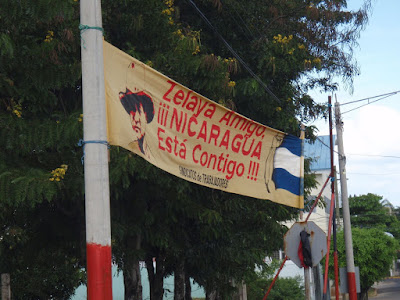
 The Honduras coup is covered a lot in the news here. We saw a few signs on the topic. (Zelaya is the ousted president of Honduras.)
 This is the new cathedral in Managua, paid for by the founder of Domino's Pizza, who now devotes his fortune to Catholic causes. Inside, it feels like a cross of a high school gym and a bomb shelter. Outside, it at least looks cool.
 From Managua, we went to Leon. Leon is the other major colonial center and is most famous because it has nearly a one-to-one colonial church to person ratio. Here is one such church. Because I don't remember the names, I'll call this the pink one.
 Leon is near the Cerro Negro Volcano, which is one of the most active in the world. However, when it erupts, it just spews out lava bombs (small bits of lava that harden in the air and are rock before they hit the ground). They have tours here in which you hike to the top with a piece of plywood nailed to a piece of metal and then sled down the volcano on it. We first read about this in the New York Times about a year ago and have known we had to do it ever since. Here is the truck to take us to the volcano.
 Here is the volcano. We climbed up the right side in this picture and then slid down at almost the left side.
 Looking down from the top, you can clearly see where the small lava flow and rocks from previous eruptions stop. Lots of volcanoes in the area, but this is the only active one.
 Looking down into the crater of the volcano. We actually got to hike around in the crater as the guide was telling us about how they are really bad at predicting when it will erupt.
 Now, for the main event. Here we are in our jump suites getting ready for the sledding. On the ground in the background, you can see a couple of the sleds.
 This isn't either of us, but here is roughly what you look like sledding down. The incline is 41 degrees, which may not sound like a lot, but is really steep. While you are sledding down, these tiny black rocks are flying at your face. And they have a radar gun to clock your speed. It was great! We have video of Tara going down.
 Here is Tara upon completion of her run. She fell a couple times, but did a great job. In the end, I was clocked at 65km/hour (40mph) and Tara was clocked at a slightly slower 20km/h (though she was going faster at one point before the radar gun). The record is 50mph, so I wasn't even close to that.
 Back in town, we ran into this woman. Not sure who she was supposed to be, but I'll guess that it has something to do with the Virgin Mary.
 We'll call this the Yellow Colonial Church of Leon.
 This one is the main cathedral of Leon. It is huge for a city this size. Apparently, there are stories that the plans for Lima were accidentally sent here instead, so now they have a huge cathedral.
 We don't know what kind of store this is, but we have seen it in two different cities and we like the logo. I think they sell clothing. Or maybe execution equipment.
 That ends our travels in Nicaragua. After this, we head to El Salvador, passing through Honduras on the way. Nicaragua has been a good experience. To any thinking about visiting, it is worth the trip and definitely go volcano boarding.