Countries Visited

Svalbard Spain United States of America Antarctica South Georgia Falkland Islands Bolivia Peru Ecuador Colombia Venezuela Guyana Suriname French Guiana Brazil Paraguay Uruguay Argentina Chile Greenland Canada United States of America United States of America Israel Jordan Cyprus Qatar United Arab Emirates Oman Yemen Saudia Arabia Iraq Afghanistan Turkmenistan Iran Syria Singapore China Mongolia Papua New Guinea Brunei Indonesia Malaysia Malaysia Tiawan Philippines Vietnam Cambodia Laos Thailand Myanmar Bangladesh Sri Lanka India Bhutan Nepal Pakistan Afghanistan Turkmenistan Tajikistan Kyrgyzstan Uzbekistan Japan North Korea South Korea Russia Kazakhstan Russia Montenegro Portugal Azerbaijan Armenia Georgia Ukraine Moldova Belarus Romania Bulgaria Macedonia Serbia Bosonia & Herzegovina Turkey Greece Albania Croatia Hungary Slovakia Slovenia Malta Spain Portugal Spain France Italy Italy Austria Switzerland Belgium France Ireland United Kingdom Norway Sweden Finland Estonia Latvia Lithuania Russia Poland Czech Republic Germany Denmark The Netherlands Iceland El Salvador Guatemala Panama Costa Rica Nicaragua Honduras Belize Mexico Trinidad & Tobago Puerto Rico Dominican Republic Haiti Jamaica The Bahamas Cuba Vanuatu Australia Solomon Islands Fiji New Caledonia New Zealand Eritrea Ethiopia Djibouti Somalia Kenya Uganda Tanzania Rwanda Burundi Madagascar Namibia Botswana South Africa Lesotho Swaziland Zimbabwe Mozambique Malawi Zambia Angola Democratic Repbulic of Congo Republic of Congo Gabon Equatorial Guinea Central African Republic Cameroon Nigeria Togo Ghana Burkina Fasso Cote d'Ivoire Liberia Sierra Leone Guinea Guinea Bissau The Gambia Senegal Mali Mauritania Niger Western Sahara Sudan Chad Egypt Libya Tunisia Morocco Algeria
Map Legend: 28%, 75 of 263 Territories

Sunday, November 15, 2009

Let's Dance! (Southern Colombia)

We are in Colombia!

The very first thing that happened when we crossed the border from Ecuador in the south is that we were met by moneychangers in the street, a pretty typical border occurance. What was new is that these guys had rigged calculators in an attempt to rip off tourists on the dollars-to-pesos exchange rate! We had read that such calculators exist, but had not encountered them yet. Luckily, Andy's fast ability to commit math saved us from being gauged by these nogoodnicks.

That has been quite atypical of Colombians, though, who on the whole seem incredibly friendly and helpful. In general, this is the kind of country where if you stand on the corner for a minute with your guidebook, looking confused, people start shouting at you from across the street asking how they can help. It's like being in Sao Paulo again, or somewhere midwestern, like St. Louis.

One of the other first things that happened in Colombia was that Andy's third pair of sunglasses on this trip bit the dust. He has been very unlucky with sunglasses! (Left his old ones on a bus in Brazil; bought cheap ones in Paraguay that broke the next day; then swore off sunglasses for a long time, til Bolivia when we were going to the blinding white salt desert.)

Here is what was left of the Bolivian sunglasses.

So, our first major stop in Colombia was Cali. You may know of it as a formerly notorious drug-smuggling center, but I was excited about it for two reasons--it's supposed to be the cheese-bread capital of Colombia and the salsa-dancing capital of Latin America. In these two areas, it did not disappoint!

The town itself wasn't the most exciting, though, especially on a Sunday morning, which is when we first walked around. Here is a view from a nearby hill.

I did love all the azaleas, though! (There are way more in Cartagena, as I would later learn.) Here is a cool gothic church near the center of town in Cali. Couldn't get inside, sadly.

One thing I found curious about Cali is that their pigeons are different from the standard ones you see everywhere, even in other cities in Colombia. They are smaller, and brownish--a classier breed of dove, methinks.


Here is Andy in our hostel with the resident puppy. Puppy is sad that we won't give him any of our breakfast. Andy looks sad, but really his mouth is just full of breakfast.

There are way more black people in Colombia than in almost any other South American country we've been to...but political correctness does not yet seem to have affected this restaurant's logo.

So, the salsa dancing! We actually found Colombia (or at least Cali and Cartagena) to be surprisingly expensive, but one great deal we got was private salsa lessons with champion salsa dancer Carlos (and one of his female students) for $10 US an hour. (Which was apparently expensive, since our hostel-keeper seemed slightly appalled at the asking price when he phoned them up for us.) So our teachers came to our hostel and taught us some basic salsa steps for two hours out on a lovely terrace with views of the rooftops of Cali.

How did I get Andy to agree to do this, you ask? Easy--I just reminded him of the countless, endless hours I have spent hiking with him on this trip, and pointed out that two hours of dancing would hardly begin to make up for the time I have devoted to his physical activity of choice. Hard to argue with that logic.

So, here you can see Andy concentrating very hard as he prepares for our big twirling/switching places move...

...and smiling, because we nailed it!

At the end of our lesson, we asked our teachers to do a little demo of their own for us. Of course, they were amazing.
I had a great time at the lesson...Andy decidedly less so, but he stuck with it and though he refuses to believe me when I say this, he did a terrific job. We meant to go out to a club that night and try out our moves...but, well, we were tired, and I decided I had tortured Andy enough for one day, so we went to sleep instead.

Speaking of sleep, we ended up with the most amazing "bedroom" in our next destination, the capital city of Bogota. At the excellent Hostel Platypus in La Candelaria, the old city area, we were given a choice of a room with shared bathroom for $20 US or private bathroom for $25. We decided to spring for the private bath...and ended up with a private apartment! In addition to the promised bathroom, it had a bedroom with three beds, a kitchen, and dining room/living room with a big hammock. We kind of wished we were staying more than one night.

Our first stop in Bogota was the Museo de Oro, or Gold Museum, which cost about $1.50 apiece and is supposed to be one of the best museums in South America. I usually get bored at such places, but I must say that it was pretty cool. The first part taught us all about how different metals are mined, smelted, and made into different shapes, and the second displayed all sorts of amazing artifacts from indigenous cultures all around Colombia and South America. We called this guy the flying monkey.

There was also amazing pottery in all sorts of shapes, like this fellow, who I think is some sort of jug.
Fun churches in the old city in Bogota: I thought this one was straight out of Candyland.
And here is the cathedral on the main square. We couldn't get to it because the whole square was closed for some sort of police promotion ceremony. Note the lovely mountains in the background. Bogota is the third-highest capital in S. America (after La Paz and Quito).

Speaking of the police, it cracked me up that in the cities here, police are labeled "me" (short for metropolitan) and the beginning of their city's name. So in Cartagena, their vests say "MECART," and in Bogota, well, see below.


The fun abreviations continue at the public library, aka Biblioteca Luis Ángel Arango, aka Blaa.


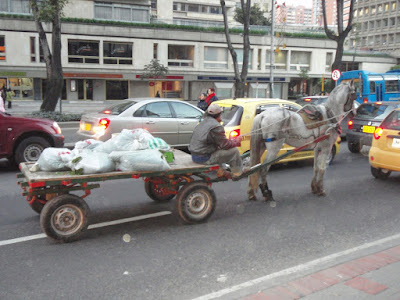
Bogota seemed like a very modern, cosmopolitan place to us, especially in North Bogota, which is the newer section with all the business towers and malls. But even there, we saw horsecarts in the rush-hour traffic!

We weren't even going to go to North Bogota, but then I found out that "Julie & Julia" (which I have wanted to see for three countries now) was playing at a mall up there, so we had to go!


At first we thought that we could walk the 60 blocks in an hour, easy, but we quickly realized that Bogota blocks are waaay longer than New York City blocks. This led to a frenzy of bus-system-figuring-out, and walking around confusedly after we were dropped off (North Bogota has so many malls that at first we went into the wrong mall). Then there was a power outage in our mall, and the theater's computers went down, and we were afraid that the showing would be canceled! But lo and behold, the lights came back on, and the movie showed, and it was just as delicious as I had hoped. (And, since it was half-price Tuesday, tickets only cost $3.50 apiece!)Getting home was another story, as we ended up on an express bus (oops!) that took a turn in the opposite direction from where we wanted to go (double oops!). But we eventually made it back to our sweet pad, where, inspired by all the cooking in the movie, we cooked lentils and pasta and fresh tomato sauce in our sweet little kitchen.


The next day, we took a trip to Zipaquera, a town outside of Bogota that claims to have the #1 tourist attraction in all of Colombia--the Salt Cathedral. It was set in a very touristy "theme park," and would have been really expensive if it hadn't been half-price Wednesday (Tuesday and Wednesday are clearly the days to visit the Bogota area!).


As it was, we paid $5 US each to get a 1.5-hour tour of the Cathedral, which was built completely out of salt and some marble underground in a huge salt mine, completed in 1995. Yes, you could lick the walls, and yes, we did.


Here's a detail of a cathedral wall that had been damaged by water, causing this cool texture to form.

The main cathedral chamber, which is huge and pretty awe-inspiring. Though the subterranean surroundings really seem more fitted to worshiping Satan than Jesus, don't you think? Hm, maybe that's just me. My favorite thing in the salt cathedral--this carved stone version of the hand of God reaching out and touching the hand of Adam, as it is on the ceiling of the Sistene Chapel in Rome. This piece is lit from behind and central to the main cathedral chamber.

After the tour, we were treated to a 3-D movie about how the mine works.

I'll just say that it featured a time-traveling robot that can project holograms and was almost as good as some of the movies we have seen on the buses here--such as "Fireproof," in which Kirk Cameron is a fireman who finds Jesus and stops yelling at his wife, "Nostradamus 2012," and "Drop Zone," starring Wesley Snipes as a skydiving cop. Only the best of world cinema on the Colombian buses, I tell you.


That wraps it up for the first half of Colombia. My better half will tell you all about the second in due course!

Friday, November 13, 2009

Ecuadorian food: more than bananas

You may have guessed that people in Ecuador eat only bananas. And maybe an occasional pineapple. But that isn't the whole story. As it turns out, they also eat a lot of good street food. When we got our camera fixed, we discovered that we had been taking all our pictures on underwater macro mode, which makes everything super zoomed, so sorry for the closeups in some of the pictures.

The first picture wasn't even clear enough to see, but it was Tara holding a glass of white stuff just as we got across the border into Ecuador. It tasted like melted ice cream and was really good. We later discovered that it is a popular drink made of cream, milk, and oats. Really tasty. And it had oats, so it was healthy.

Once we made it to Puerto Lopez on the Ecuadorian coast, the street food abounded. We jokingly call this city the Brigadoon of street food. You would find the most amazing food, walk a block to try something else, come back for seconds, and the vendor was gone. Ecuador was the first place we had been where street vendors apparently roam rather than staying in one spot for the day.

Here is Tara trying a sweet coconut bread in Puerto Lopez. The bakeries were not bad, and very cheap. What I don't have a picture of is her eating the first cheese bread of the trip. More on that later.
We discovered these people that sold a big pile of fries covered with tasty chicken breast (and doused in ketchup and mayo) for $1. Not surprisingly, they disappeared after our first night in Puerto Lopez.

Sometimes, we go wrong with street food. This most often occurs when I see something that looks tasty, knowing in my heart that it probably isn't as good as it looks, but thinking, "what if it is the best food around and I miss out on it?" That thought resulted in this purchase of some dry rolled up cake stuff with the fairly tasteless sugary icing from a homeless looking guy hawking them to a bus of senior citizen tourists outside our hotel. Nonetheless, I ate all of them.

The underwater macro mode made this photo look much better than it probably would have otherwise been. Tara looks like a devil fish accepting her meat sacrifice. This spiral sausage had some nice french fries stuck on the end for Tara's enjoyment.

Our biggest victory in Puerto Lopez was milkshakes. I had been craving real milkshakes for at least a few weeks. We came upon some teenagers in the street who would mix homemade ice cream with fresh fruit and sell a big milkshake like the one in the lower right of this photo for 75 cents. We each had a strawberry one and a pineapple one. We came back the next night before our bus left town, but, alas, they weren't there.

We took a long walk in the cloud forest outside Puerto Lopez, and it was really beautiful despite not seeing any birds. Our talented guide, Juan, saw a grapefruit still hanging on the tree (it is past the season), chopped off a stick with his trusty machete, and perfectly hit the branch above the grapefruit to make it fall. I generally find grapefruit to be bad, but this one was almost sweet enough to be edible. (Those who know me are aware that sweetness is my primary determinant of good or bad in food, and really in people, I suppose.)

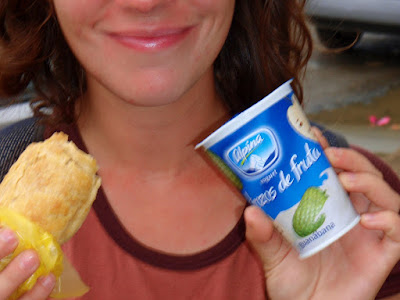
Tara found some guanabana yogurt and a sausage in a roll for breakfast. She loved the sausage pastry, but we returned less than five minutes after buying it for another and the vendor was gone. We looked around for a few blocks, but he had vanished.

Tara seems to be in more food pictures than me, but we both eat a lot. I just happen to be holding the camera more. In this one, she is eating freshly fried plantain chips. Made more interesting because they put a salad and mayo on top. It is a lot better than it sounds.

When we made it to Quito, we arrived at 3:30 in the morning. Because Tara and I knew we would have to pay an extra night if we checked into a hotel then, we decided to wait a couple hours at the nice new (though cold) bus station. While there, we had some excellent hot chocolate and some not so excellent churros.
Once we arrived in Quito proper, however, Tara immediately noticed that every other restaurant was a pan de yuca and yogurt place. For those who Tara hasn't forced to go to the Colombian bakery she frequents in New York, pan de yuca is also know as cheese bread or cheese rocks. It is one of several types of cheesy breads that you will learn more about in the Colombia food section, but it is one of her favorite foods on earth, along with yogurt. Thus, the combination of these foods made her so happy that I feared she might have a stroke right there on the main street of Quito. Here is an unfortunately large picture of the yogurt, a small pastry that I ate, and the smallish cheese breads on the far right. Tara took it upon herself to sample them from each different place until she was literally sick. She did this each day we were in Quito until she had possibly tried each of the 800 places that all looked the same to me.

We now enter the phase when my camera was being repaired, so I have to describe the food in words rather than pictures.
Our first night in Quito, we ate at a Mongolian barbeque. It was $6 for all-you-can eat food with a salad and drink thrown in for good measure. My guess is they priced this deal for Ecuadorians and maybe the occasional French person. They definitely lost money on me. I ate a lot, and still felt good after.
The next day, we had an interesting ball of coconut and molasses on the street. I really don't like molasses (surprising, I know), but it wasn't bad. Tara liked it more than I did.
For dinner, we had semi-authentic Southern BBQ at a place called Adam's Rib. Owned by Americans and frequented by Americans, we had fairly good smoked babyback ribs for a place in Equador. They claim to be the best BBQ south of the equator, and we haven't found anywhere to disprove that notion.
We also had a big cup of fruit salad on the street. This seemed good at first, and was really cheap, but then I got a bite that tasted like poison. That's exactly how I described it to Tara at the time. Unfortunately, in my disgust, a panic caused me to swallow rather than spit. Had I known what I know now, I would have made Tara punch me in the gut until I spit it back up.
I ate something that made me violently ill. Maybe the fruit salad poison, maybe not. Without going into details, I didn't move farther than from the bed to the bathroom for a day and a half. However, I made that trip enough to walk about 15 miles. During that time, I suspect that Tara mostly ate cheese bread, though she would dutifully bring me back fake gatorade, which was all that I consumed for a couple days. By the time I was better, we had to skip a sidetrip we wanted to take, but we had our camera back.

At the store, I pointed out to Tara that Ecuador was really her kind of country. It was the only place we have been where yogurt comes in gallons.
In Ecuador and Colombia, tomato del arbol, or tomato of the tree, is a really popular fruit. We tried a shake made of one when the camera was out of order, and it did taste a bit like tomato. Not terrible, but we would never go out of our way to get it. Here is a picture of some.

After not eating for a few days, here is the first thing I ate: grape jello. Jello is really popular on the streets in Peru and Ecuador and I had been wanting to try some. The timing seemed appropriate and they had grape, which everyone knows to be the best flavor. It tasted just like American jello. Not sure what I expected, but at least it didn't taste like poison.


Tara got a mix of guanabana and raspberry juice at the market in Otavalo. It was fairly good. I don't have a picture of a guanabana for those reading, so look it up on the Internet. It looks sort of like a mutant pineapple.
I went from my grape jello to a concoction of fried potatoes with fried meat topped with a tomato salad. The meat was bad, but the potatoes were tasty. I later regretted this decision as my stomach informed me that I was an idiot and that it was going on strike for several hours.
Tara liked my potatoes enough to go and ask a lady if she could just buy the potatoes. Despite being skeptical of the idea, the woman sold them to her and put them in this nice bucket so that Tara had a bucket of potatoes. We had a similar bucket when I was a kid that held Mr. Potato Head.


From Otavalo, we traveled to Ibarra, a town specializing in ice cream. And specifically specializing in fruit flavored ice cream. Fortunately, my stomach had forgiven me for the earlier fried food and was good with ice cream. We started at Rosalia Suarez, the most famous of these ice cream places (and apparently the original). We wanted to try a couple places, so we started with the cones, which were smaller than the cups. I had raspberry and coconut while Tara had taxo (related to passionfruit) and coconut.
At first, this picture might look like a second shot of the one above. But, then you might notice that the ice cream flavors are different. The first was so good that we got seconds. I stuck to the amazing coconut and tried strawberry. Tara outright stole my first combination. They were really great, but we knew that other ice cream places awaited.


So, we went to the second most famous place in town. It was slightly cheaper, and good, but not as good as the first place. Note that by this point I had upgraded to the larger cup size. After this place, we tried two other places, which got progressively worse. If you ever go to Ibarra, stick to Rosalia Suarez. It's the best.

So, after eating ice cream from four different places, we caught a bus to the Colombian border. Ecuador left a positive food impression on us, and I don't think we ate a single banana while there (though there was some in the fruit salad that stayed in my body for only a few hours). Tara could live on cheese bread and yogurt forever (I would starve on the same), and we could both eat street fries and shakes for most of our meals. It also helped to keep our food cost down for Ecuador. In conclusion, hooray for cheap street food and boo for the bacteria contained in cheap street food.

Thursday, November 12, 2009

Less math, more eating: The rest of Ecuador

We did stuff other than eat street food in Ecuador, I swear, but our pictures don't really back me up on this. Part of the problem, of course, is that our camera screen was broken for all of Puerto Lopez and our first two days in Quito, then spent the following two days in a repair shop...and one of those days my significant other spent in bed with food poisoning, and you wouldn't want to see pictures of that anyway.

So I'll do the best I can with what I've got. We left you with a snap of the boobies (heh) we saw on our sea trip from Puerto Lopez. Our next stop was Quito, the capital city of about 2 million people. Like La Paz, it is at elevation and surrounded by beautiful mountains. Unlike La Paz, we did not get robbed in Quito, which may be part of the reason I liked it so much.

Central Quito is divided into an Old City and a New City. We stayed in the New City, which had more amenities (like camera repair shops, and yogurt-and-pan-de-yuca shops, which may be the best shops ever invented), but visited the Old City to check out the churches and lovely colonial architecture.

Here are two shots we took (blind, btw--the screen on our camera was still busted at this point) facing in two different directions from the same street in the Old City. In one direction you can see a huge statue of the virgin, keeping an eye on the town...
...and the other way you can see the towers of the basilica. Neat!
Quito had more old churches in the town center than almost anywhere we've been. Unfortunately, our first day in the city was a national holiday, so they were all closed to visitors. "God is on vacation from Ecuador," Andy said.

Another street in the old city...the closest we got to visiting the real thing. Ah well, next trip to Ecuador! One thing that was open on the holiday was the Teleferico, or cable car that takes you hiiiigh above Quito up a nearby mountain. I suggested we walk from the Old City, but our guidebook map gave me a really innacurate estimate of how far it was, and we ended up walking for about two hours, most of it uphill. The book also goofed on the price, which at $8 per ticket was twice as expensive as we'd expected.

But we'd come so far, we had to go up. And in fairness, the Teleferico took us at least twice as high as we'd expected, too. Well up into the clouds, in fact. So, no more pictures of Quito, as early the next day we found a repairman who had the right parts to fix the screen. We kind of got the sinking feeling that said parts may have been supplied by stolen cameras through some chain of suppliers. I hope not, but unfortunately I can't say for sure.

Katie D., this is for you: One thing I wish we had a picture of was the public transit system, which I thought was really great. Quito has a really nice, efficient Trole (trolleybus) system and bus system, with subway-like stations in the streets where you buy little plastic tokens for 25 cents, enter though a turnstile, and wait for the bus or trolley to come. They run on fixed routes to other little stations; we never had to wait long, and the system was really easy to figure out (much easier than the similar Transmilenio system in Bogota, which cost 75 cents a ride and in which we were constantly getting lost!).

That night, as we were going to bed, Andy mentioned that his stomach didn't feel great. A couple of hours later he woke up, ran off to the baño, and thus began the first bout of food poisoning either of us has suffered on this trip. We knew it was bound to happen, but had been happy to be lucky so far.

He thinks it came from a cup of fruit salad we bought (where else?) on the street in Quito. We have had countless similar fruit salads before, but apparently one bite of this one tasted like poison to him, and though he should have spit it out, he didn't. (My prince charming, swallowing the poison to spare me!) So poor Andy was in for 24 hours of misery. I ran a few errands to get him Gatorade knock-offs and find food for me, but mostly hung aroud the hostel as well. Luckily we had sprung for a room with private bath this time around.

Happily, he was much better the next day, and after picking up our fixed (yay!) camera, we headed off to Otavalo, the town 2 hours away that is known for its giant Saturday market. And the next day just happened to be Saturday!

Here is a fun huge statue you pass between the bus station and the center of town in Otavalo. For once, is not Jesus/the Virgin, but local people dancing. The main church in Otavalo is lit up beautifully at night. It's not quite so impressive in the daylight.
The next day was market day! Most of what we bought was food (which you'll see in our next foods post) or gifts for people (which we're not going to post, of course), but I did finally get a Peruvian-style hat with earflaps of my very own! The vendor wanted $3 but I used all my shrewdness and cunning to bargain him down to $2.50.
A note on money--did you know that the official currency of Ecuador is the US dollar? Yup, the country made the switch in the 1990s to curb inflation...so all prices are now in dollars, and you pay in US cash. This was wonderful for me and Andy, of course, because it took away the need for us to, as my friend Jan C. would put it, "commit math." No longer did we have to go up to street vendors, hoteliers, etc., ask "¿Cuanto cuesta?", and furiously multiply or divide to figure out how much things "really cost"...we just knew. (Also nice was that hotel rooms generally cost $15-$25 and street food was often as cheap as 25 or 50 cents.)

The only confusing thing about the money was that Ecuadorians use dollar coins and 50-cent pieces regularly (the rest of their change is actually a mix of US$ and Ecuadorian coins that are the same size as their US equivalents but wouldn't be valid tender in the US). I got into a bit of a mess at an ice cream place when I took back my change in bills but told the scooper to keep the coins as a tip, not realizing that she was giving me two dollar coins as part of my change with the rest of the small change, which I'd meant to leave her. She thought I was the most generous tipper ever until Andy caught my mistake and made me go get our $2 back. D'oh.

Speaking of ice cream, the last town we visited in Ecuador was Ibarra, which is famous for its helados de paila, or fruit-flavored ice creams made fresh in huge copper pots. As soon as I read about this place, I knew that we would have to make a pilgrimmage there.

Turns out that there is a whole street in Ibarra lined with heladerias serving this kind of ice cream, and we visited four of them. The oldest (from the late 1800s), most expensive (at 65 cents a cone rather than 50 cents), and best was the first place we visited, La Heladeria de Rosalia Suarez. Pictures from our five rounds of ice cream to come in the next food post!

In closing, Ecuador was pretty great; nature, shopping, city life, delicious food, pretty cheap, and no currency converting. It seems to be the country where Andy is cursed to get sick (when he was there eight years ago with his sister, he had a bad reaction to malaria medicine and couldn't swallow for a few days), but marred by no such experiences myself, I give it high marks.

Sunday, November 8, 2009

Financial Updates

We've been delinquent in posting Financial Updates, but here we go.

Uruguay: $110/day. Tough to call this a good average since we were only there for two days. In general, though, there isn't much to do in Uruguay. Food is more expensive than many South American countries, and you have to look around to find good deals on lodging, but there aren't a lot of tours or other expenses even if you were looking to spend money. A lot of hotels seemed to have raised prices dramatically, but we ended up finding a very nice room for less than $30/night in Montevideo.

Argentina: $115/day. Transport in Argentina is a good deal cheaper than Brazil, which helped to keep costs down. Lodging continued to average $20-30 per day. Food is a bit more expensive, but still cheaper than the US. We took a few different tours in Argentina, which were reasonable, but not super cheap.

Chile: $108/day. This one actually surprised us. It seemed more expensive while we were actually there, especially considering that we took the somewhat pricey boat for three days from southern Chile to slightly less southern Chile. Transport was much cheaper in Chile, though. And we didn't eat out much. Overall, a really good value.

Bolivia: $63/day. This is not including the cost of being robbed, which would have added close to $1000 (about $50/day) to the cost of the country. It does include the $270 for visas, though, so it would have only been about $45/day without the visas. It is by far the cheapest country in South America. Tours and lodging are both very cheap and transport is fairly cheap as well.

Peru: $87/day. Peru ranks high on the value scale. It is cheap, but you can normally find decent quality buses, hotels, and tours. We took some really nice buses for just a few dollars more than the poor local buses. Machu Picchu is expensive (and worth it), but the rest of the country is cheap.

Saturday, November 7, 2009

Some Questions from Readers

Okay, we have some questions in the queue and I got some more today, so here it goes:

Q: How much of a difference is there in the Spanish from country to country? Are the idioms and accents pretty similar throughout?
A: The Spanish definitely differs from country to country. In Venezuela (and apparently in Colombia from the Colombians we have met), they have removed the letter 's' from the alphabet. Adios becomes adio, for example. These are the hardest accents to understand. In Argentina, the Spanish has almost an Italian accent, which isn't surprising given the country's desire to be European. Chile has a tough accent as well (a Peruvian guide actually told me that she can barely understand people from Chile). Peru, Bolivia, and Ecuador have accents more like Americans learn in Spanish class. As to idioms, our Spanish really isn't that good. They definitely exist, but we don't understand any of them.


Q: Wait, so those line pictures (in Nasca) *aren't* carved into rock? No way! It's amazing they haven't washed away in the rain. How big are they?
A: No, they aren't carved into the rock. Just dug down in the top layer of small rocks to a depth of upto about a foot. The drawings in the picture on the blog are some of the smaller ones and are maybe 500 feet long. Some of the larger ones are up to about a half mile across.


Q: So, I see all the street food you are eating. Are you getting fat from the food or skinny because you aren't eating much?
A: We definitely eat our fair share of unhealthy street food, but we also do a lot of hiking and often don't eat at real restaurants to save money. So, I think we are staying about the same, though it is safe to say that our diet is not as healthy as when we were in the US. Bolivia, despite its theft problem, was the only country where they routinely gave salad or vegetables with any street food.

Q: Do you ever get a good night's sleep? What time do you normally sleep to?
A: We take a ton of night buses, and it is difficult to get a good night's sleep, though we have gotten better at it. I would say that we get a good night's sleep about half the time. However, we do get up early a lot because the sun comes up around 6 and goes down around 6 and we try to take advantage of the light when we aren't in a big city. In the cities, we sleep until around 8am on average, but are up earlier when doing outdoors trips.

Q: Are you sick of being together 24/7? Do you ever get anytime to yourself?
A: Depends on the day. We definitely have days when we are completely sick of one another. The odds of it being such a day goes up dramatically if it is a day when we are both tired from traveling a long distance or hiking a lot. We're still happily married for now, though. We sometimes go our separate ways for a few hours when we are in cities, but not all that often.

Q: How does your budget look? You sticking to it?
A: We are doing fairly well in terms of budget. We need to publish a financial update, but our costs have actually been lower in our last few countries. We should be about where we expected or a little lower for the South American portion of the trip.