

You have seen the great photos from Guyana, Suriname, and French Guyane (collectively called the Guianas down here), but there is a darker side to these places: the cost. They are some of the most expensive countries to visit in South America. Here is a bit more of the breakdown:
Suriname: $190/day. We covered most of this one already. Food is reasonable and cheapish accomodation can be found, but transport is really expensive to the interior. Might have been possible to get their cheaper, but we had heard some bad stories. The $100 for visas is also ridiculous, and really brings up the average since we were only there for 6 days, but they are quick to remind you that the US levies similar visa fees on them. Oh, and on the visa side, if you are getting your Suriname Visa in Georgetown, it isn't hard, but you must pay them in US dollars and they only accept newer $10, $20, and $50 bills. This is true no matter what country you are from. They absolutely will not accept local currency, their own currency, or $100 bills. We can recommend Blue Frog Travels for arranging trips to the interior. They were really great for us, though the A/C was unfortunately broke on their vehicle at the time. Jodensavanne and Brownsberg National Park are both nice places.
French Guyane: $165/day. Had it not been for the kindness of Dan the American and Manuela and Max the Italians, this would have been much, much higher. French Guyane really does cost more than France. Dan was nice enough not only to drive us half way across the country, but to take us to dinner as well. Manuela and Max were kind enough to put us up for about the price of the cheapest hotel rooms, which were all booked, and they helped us get around. Hotel rooms cost a minimum of 50 euros ($70 at present) for less than great places, though they do all have A/C. Try to find people with whom you can stay. Definitely try couch surfing here if you can lock in your dates (we couldn't). A lot of people apparently hitchhike. Consider it. If you don't speak any French (Tara does), it will be difficult. I was excited to go to Cayenne because it is the city for which Cayenne pepper is named and that seemed to give it a fun aura. It turns out that Cayenne is a boring town, especially in the summer. Go to the prison camp in St. Laurent (try to find a guide who speaks English), go to the space launch tours in Kourou (free, but in French--probably interesting even if you don't have Tara translating), and go to Glacier for ice cream in Kourou.
Countries Visited
Monday, August 17, 2009


Questions
One of our loyal readers, whom we will call AJ, asked the following a while ago and we're just getting around to answering (paraphrased): 1)Do we carry a suitcase full of cash with us? 2) Do we have to buy bottled water everywhere? and 3) Why did we choose to go north through Guyana rather than starting in Georgetown and going south?
All great questions. We did bring a lot of cash, mostly because of the Venezuela black market situation. Between the two of us, we had about 1200 dollars, mostly in Pacsafe money belts. These are normal nylon belts with a zippered compartment down the back. Unlike a normal moneybelt, it is nearly impossible to notice anything extra. We did not think that finding ATMs in most countries would be a problem, but that has not always been true. Entering Guyana, we found no ATMs until Georgetown and really depleted our cash. In Suriname, they had ATMs, but almost none took Visa (it is not where we wanted to be) and most of the ATMs were out of cash. In hindsight, we probably should have brought more cash.
We filter all our water with the filter that we brought. At first, this worked really well. The filter clogged after about 30 gallons rather than the promised 150 though and is now very slow. We are hoping the second filter is better. If not, we will reevaluate carrying a filter, but we hate having to rely on finding stores and then wasting all the plastic bottles (that normally end up in the river in South America).
The choice of routes through South America was determined in part through roads and borders. Guyana and Venezuela don't like one another because of a territory dispute, so you can't go from Venezuela to Guyana.
Jewing it up in Suriname!
Wow, Andy and I have fallen way behind on the blogging. We are currently in Belem, Brazil...and need to catch up on culture and food of Suriname, all of French Guyane, and our adventures so far back in this country, which have so far included finally purchasing our own hammocks, a 40-hour riverboat ride and, improbably, speaking a ton of French.
But I get ahead of myself.
Let´s go way back in time to Suriname, land of the Jews.
"What?" you say. "I didn´t know there were Jews in Suriname..."
Well, join the club. But it turns out that Suriname, a Dutch colony until the embarrassingly late decade of the 1970s and now a small nation on the northern coast of South America (sandwiched between Guyana and French Guyane) once had one-quarter of its population made up of Jews (though we figured out that this was not including slaves, which it seems dwarfed the entire colonial population considerably).
A large synagogue still stands in central Paramaribo (the capital). Apparently it is still used for services on Shabbat, though our timing was not right to check that out or get a tour inside, which has to be arranged a day in advance.

The synagogue dates from the 1800s. It stood right next to this admittedly rather more impressive mosque...

But since the getting along nicely of various cultures seems to be the national theme of Suriname (where the population is a very heterogenous mix of African, Indonesian, Chinese, Amerindian, and Dutch people, with many tasty cuisines to boot!), the proximity did not seem to cause trouble.
Anyway, my people (OK, I use that term very loosely, since 1) I´m not religious and 2) the Jews in Suriname were Sephardic Portuguese immigrants, which is about as far as you can get from my Ashkenazi Eastern European heritage) did not just stick to the city when they came over in the 1600s, but actually had their own giant plantation south of Paramaribo along the Suriname river. This was called the Jodensavanne (Jew´s Savannah), and the remains of it are now a national historic site.
The site itself is beautiful and tranquil, with forest having reclaimed much of the land that was once under cultivation. We visited the Africans´ cemetary (yes, these Jews owned slaves--but apparently made a lot of enemies among other plantation owners for giving their slaves the Sabbath off) and the Jews´ cemetary. But the main site to visit is the foundations of the synagogue, which counts as the oldest surviving synagogue in the Western hemisphere.

This being Suriname, nothing was roped off, and you could go climb all over the monument.
The best thing we learned about the synagogue was that, during World War 2, a German spy ship was captured in Suriname and the crew imprisoned. As their punishment, they were put to work restoring the synagogue at Jodensavanne, which had fallen into disrepair after the plantation was abandoned (I think in the late 1800s or early 1900s). So, yes, the synagogue was actually restored by forced Nazi labor!
Our last stop at Jodensavanne was the "medicinal well" which still produces a trickle of water.

Back in the day, doctors apparently documented the abilities of water from this well to cure all sorts of ailments, including constipation. I am still waiting for this to work.
But I get ahead of myself.
Let´s go way back in time to Suriname, land of the Jews.
"What?" you say. "I didn´t know there were Jews in Suriname..."
Well, join the club. But it turns out that Suriname, a Dutch colony until the embarrassingly late decade of the 1970s and now a small nation on the northern coast of South America (sandwiched between Guyana and French Guyane) once had one-quarter of its population made up of Jews (though we figured out that this was not including slaves, which it seems dwarfed the entire colonial population considerably).
A large synagogue still stands in central Paramaribo (the capital). Apparently it is still used for services on Shabbat, though our timing was not right to check that out or get a tour inside, which has to be arranged a day in advance.
The synagogue dates from the 1800s. It stood right next to this admittedly rather more impressive mosque...
But since the getting along nicely of various cultures seems to be the national theme of Suriname (where the population is a very heterogenous mix of African, Indonesian, Chinese, Amerindian, and Dutch people, with many tasty cuisines to boot!), the proximity did not seem to cause trouble.
Anyway, my people (OK, I use that term very loosely, since 1) I´m not religious and 2) the Jews in Suriname were Sephardic Portuguese immigrants, which is about as far as you can get from my Ashkenazi Eastern European heritage) did not just stick to the city when they came over in the 1600s, but actually had their own giant plantation south of Paramaribo along the Suriname river. This was called the Jodensavanne (Jew´s Savannah), and the remains of it are now a national historic site.
The site itself is beautiful and tranquil, with forest having reclaimed much of the land that was once under cultivation. We visited the Africans´ cemetary (yes, these Jews owned slaves--but apparently made a lot of enemies among other plantation owners for giving their slaves the Sabbath off) and the Jews´ cemetary. But the main site to visit is the foundations of the synagogue, which counts as the oldest surviving synagogue in the Western hemisphere.
This being Suriname, nothing was roped off, and you could go climb all over the monument.
The best thing we learned about the synagogue was that, during World War 2, a German spy ship was captured in Suriname and the crew imprisoned. As their punishment, they were put to work restoring the synagogue at Jodensavanne, which had fallen into disrepair after the plantation was abandoned (I think in the late 1800s or early 1900s). So, yes, the synagogue was actually restored by forced Nazi labor!
Our last stop at Jodensavanne was the "medicinal well" which still produces a trickle of water.
Back in the day, doctors apparently documented the abilities of water from this well to cure all sorts of ailments, including constipation. I am still waiting for this to work.
Monday, August 10, 2009
Animals of Suriname
I am on a crazy French keyboard, so sorry for any typos. Here are pictures of some of the cutest, cuddliest, and tastiest animals that we saw in the very nice forests of Suriname:
Me holding a sloth! This is a three toed sloth, sometimes called a sun sloth because of the bright yellow orange area on its back. He was trying to cross a busy road, so we helped him.
 This are called comi-comi birds, presumably because they collaborated with the Russians in the Cold War. Or maybe they just make a sound that sounds vaguely like that.

A red howler monkey with a baby! These monkeys make the loudest noise of any land animal except for me after losing a game to Tara.

Money may not grow on trees in Suriname, but butterflies do. These sleep on this tree everynight. Seems like a bird might catch on...
 This toad is called a whistling toad and makes a noise that sounds more like a bird. It is also huge. Nearly the size of Tara. And we saw even bigger ones, but Tara ate those before I could take the picture.
 Poison dart frogs! This one is apparently a very rare one, as our guide had never seen one in person. National Geographic, you will need to pay me before using this image.
 This is called a dyeing poison dart frog and is more common, but this was apparently a very nice one. He was nice enough to let us get close for a picture. Our guide spotted this guy from about 100 feet away out the back of our hut. It took him pointing at it from about 12 inches before I saw it.
 Beautiful butterflies everywhere. Pictures included mostly for the benefit of our butterfly loving mothers.
 The tree frogs in Suriname are also huge. This one was probably 6 inches long and could have eaten every tree frog I have ever seen for dinner. You can see in the picture that he hangs of both sides of a 2 x 4.

Overall, Suriname was a great country for wildlife spotting, even if it was expensive. And it only took us a day or two to become fluent in Dutch. Seriously, the Dutch figured out years ago that Dutch is a useless language, so everyone learns perfect English and about 3 other languages. Why continue the charade? Get rid of Dutch. No one needs it. Even as we were leaving, the official exit sign for the country said goodbye in English and French. No Dutch.
Me holding a sloth! This is a three toed sloth, sometimes called a sun sloth because of the bright yellow orange area on its back. He was trying to cross a busy road, so we helped him.
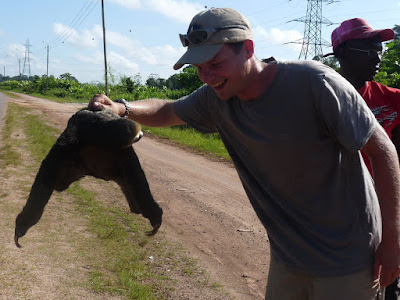 This is the much larger two toed sloth, called the sheep sloth by the locals This guy was crossing a much less busy road in the middle of nowhere. No one really picks them up. Unfortunately, this guy was also spotted by some locals, who consider sloth an easy protein source...
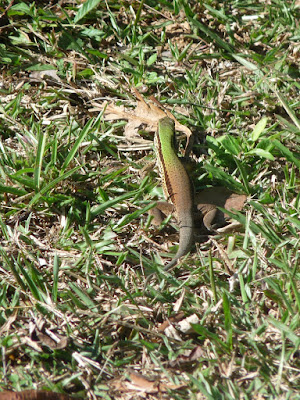
 If I were a country, lizards would definitely be in contention for my obsession. So many types, colorful, and some will sit for a photo. No idea what kind this is, but I really like them.
This are called comi-comi birds, presumably because they collaborated with the Russians in the Cold War. Or maybe they just make a sound that sounds vaguely like that.A red howler monkey with a baby! These monkeys make the loudest noise of any land animal except for me after losing a game to Tara.
Money may not grow on trees in Suriname, but butterflies do. These sleep on this tree everynight. Seems like a bird might catch on...
This toad is called a whistling toad and makes a noise that sounds more like a bird. It is also huge. Nearly the size of Tara. And we saw even bigger ones, but Tara ate those before I could take the picture.Poison dart frogs! This one is apparently a very rare one, as our guide had never seen one in person. National Geographic, you will need to pay me before using this image. This is called a dyeing poison dart frog and is more common, but this was apparently a very nice one. He was nice enough to let us get close for a picture. Our guide spotted this guy from about 100 feet away out the back of our hut. It took him pointing at it from about 12 inches before I saw it. Beautiful butterflies everywhere. Pictures included mostly for the benefit of our butterfly loving mothers.The tree frogs in Suriname are also huge. This one was probably 6 inches long and could have eaten every tree frog I have ever seen for dinner. You can see in the picture that he hangs of both sides of a 2 x 4.Overall, Suriname was a great country for wildlife spotting, even if it was expensive. And it only took us a day or two to become fluent in Dutch. Seriously, the Dutch figured out years ago that Dutch is a useless language, so everyone learns perfect English and about 3 other languages. Why continue the charade? Get rid of Dutch. No one needs it. Even as we were leaving, the official exit sign for the country said goodbye in English and French. No Dutch.
Tuesday, August 4, 2009
Financial Update
Time to update our financial picture. Here is the breakdown and summary by country:
Trinindad & Tobago: $109/day average. TnT is fairly expensive, with lodging really tough to find for less than $35-$40/night. We also spent money on the flight to/from Tobago and on renting a car for a couple days. Overall, our spending here was fairly even, though, so I think that's about the right amount. Note that food is overpriced in Tobago because they are an isolated island. We ate several peanut butter and jelly sandwiches to keep the cost down.
Venezuela: $90/day average. $50/day without the trip to Angel Falls. We think the trip was worth it, though. You have to use the blackmarket or these numbers would be 3 times as high. We normally paid $10-15 for a room and about $3-$4 each for a decent dinner. Transportation is nearly free because gas is nearly free (we paid $11 each for an overnight bus for 13 hours and the buses are way nicer than American buses). Angel Falls costs $250/person, though we wish we would have found an operator that would throw in a free hotel the night before and after, as many of them do. In Santa Elena, we suggest Francisco at Touristica Alvarez at the bus station. He did a good job getting us a tour in the Gran Sabana, though you have to be flexible with everything.
Guyana: $70/day average. Skewed by us hitchhiking the length of the country rather than paying the high bus fares. We sort of wish we had visited more of the interior, but we couldn't afford the very high transportation costs. We met people who often spent $300/person just to get to some of the inland places. Mostly, I wanted to see giant anteaters, but maybe somewhere else. Lodging was consistently $30-40/night and you should bring your own food to the rainforest or be prepared to pay higher prices for it. Food in Guyana, especially local food, seemed almost free. One morning, we bought every bit of street food and drink that seemed at all interesting until we could barely move. It amounted to about $4. We did have a bad experience going to a Rodizio suggested by our book. It ended up costing about $30 and was not very good. Don't go to rodizios outside Brazil, I guess. Oh, and lastly we decided to skip Kaiteur Falls. They looked very nice and I would have loved to do the overland hike to them, but it was $800/person, which seemed crazy for 4 days.
Suriname: we're on track to average $190/day. Suriname, mostly because of transport into the interior, is really expensive. Paramaribo is also very expensive. Rooms for less than $35-40/night are really hard to find. Meals aren't as expensive as the US, but average about $7 for a standard restaurant. We're taking a cheap tour that doesn't go that far inland and it is $300/person for 3d/2n. The ones that really go to the more interesting parts start at about $700 for 4 days/3 nights and most are even more.
Feel free to ask if you have any questions. Our guidebook is woefully out of date for the Guyanas, so expect to pay a lot more than many books indicate. We've learned a lot and are happy to share our knowledge if useful to anyone.
Foods of Brazil and Guyana!
Here's another entry in our popular series about the incredibly healthy food we've been eating around the world.
Brazil:
In Brazil, there are a lot of pay-by-weight buffet restaurants, but we weren't quite prepared for the pay-by-weight ice cream parlor!

It was fun because it let us try lots of strange (to us) local fruit flavors we may not have gotten otherwise. But since Andy can put away a lot of ice cream, it didn't end up being such a bargain.
Speaking of dairy, yours truly had to sample some yogurts, of course. You wouldn't believe how many different types of Activia they have there--big tubs, small cups, big and small drinkable versions...here I am with a carrot-orange-honey flavored one. (Note the "experimente" sign I'm pointing to on the container...I'm not sure this experimente in flavors really worked so well).

And here's a locally-made, prune-flavored drinkable yogurt I tried at the Boa Vista bus station, where we changed buses from Manaus heading for Guyana. Yum.

In Brazil, dulce de leche (in Portuguese: doce de leite) comes in jars, tubs, and many other forms. We chose the squeeze tube and had it on bread (lack of peanut butter leads to desperate measures!).

And of course, there were the amazing doce de leite filled churros, which I posted a picture of in my Manaus post.
Guyana:
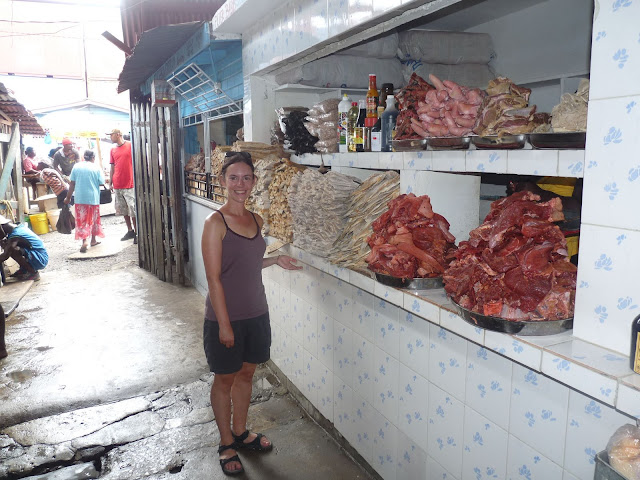
The offerings of the Stabroek Market, the main market in Georgetown, Guyana's capital, really deserve their own post. Here are some snaps we took there:
Yum, fish.
A triangle-shaped flaky pastry filled with "pine jam" (pineapple jam). (Jews, this was kind of like a hammentaschen!)

On the right, the "cashew fruit," a tasty sweet-and-sour fruit that comes from the "French cashew" tree, different from the cashew nut tree. On the left, a not-so-tasty small fruit with edible seeds and flesh that had little taste and the consistency of cotton.

Both are usually sold in bunches but when we said we just wanted to buy one to try, the vendor would not take any money from us for them.
Boy walking around the market and selling live crabs on a string. Apparently he thought we looked like the types of people who might be interested in this, because he tried to sell one to Andy.

(P.S. It's school holiday time right now in Guyana, so we didn't worry too much about the occasional kid we saw, er, helping out at the marketplace...)
More tasty pastries. On the right, a pastry filled with more pine jam. On the left, cassava bread, which was dense and sweet and also had coconut in it.

Sugar-cane juice. It was surprisingly a little bit bitter with the traces of molasses still there from the raw cane. When you buy stuff with "evaporated cane juice" in it, ostensibly this is what the manufacturer starts with...

Side note--they love their little plastic bags in Guyana and put all sorts of commestibles in them that you wouldn't think should go in baggies. Like any fresh juice we bought, and snacks you'd eat with a spoon, such as...
Channa! (Tasty Indian-spiced chickpeas. This was at a different market, later in the day, but same idea as Stabroek. God, I love chickpeas.)

The one juice I got that didn't come in a baggie was this fresh coconut water, which came still in the coconut.

Also, please note that in this final picture I am wearing a different one of my three shirts! Yes, I do occasionally change my clothes.
In conclusion, the street food in Guyana was really tasty and darn cheap--I think that everything I posted pics of here cost 50 cents US or less. Here in Suriname, where we are now, there's not nearly as much fun street food and it costs more (we've been paying nearly $1 apiece for our sno cones, painful). So in addition to the lovely interior and bouncy flatbed trucks, the food is something we will surely miss about Guyana.
Brazil:
In Brazil, there are a lot of pay-by-weight buffet restaurants, but we weren't quite prepared for the pay-by-weight ice cream parlor!
It was fun because it let us try lots of strange (to us) local fruit flavors we may not have gotten otherwise. But since Andy can put away a lot of ice cream, it didn't end up being such a bargain.
Speaking of dairy, yours truly had to sample some yogurts, of course. You wouldn't believe how many different types of Activia they have there--big tubs, small cups, big and small drinkable versions...here I am with a carrot-orange-honey flavored one. (Note the "experimente" sign I'm pointing to on the container...I'm not sure this experimente in flavors really worked so well).
And here's a locally-made, prune-flavored drinkable yogurt I tried at the Boa Vista bus station, where we changed buses from Manaus heading for Guyana. Yum.
In Brazil, dulce de leche (in Portuguese: doce de leite) comes in jars, tubs, and many other forms. We chose the squeeze tube and had it on bread (lack of peanut butter leads to desperate measures!).
And of course, there were the amazing doce de leite filled churros, which I posted a picture of in my Manaus post.
Guyana:
The offerings of the Stabroek Market, the main market in Georgetown, Guyana's capital, really deserve their own post. Here are some snaps we took there:
Yum, fish.
A triangle-shaped flaky pastry filled with "pine jam" (pineapple jam). (Jews, this was kind of like a hammentaschen!)
On the right, the "cashew fruit," a tasty sweet-and-sour fruit that comes from the "French cashew" tree, different from the cashew nut tree. On the left, a not-so-tasty small fruit with edible seeds and flesh that had little taste and the consistency of cotton.
Both are usually sold in bunches but when we said we just wanted to buy one to try, the vendor would not take any money from us for them.
Boy walking around the market and selling live crabs on a string. Apparently he thought we looked like the types of people who might be interested in this, because he tried to sell one to Andy.
(P.S. It's school holiday time right now in Guyana, so we didn't worry too much about the occasional kid we saw, er, helping out at the marketplace...)
More tasty pastries. On the right, a pastry filled with more pine jam. On the left, cassava bread, which was dense and sweet and also had coconut in it.
Sugar-cane juice. It was surprisingly a little bit bitter with the traces of molasses still there from the raw cane. When you buy stuff with "evaporated cane juice" in it, ostensibly this is what the manufacturer starts with...
Side note--they love their little plastic bags in Guyana and put all sorts of commestibles in them that you wouldn't think should go in baggies. Like any fresh juice we bought, and snacks you'd eat with a spoon, such as...
Channa! (Tasty Indian-spiced chickpeas. This was at a different market, later in the day, but same idea as Stabroek. God, I love chickpeas.)
The one juice I got that didn't come in a baggie was this fresh coconut water, which came still in the coconut.
Also, please note that in this final picture I am wearing a different one of my three shirts! Yes, I do occasionally change my clothes.
In conclusion, the street food in Guyana was really tasty and darn cheap--I think that everything I posted pics of here cost 50 cents US or less. Here in Suriname, where we are now, there's not nearly as much fun street food and it costs more (we've been paying nearly $1 apiece for our sno cones, painful). So in addition to the lovely interior and bouncy flatbed trucks, the food is something we will surely miss about Guyana.
Obsessions of the World
We have decided to introduce a new regular feature about the obsessions of different countries. For each country we visit, we will choose one thing, at our sole discretion, that we consider the country to be obsessed with. We will try to explain where needed. We may, at times, repeat. Here we go:
Trinidad & Tobago: Fried Chicken. We estimate that 65% of all the food consumed in Trinidad is fried chicken. They have KFC, Popeyes, Chester Fried, and Church's from America. They have Royal Castle as a local chain. They have numerous other local places.
Venezuela: Cosmetics. In a city of 300,000, we couldn't find a single place to buy food. Yet, a cosmetics store was on every corner. This explains why they have so many Miss Worlds--lots of make-up and no food.
Brazil: Shoes. Shoes everywhere. Any kind of shoes you want. Want to buy some shoes with your lunch? Not a problem. Shoes while you wait for the bus? Sure. Imelda Marcos had nothing on Brazilians.
Guyana: Taxis. One taxi driver explained how hard it is to become a taxi driver there: you have to have a normal license for 3 years and then you have to pay slightly more to register your car. Apparently, everyone gets this and then can act as a taxi. We averaged about 5 requests per minute to take a taxi.
Suriname: Supermarkets. Here's an imaginary conversation between an American and a Surinamese who don't know anything about the other's country:
A: You are from a poor country. You would be amazed at how many supermarkets we have in America!
S: How many are there?
A: It seems like we must have one on every corner!
S: Haha. That's absurd. How could all the people possible live with just one supermarket per block?
We passed through villages where we are certain the supermarket to person ratio was 1:1. I have no idea how they can all stay in business. We're happy to be able to buy food, though.
We'll post more as we venture to new countries.
Saturday, August 1, 2009
Of parrots and peanut butter, hiking and hitching: Guyana!
Today is our last day in Guyana, the Westernmost of those three small countries in the northwest of the contenent that no one really seems to know about. Guyana is English-speaking and feels decidedly more Caribbean than South American, with a lot of goods available that we haven't seen since Trinidad. Culturally, it is a mix of people African and Indian (East Indian, as in from the country of India) descent with some Amerindian (what we would call Native American in the US) villages in the interior.
Though I am blogging from the capital city of Georgetown, on the Atlantic coast in the north, we started our adventure here far south, in the small town of Lethem, on the border with Brazil. It was a dusty town with no paved roads (here is our guesthouse)...

But, peanut butter!!!

Locally made by a women's collective, to boot.
The next day we took a bumpy bus ride north a couple of hours to the Oasis, a "rest area" along the side of the main road where we got a cabin and were able to hike to see a panorama of the surrounding rainforest and savannah.

(Interestingly, when our book said that the "newly completed" road connecting Lethem and Georgetown was "now all-weather," I took that to mean it was paved. Wrong-o!)
The next day, the real adventure began. We really wanted to go to Surama, an Amerindian village 25KM north that was known for its affordable eco-lodge and beautiful rainforest and savannah surroundings. But when the Oasis told us it would cost us $80 US to hire a car to drive this short distance, we balked...and (moms, don't read this!) hitched a ride with a guy we met at the rest area who was heading that way anyway.
OK, that sounds a lot worse than it was--he was a tour operator with a company jeep and also had two other passengers with him, so it really wasn't that sketchy. But, it gave us a taste for how easy hitchhiking was in this country, which was to come in handy a few days later...
But first, we needed to walk to Surama, which was actually 5.8KM (almost 4 miles) from the junction with the main road where we were dropped off. We knew this in advance and had accepted that it would be a long slog into town carrying our 30-lb bags, but we geared up and did it. We even spotted this pair of scarlet macaws en route, which seemed like a good sign for wildlife to come.

The thing is, no one had told us that once we reached Surama proper, it was ANOTHER 3miles walk to the Eco Lodge, which was well on the outskirts of the small cluster of buildings on the savannah known as "town." So we walked and walked and walked in the direction the woman in town had pointed, and finally we got there.
(When we told the people at the lodge that we had walked in from Surama junction, they looked at us like we were completely insane. They were probably right, but we also thought that paying $80 for a taxi was insane!)
Anyway, we stayed two nights in Surama, and it was one of the highlights of our trip so far for me. We saw lots of birds and a few monkeys in the beautiful, untouched rainforest and out on the savannah that surrounded the eco-lodge.
On our boat trip up the Burro Burro river, we saw loads kingfishers, herons, swallows, macaws, and some capuchin monkeys. Here is a great shot Andy got of a kingfisher.

Turkey vulture:

And here are the bees that decided to attack my bag on the boat. Notice how well they match my bag!

The rainforest was also chock-full of these millipedes, and on our hike up Mount Surama, Andy and the guide convinced me to let one crawl on my arm. Yes, I've officially lost my mind.

Aaand, remember how I said I'd come back to hitchiking? Well, when it was time to leave Surama, we were told it would be $25 US to be driven the 6 miles to the junction, where we could wait for a minibus running the 12-hour route to Georgetown. Now that we knew how long the shlep was and could mentally prepare, we turned down the taxi offer and, once again, strapped on our packs for a long, long slog by foot to the main road.
Two hours and over 500 choruses of "999 bottles of beer/guava-pineapple juice/milkshake etc." later (we switched beverages every 10 choruses and got pretty creative), we arrived at the shop at the junction. It was 12 noon. And we were told that there would not be a minibus arriving until 10PM, and that it wouldn't actually leave the junction until 4AM. Crap.
But then, literally 30 seconds later, this truck pulls up...

I mean, it's like the gods of hitchhiking had sent us this ride. It was clearly meant to be!
So we road 12 hours in the back of an open supply truck over an unpaved road to Georgetown. This was my position for approximately the first 5 hours of it.

My view wasn't bad at all. Note the rainbow!

Of course, when we picked up three more people in Mabura, and it started to get dark, and then it started to rain and we all had to get under this dirty tarp, well, it was a bit less pleasant then. And three days later, Andy's and my butts and lower backs are still a little sore from our adventure.
But, hey, we made it, and saved somewhere between $50 and $100 on bus fare. Solid.
We'll have to do another post recapping all of the fantastic and cheap street food we have enjoyed in Georgetown--we took a lot of pictures. Tomorrow we are off to another country, Suriname and will try to check in from there if we can figure out how to surf the Web in Dutch.
Though I am blogging from the capital city of Georgetown, on the Atlantic coast in the north, we started our adventure here far south, in the small town of Lethem, on the border with Brazil. It was a dusty town with no paved roads (here is our guesthouse)...
But, peanut butter!!!
Locally made by a women's collective, to boot.
The next day we took a bumpy bus ride north a couple of hours to the Oasis, a "rest area" along the side of the main road where we got a cabin and were able to hike to see a panorama of the surrounding rainforest and savannah.
(Interestingly, when our book said that the "newly completed" road connecting Lethem and Georgetown was "now all-weather," I took that to mean it was paved. Wrong-o!)
The next day, the real adventure began. We really wanted to go to Surama, an Amerindian village 25KM north that was known for its affordable eco-lodge and beautiful rainforest and savannah surroundings. But when the Oasis told us it would cost us $80 US to hire a car to drive this short distance, we balked...and (moms, don't read this!) hitched a ride with a guy we met at the rest area who was heading that way anyway.
OK, that sounds a lot worse than it was--he was a tour operator with a company jeep and also had two other passengers with him, so it really wasn't that sketchy. But, it gave us a taste for how easy hitchhiking was in this country, which was to come in handy a few days later...
But first, we needed to walk to Surama, which was actually 5.8KM (almost 4 miles) from the junction with the main road where we were dropped off. We knew this in advance and had accepted that it would be a long slog into town carrying our 30-lb bags, but we geared up and did it. We even spotted this pair of scarlet macaws en route, which seemed like a good sign for wildlife to come.
The thing is, no one had told us that once we reached Surama proper, it was ANOTHER 3miles walk to the Eco Lodge, which was well on the outskirts of the small cluster of buildings on the savannah known as "town." So we walked and walked and walked in the direction the woman in town had pointed, and finally we got there.
(When we told the people at the lodge that we had walked in from Surama junction, they looked at us like we were completely insane. They were probably right, but we also thought that paying $80 for a taxi was insane!)
Anyway, we stayed two nights in Surama, and it was one of the highlights of our trip so far for me. We saw lots of birds and a few monkeys in the beautiful, untouched rainforest and out on the savannah that surrounded the eco-lodge.
On our boat trip up the Burro Burro river, we saw loads kingfishers, herons, swallows, macaws, and some capuchin monkeys. Here is a great shot Andy got of a kingfisher.
Turkey vulture:
And here are the bees that decided to attack my bag on the boat. Notice how well they match my bag!
The rainforest was also chock-full of these millipedes, and on our hike up Mount Surama, Andy and the guide convinced me to let one crawl on my arm. Yes, I've officially lost my mind.
Aaand, remember how I said I'd come back to hitchiking? Well, when it was time to leave Surama, we were told it would be $25 US to be driven the 6 miles to the junction, where we could wait for a minibus running the 12-hour route to Georgetown. Now that we knew how long the shlep was and could mentally prepare, we turned down the taxi offer and, once again, strapped on our packs for a long, long slog by foot to the main road.
Two hours and over 500 choruses of "999 bottles of beer/guava-pineapple juice/milkshake etc." later (we switched beverages every 10 choruses and got pretty creative), we arrived at the shop at the junction. It was 12 noon. And we were told that there would not be a minibus arriving until 10PM, and that it wouldn't actually leave the junction until 4AM. Crap.
But then, literally 30 seconds later, this truck pulls up...
I mean, it's like the gods of hitchhiking had sent us this ride. It was clearly meant to be!
So we road 12 hours in the back of an open supply truck over an unpaved road to Georgetown. This was my position for approximately the first 5 hours of it.
My view wasn't bad at all. Note the rainbow!
Of course, when we picked up three more people in Mabura, and it started to get dark, and then it started to rain and we all had to get under this dirty tarp, well, it was a bit less pleasant then. And three days later, Andy's and my butts and lower backs are still a little sore from our adventure.
But, hey, we made it, and saved somewhere between $50 and $100 on bus fare. Solid.
We'll have to do another post recapping all of the fantastic and cheap street food we have enjoyed in Georgetown--we took a lot of pictures. Tomorrow we are off to another country, Suriname and will try to check in from there if we can figure out how to surf the Web in Dutch.
City mouse in Manaus!
Hello from Georgetown, Guyana! The internet where we're currently ensconced is super-fast and cost $1 US an hour (not bad, though we had cheaper in Venezuela and Brazil).
We are having a great time in this English-speaking, peanut-butter-loving nation, but before I get into that, I want to catch you up on our last few days in Brazil.
As Andy hinted in the last post, I did not really enjoy our rainforest excursion in Brazil so much. I have been to rainforests in three or four other places before, so I thought I knew what I was getting into, but I have to say, the bugs (mosquitoes, black flies, ticks, ants, spiders, and the famous tarantula in Andy's pants) were really awful, the wildlife sightings really few and far between, and the accommodations rough--especially at the satelite camp, where we slept in uncomfortable hammocks covered by holey mosquito nets. (And I'll just add that I'd really prefer not to spend my next "that time of the month" camping out in the jungle if at all possible, thanks. Though my Lunette served me admirably!)
But I did really like Manaus, the big city in the rainforest. We stayed at the Hotel 10 de Julho, in one of the cheaper rooms in the "dungeon." (Hey, who needs windows when you have a private bathroom and A/C?) The room was clean (only one roach spotted in the room itself, which may be an all-time low for the establishments we've been staying in) and came with breakfast (which was an interesting assortment of cakes that looked sweet but often had a surprise in them, like super-salty sausage and cheese or a hot dog).
But the best thing about the hotel was its location, right down the street from Teatro Amazonas, the world-class opera house.

Built at the height of the rubber boom in the early 1900s (of whose horrors we heard many tales, so it's important to note that this lovely if somewhat extravagant architecture came at a great cost to the poor rubber workers of the region), it is apparently the only domed opera houses in the world, though that's kind of a misnomer because the ceiling inside didn't appear to be domed, meaning the dome is just a decoration.
So, yes, we went inside--we happened to be in town during the Amazonas Jazz Festival, and were able to get tickets for third-tier seats for $5 US apiece! So we enjoyed a double-bill of a terrific Brazilian jazz pianist and a saxophonist from New York (whose set was billed as something like "Vanguard of New York jazz," and we thought it was funny that we had come all the way to Manaus to hear the latest from the NY jazz scene).
The theater, built at the turn of the century, was just as beautiful inside as it was on the outside. We felt like we were in one of those Degas or Cassat paintings of people at the theater (well, except that we were wearing smelly tourist clothes and muddied sneakers instead of lovely ball gowns and suits). 

 For me, it was the perfect antidote to days of sweating and being bitten up in the jungle.
Even better, on the square in front of the theater was a vendor who sold churros filled with doce de leite (dulce de leche). They were kind of expensive--2 real, or $1, apiece--but sooo good.
Friday, July 24, 2009
Action in the Amazon
This entry will be the Amazon Rainforest in pictures. First, though, let me say that you should not use Blogger to create a blog if you plan to have pictures. It deals with pictures in a terrible way and is incredibly difficult to use. I take full blame for choosing to use it...
This trip to the rainforest was a tough one. We did not see much wildlife despite spending 4 days and 3 nights in the middle of no where. The trip cost was $260 each for everything, which is expensive, but not insane for the amount of time. The wildlife that we did see was often fast moving and far away, so we do not have pictures of much for the animal fans. This is also why you won't find the picture of Tara scaling a tree to pet a jaguar or me when I jokingly put my head in the mouth of the anaconda.
This is the "meeting of the waters" where the Solimoes River and the Black River come together to form the Amazon River. The two are different speeds and temperatures, so it takes many miles for them to mix together. Apparently, dolphins often play here, but we did not see any of the river dolphins. A yellow finch just like you might see in a pet store. They are very common in this part of the Amazon.
 Ants in the Amazon are everywhere and come in all shapes and sizes. These are some of the bigger ones. I also ate a couple of these fried in Venezuela.
 One of the best parts of the Amazon is that life is everywhere. Plants and animals will try to live anywhere, even if it means growing on an electrical cord.
 This type of kapok tree is called a Christmas tree by the locals because of these massive red things that hang off it. They are filled with a cotton like substance, which is often used to fill pillows and other things.
 We went to visit a local village of Moro Indians (probably not the right spelling). There are about 20 families who mostly earn a living through making manioc flour and collecting acai berries. They have no power and, as Tara pointed out, are about as low impact as it is possible to be. Here, they are building a new house to replace one that burned down.
 This is school for the village.
 Is Tara happy or scared to be holding this little caiman? I would say scared. This guy may grow up to be 20 feet long. Or another caiman may eat him tomorrow. The water levels are just starting to recede from all time record high levels, so most of the bigger guys were apparently inland while we were there.
 Tara after her face has been painted with the local fruit. The color is also used as food color and sunscreen.
 These ants build their homes on trees. They are massive. Local people touch the nest to get covered in the ants (too small to bite) and then rub them all together to create an anesthetic. Smells sort of like iodine.
 We have a video that we will try to post eventually, but there were at least a couple hundred of these guys all head to tail like this. Apparently, they look like a snake this way and are less likely to be eaten.
 Andy in training to be Tarzan. The vines in the rainforest are really strong.
 Gratuitous sunset picture.
 This is where we stayed in the jungle for a couple days. It turns out that mosquitos can get through a tiny hole in the mosquito nets. On mosquitos--water levels are just starting to recede for the year, which means that mosquitos and flies are just hitting their peak for the year. I suspect that Dracula was not based on Vlad the Impaler, but on Amazonian mosquitos. They are everywhere and they are ferocious. I think it conservative to say that Tara and I ended up with a couple hundred bites each.
 A tiny gold frog. Apparently the area has poison dart frogs about this same size, but we didn't see any.
 This guy was in my pants that I had hung out to dry. I picked them up to see if they were dry (a joke since nothing ever dries in the Amazon no matter how quick drying the manufacturer claims it to be), when I almost grabbed this tarantula. I screamed like a little girl and threw the pants down. The spider was less scared and just sat there posing for pictures after. Hard to tell size from the picture, but he's about 6 inches across.
 The shiniest thing we saw in the rainforest.
 The local school "bus" in the Amazon. People live so far apart that it has to go along the river picking up the kids.
 The bus stop back to civilization! How did we get there? Boat, of course. You can drive your boat right up to the back.

Overall, the Amazon was interesting, but probably this particular trip won't be one our our round-the-world highlights. We'll be spending some more time in the rainforest, though, so we hope it improves.
One last thing--the rainforest made us smell terrible. I don't know what it was, but it took us hours to wash the smell out of our clothes, and our hotel room still smelled when we left today. Maybe because it is always we there, things mildew. Our wool shirts can go two weeks without even starting to stink from sweat. 10 minutes in the Amazon and they smelled awful...
This trip to the rainforest was a tough one. We did not see much wildlife despite spending 4 days and 3 nights in the middle of no where. The trip cost was $260 each for everything, which is expensive, but not insane for the amount of time. The wildlife that we did see was often fast moving and far away, so we do not have pictures of much for the animal fans. This is also why you won't find the picture of Tara scaling a tree to pet a jaguar or me when I jokingly put my head in the mouth of the anaconda.
This is the "meeting of the waters" where the Solimoes River and the Black River come together to form the Amazon River. The two are different speeds and temperatures, so it takes many miles for them to mix together. Apparently, dolphins often play here, but we did not see any of the river dolphins.
A yellow finch just like you might see in a pet store. They are very common in this part of the Amazon.Ants in the Amazon are everywhere and come in all shapes and sizes. These are some of the bigger ones. I also ate a couple of these fried in Venezuela.One of the best parts of the Amazon is that life is everywhere. Plants and animals will try to live anywhere, even if it means growing on an electrical cord.This type of kapok tree is called a Christmas tree by the locals because of these massive red things that hang off it. They are filled with a cotton like substance, which is often used to fill pillows and other things.We went to visit a local village of Moro Indians (probably not the right spelling). There are about 20 families who mostly earn a living through making manioc flour and collecting acai berries. They have no power and, as Tara pointed out, are about as low impact as it is possible to be. Here, they are building a new house to replace one that burned down.This is school for the village.Is Tara happy or scared to be holding this little caiman? I would say scared. This guy may grow up to be 20 feet long. Or another caiman may eat him tomorrow. The water levels are just starting to recede from all time record high levels, so most of the bigger guys were apparently inland while we were there.Tara after her face has been painted with the local fruit. The color is also used as food color and sunscreen.These ants build their homes on trees. They are massive. Local people touch the nest to get covered in the ants (too small to bite) and then rub them all together to create an anesthetic. Smells sort of like iodine.We have a video that we will try to post eventually, but there were at least a couple hundred of these guys all head to tail like this. Apparently, they look like a snake this way and are less likely to be eaten.Andy in training to be Tarzan. The vines in the rainforest are really strong.Gratuitous sunset picture.This is where we stayed in the jungle for a couple days. It turns out that mosquitos can get through a tiny hole in the mosquito nets. On mosquitos--water levels are just starting to recede for the year, which means that mosquitos and flies are just hitting their peak for the year. I suspect that Dracula was not based on Vlad the Impaler, but on Amazonian mosquitos. They are everywhere and they are ferocious. I think it conservative to say that Tara and I ended up with a couple hundred bites each.A tiny gold frog. Apparently the area has poison dart frogs about this same size, but we didn't see any.This guy was in my pants that I had hung out to dry. I picked them up to see if they were dry (a joke since nothing ever dries in the Amazon no matter how quick drying the manufacturer claims it to be), when I almost grabbed this tarantula. I screamed like a little girl and threw the pants down. The spider was less scared and just sat there posing for pictures after. Hard to tell size from the picture, but he's about 6 inches across.The shiniest thing we saw in the rainforest.The local school "bus" in the Amazon. People live so far apart that it has to go along the river picking up the kids.The bus stop back to civilization! How did we get there? Boat, of course. You can drive your boat right up to the back.Overall, the Amazon was interesting, but probably this particular trip won't be one our our round-the-world highlights. We'll be spending some more time in the rainforest, though, so we hope it improves.
One last thing--the rainforest made us smell terrible. I don't know what it was, but it took us hours to wash the smell out of our clothes, and our hotel room still smelled when we left today. Maybe because it is always we there, things mildew. Our wool shirts can go two weeks without even starting to stink from sweat. 10 minutes in the Amazon and they smelled awful...
Subscribe to:
Posts (Atom)